Avoiding conflict
In writing about LSE-related events, I overlooked a further seminar that I attended last week, this time on conflict prevention. It was presented by Armeen Jan, who has been working at the Strategy Unit in Downing Street to create a methodology by which countries at risk can be assessed. It poses extremely interesting questions, perhaps the most obvious being: why bother, if realpolitik considerations trump all others?
Yet there is something extremely interesting and worthwhile in the work that Jan presented. The methodology looks at a wide range of factors that can trigger instability in countries, both internal and external. The intention is to maintain the assessments as a rolling programme which can assist government policies and ideally help prevent conflict before it happens. However, since government is a different reality there will have to be a second filter through which government priorities are determined. This is where the political dimension comes in and may weaken the work in the long run.
Yet Jan was keen to stress that the work was at the cutting-edge; no other government has a similar process in train. Whether we will be able to get our hands on those countries deemed to be at risk is another matter though. I suspect that it may be a politically senstive list. It might be interesting to see how far the Freedom of Information Act will work in this respect.
Thursday, November 17, 2005
From the bottom up
Argentina seems extremely popular at the LSE's Latin America research seminar at the moment. Besides the discussion on investment treaties, we've also had a look at Argentine national development last week and the local elections the week before. And speaking of Argentina local elections, City Mayors has finally put up my latest piece, on the structure of Argentine local government to go alongside my one on Brazil. Apparently another I wrote, on Chilean local government, will also go up this weekend.
Argentina seems extremely popular at the LSE's Latin America research seminar at the moment. Besides the discussion on investment treaties, we've also had a look at Argentine national development last week and the local elections the week before. And speaking of Argentina local elections, City Mayors has finally put up my latest piece, on the structure of Argentine local government to go alongside my one on Brazil. Apparently another I wrote, on Chilean local government, will also go up this weekend.
Back to the old ways?
Argentina's jurists played a prominent role in the late 19th century and early 20th century, reducing extra-territorial claims by arguing that foreign nationals shouldn't operate under separate rights to nationals. This was enshrined in the Calvo Doctrine which stated that foreign states could not use force to seek redress for any outstanding debts to them. But Gus van Harten in the LSE's law department argued that this position was being eroded through the recent investment arbitration rulings against Argentina following the 2001-02 economic collapse.
Van Harten's argument in the Latin American research seminar (my regular Tuesday fix at the School) was that the increase in signed bilateral investment treaties between industrialised and industrialising countries since the 1990s has set the scene for something similar to what existed at the beginning of the last century. With investors losing out as a result of the Argentine economic crisis, many have taken to pursuing them claims through the courts using the treaties as their main instrument.
The result has been substantial dmagaes awarded against the Argentines with van Harten citing CMS Gas as an example. What is notable about these decisions are the structure of the arbitration models, adopting a commercial approach rather than a public one and the apparent absence of any desire by either Argentina or other treaty signatories either to renegotiate the nature and terms of these treaties or avoid signing them at all.
Monday, November 14, 2005
Three months for change
Thinking about it, I jusy don't get it. I mean, how could the police be pissed off that they didn't get three months detention last week? They must be pretty chuffed with the outcome, which saw thei ability to arrest people from two weeks to one month. As a friend suggested to me, going for three months was probably a bargaining chip, so one month is a good result for them.
But if that was the case, why did Blair push it to a vote? Charles Clarke managed to get the one month deal and was on course to get that through until Blair intervened. I can only assume that he's taken it to heart, rather like his decision to stand by Bush come what may. All of us who thought that he was changeable with the political wind during his first term discovered in his second that he had taken on 'convictions'. Maybe it was the same with the police powers.
Or as a former MP I spoke to recently suggested, it could be a way of ensuring defeat on one issue so that Labour MPs don't sabotage his other key policies including education and health reform. If so that's quite a cynical and long-term game, considering they aren't due for debate until next spring. But it may well be true.
Texts to read...
I need to get a thesis outline including how I'm going to do it back to my suprvisor by the beginning of December ahead of my next meeting with him. Having spent part of the weekend in the library - and finding a mine of education policy and reform material relating to Chile (mainly the 1960s and 1970s), it looks slightly more do-able than I had initially assumed.
I've even got an initial hypothesis which looks like it needs honing still further. But at least it looks like I'm back on track (fingers crossed).
A rethink
It looks like I'm taking a slightly different course with my PhD thesis following a session with both supervisor and advisor (a backup supervisor to provide some external help). The choice on the table was whether to pursue the direction uncovered by my Masters dissertation and focus on in-country case studies in Brazil, or go back to my original thesis proposal, which involved a comparison on education systems and policies in Chile and Brazil.
There are arguments in favour of each, but as Francisco (Panizza, my supervisor) commented, each will take me in a differetnt direction: participation in the case of in-country cases in Brazil, or on public policy analysis between Brazil and Chile. Ken (Shadlin, my advisor) made the point that the difficulty with an in-country thesis is that it might be difficult to disentangle the role of federal and sub-national governments in educational policy, an issue that would be absent in a two-country case study. Then there's the question of available material - and I can tell there's not a lot in the UK on the Brazilian states I would be looking at; at least with Chile and Brazil there's some stuff I can already get my hands on.
Having thought about it, I look like going back to the Brazil-Chile study, which would also benefit me by ensuring that I have knowledge of more than one country - always an asset as single country expertise may be rather limiting. It just means I'm going to have to brush up on Spanish though...
Interviewing individuals and the data
This week's subjects before the PhD seminar group were Gwendolyn Sasse and Cheryl Schonhardt-Bailey who gave contrasting accounts of quantitative and qualitative work.
Dr Sasse gave some quite useful thoughts and observations on the use of fieldwork, much of with which I could concur. But there's always the problem of knowing whether to do it or not. On the two occasions I've done fieldwork I've had different views about whether it was worth doing. In the first instance I knew I had to do it to get the information I needed; the second time I wasn't sure that it could be justified. But in both cases I realised that it was necessary, since it disabused me of my initial assumptions and ideas which had only been gleaned from reading texts in British libraries. Actually being on the ground made me realise that there were different views and perspectives and not everything I learnt was in those texts.
I recall being in Dr Schonhardt-Baily's classes while as an undergraduate. She took us for the quantitative component of a course I did back in the late 1990s here at the LSE. Then I recall getting very little from the sessions, since I've never been statistically-minded. This time was no better, but I had a greater appreciation for her presentation on an empirical assessment of ideas as words between Bush and Kerry in the election last year. We were encouraged to read her paper prior to the session and I was able to follow it.
But I did have one or two reservations. Whereas she has made available the datasets from the computer software she used to quanitify the data, I still find myself having to fall on trusting her work - since I still remain weak on the quantitative side. Which brings me to the second point, that of the results themselves. In her presentation Dr Schonhardt-Bailey noted that if the results had been counter-intuitive then she would have known the data was wrong. To another questioner she stressed the importance of knowing the context wince the language used could have contrary meanings. Which all suggests to me that this kind of empirical work is useful, but in a descriptive approach, subsequent to qualitative work. I question whether it is possible to do such work without having had prior qualitative work done (e.g. knowing the subject and how different audiences perceive it).
Thursday, November 10, 2005
Unexpected - at least for me
So Blair has suffered his first Parliamentary defeat. Regardless of what it means for him now, one really has to wonder what on earth he was playing at with his excuse that the 'police asked for these powers'.
If teachers ask to scrap the curriculum, or doctors recommend fewer people in their surgeries the Government is going to stand by them?
Of course not. So why should the police be any different? The justification is that these people are at the front line of the 'war on terror'.
Yet did the police (and its cheerleaders in the Government) ever consider what might be the consequences of locking someone up for 3 months? Would it make particular sections of the society (OK, ethnic minorities) feel particularly pre-disposed to such action? I doubt it; in fact it might be more likely to stoke up a 'them-against-us' mentality.
As for the claim that the police need it to stop future terrorist atrocities, aren't we always being told about how many they've foiled - without needing 3 months? And if it were to happen again after they received what they wanted would we then have to accept a future argument that 3 months wasn't enough and they really need 6?
Then there's the question of resources. If the jails are full of people inside for 3 months where on earth are we going to put other criminals - especially given the Government's keenness to clamp down on law and order and the breaking capacity of British prisons.
Finally, how many anti-terror bills have we had in the last few years? And just because the police keep getting all these powers, do they use it responsibly? Is it only just a couple of months since a police force detained a pensioner who heckled Jack Straw at the Labour conferece under anti-terror legislation?
I could go on, but for once I feel cheered by events down the road in Westminster. And that's not something I can say I feel very often.
Making economic policy work?
I also attended my first student-led seminar on a PhD topic this week. Chris Vellacott in the LSE's economic history department presented a chapter from his thesis on Agentine and Spanish economic policy in the late 1950s. he wanted to account for the difference in 'success' (as measured by capacity of the state to drive its preferred options through) between the two, the Spanish being more sucessful than the Argentines.
Vellacott's argument is that the Spanish model was authoritarian and a clear top-down hierarchical structure existed between the state and other social actors, including labour, capital, etc. In such circumstances the state was able to impose itself. By contrast the Argentine system at the time was one in which the state had less autonomy from either labour or capital and floundered as a result.
I failed to make any useful or perceptive comments, but others did. These included whether the the economic policies' 'success' or 'failure' was the outcome of this constellation or vice versa - which was the cause? The structure of the state or the economic policy? In addition the approach doesn't take into account other experiences whereby a chaotic state-labour-capital relationship is transformed into one that is state-dominant, e.g. Pinochet in Chile. And finally, given Vellacott's claim of Argentine and Spanish exceptionalism, what is to be said of Portugal at the same period in time?
Despite this intense scrutiny, there were some things I quite liked about the thesis. In particular it was the justification in choosing these two case studies, as exceptional in their respective continents and in offering a compare and contrast approach over a longer timeframe: Spanish authoritarian against weak Argentine democracy in the 1950s and Spanish democracy and Argentine authoritarianism in the 1970s-80s.
Transnational visions
Been awhile since I last put anything down. It's been a busy week (isn't it always), with John Chalcraft enlightening the PhD government department seminar on the role and status of Syrian migrant workers in Lebanon and what it tells us about ideas of capital and labour (the working assumption is that Syrians have more agency than is otherwise presented in Marxist theory, but in accepting their lowly status and constant cycle of return to Syria, the process merely reinforces itself) and David Held.
Held is a bit of a media darling, having written extensively on the limits of globalisation, especially in the democratic realm. His research agenda can be outlined as follows: democracy is a norm that has progressed from the polis to the nation state, but is caught out by the unequal nature of the world system. His interest is in assessing and proposing ways to overcome the global 'democratic deficit' - a topic that has put him among those few academics whose texts have a wider readership than most.
Moral of the story? Find something topical to do your PhD on, it seems.
Thursday, November 03, 2005
Thought of the week #2
Last wek it was Saddam and whether he can get a fair trial. This week I want to pose the following: everyone hates traffic wardens, given their over-zealous nature. Yet everyone also gets incensed with foreign diplomats who fail to pay their parking fines.
Rather than slating these individuals, surely we should be championing them as the one class of people who are standing up to the questionale antics (and anyone who saw the undercover investigation into traffic warden training and the ways they issue a ticket to anything that moves earlier this year can testify) of wardens?
Or maybe not.
New directions in sound?
Marcello D2 was in town last Friday - and I never got around to writing it up. Managed to get through a group of mildly interested people along to experience his Brazilian-themed hip hop. Half of us ended up squashed in the front row being bounced about in a manner slightly more excitable than that at the De La Soul gig at the Jazz Cafe we went to last month.
The performance itself was intense and enthusiastic - probably on account of the majority of the crowds being Brazilian and knowing his music. He played a good set, ranging from the more common and popular tunes from his 'Looking for the Perfect Beat' album to others that I didn't recognise. The stage itself was quite cramped, with nearly 10 band members ranging from percussionists to keyboard player, guitarist and bassist - and a DJ whose decks took up most of the space.
The MD2 gig was in a wierd (at least for me) venue in the heart of Leicester Square and on the third floor. Somehow that didn't seem right, especially with a rock gig going on two floors above. We stayed around after he left the stage and Sambatralia, the Jungle Drums-sponsored club night took centre-stage. Worth noting though that the majority of the music was funk, which along with DJ Cliffy's Batmacumba - and now Giles Pedersen's decision to go down the same path at the Brazilian Love Affair in Notting Hill - indicates a departure for Brazilian music in London.
Casing it
So today is the next installment of our comparative politics seminar. This time we're discussing the issue of case selection and the potential pitfalls one can fall into. Having down the recommended reading (Geddes, van Evera et al), I'm staggered that there is so much science on the subject and the problems seem so great that it's a wonder comparative studies work ever gets done.
For example, van Evera recommends looking for extreme types of cases, since their accentuation makes it clearer to see the impact that one variable may (or may not) have on another. But Geddes notes something called 'regression from the mean', which if I understand it correctly, means that taking something extreme could indicate abnormality - and is therefore not an accurate reflection of reality.
Oh, what to do?
Big beasts
Most memorable aspect of this week's PhD Government seminar? Clearly Erik Ringmar's analysis of giraffes and what they represented in the Chinese, European Renaissance and 19th century periods. All this was anecdotal observation before he entered into a study of what the appearance of giraffes - exotic and out of place everywhere except in east Africa - meant in terms of particular societies and their world view. In China's it arrival in the 1420s signified that all was well with the world and contrasted against another giraffe's appearance in Florence in the 1480s, when there was curiosity about what was going on in the world outside, while in 1820s France it was just something to place in the scientific schema.
OK, it's not really 'government', as Ringmar himself admitted. But it's fun nonetheless and along with the second week's analysis of American public policy through the medium of country music (don't ask!) and dangerous dogs legislation, the kind of thing I'd like to do one day - but maybe once I've got a doctorate...
Thursday, October 27, 2005
Boozing it up in style
Still, there was recompense to be had after the cycling debacle. A trip to the Peruvian ambassador's residence was undertaken on Tuesday evening (I admit it, I have friends in questionable places) where I availed myself of plenty of pisco and cycled home feeling slightly wobbly.
At least I think it was the alcohol. But knowing my cycling experiences...
Bike hassles
This week has been a series of early mornings as I have attempted to get to work in good time to be able to leave at 4.30 or thereabouts to attend seminars down at the LSE and ISA. But imagine my frustration when on Tuesday I walked out of the office in Angel to collect my bike and cycle to the first Latin American seminar of the the term at the LSE and found my back wheel had been nicked.
My bike was locked to one of the stands in the designated bays at the entrance to Islington Town Hall and under the CCTV. There is even a big TV screen showing the location just yards away at reception. Did the staff do anything at all? Not from what I can tell. Apparently it was a boy who got away quick.
Excuse me? Do you know how long it takes to get a back wheel off?
There was absolutely no consolation to be had as I spent 10 minutes trying to get through to the police station to report the crime (so they can collect the CCTV footage) and no apology or commiseration from the staff for what should be a sure area.
Getting the wheel replaced meant walking into the nearest bicycle shop in town with half a bicycle and paying £100 for the privilege of something that should be saving me money but isn't.
To add insult to injury I had barely got 50 yards down the road before the wheel came off. It would appear that paying £10 for labour doesn't mean that you'll get quality service. I'll spare the bike shop in question from being named, but I can assure you I am the end of my teather when it comes to cycling...
Unique or not?
Charles Jones, head of the Latin American Centre in Cambridge was at ISA last night to present a paper on American (in the hemispheric sense) international relations. His thesis was that there was a distinctive form of such relations, compared to the old world form - at least until the establishment of the bipolar and more recent unipolar worlds.
He based his argument on several factors, including the desire to create a 'new world' (i.e. eliminating indigenous populations, societies and structures), the primacy of economic concerns over political ones and the rhetorical commitment to legalism and the reality of force. Indeed, this latter point was expanded upon by his presentation of the US as a formal empire using indirect means to maintain control, in stark contrast to earlier imperial systems. This is seen most evidently in the disproportionate force against its foes, including Grenada and Iraq.
I can see where he's going with this argument, but I'm not personally convinced of the logic. I'll concede that the 'American' state was weak at its foundation compared to the European one, that the 'new world' thesis is strong. But surely legalism has always been a norm at the centre of the international system, as has the tension between pressure to conform and force to ensure it? The more I think about it, the less I am persuaded of exceptionalism, not just for the Americas, but in other regions as well. I've always been sceptical of such specifics, since it's a slippery slope towards the political cultural arguments that individuals like Wiarda make.
Monday, October 24, 2005
Less scientific, more intuitive
The other seminar today was that obligatory one devised to get first year Government students into the LSE first thing Monday morning. Christian List presented an overview of social choice theory (and in particular the problems presented with decision-making rules) while cecile Fabre offered an overview of some of the difficulties in normative political theory through the prism of her own work on the ethics of welfare distribution.
It's not an area that I know a lot about - and which I think was the same for many of my colleagues - so I fear that my questions were relatively simple in tone. What practical applications have social choice theorists done with their work (answer: not much, admitted Christian, but they should be used more often in areas like electoral reform), while I expressed concern to Cecile about my sense that normative theory seems to involve a sense of working back from an already drawn conclusion - which if starkly contrasted with political science (where the purpose seems to be to get at the 'truth'), is the opposite way around.
PhD and Lego
Whoever thought that doing a PhD would result in me playing with Lego? But it did and has made me think a little bit outside the box with regard to my research and possible approaches.
I've just come out of an extremely useful seminar, 'Authoring a PhD', which examined different ways of approaching creativity - in which Professor Dunleavy, the privider for these sessions, uses office buildings and the Gherkin as an analogy - and a facilitaive session during which we played with Lego. The toy acted as a metaphor, encouraging us to present our research interests and particular problems we may face in doing it.
One of the more challenging tasks was to write an abstract on a flipchart of our thesis in 20 minutes - the twist being that we were writing it as if we had already finished it and were presenting our findings. It showed I need to think a bit more about what I'm trying to achieve.
But strangest experience of the session was the constant backgroun music - rock, classical and other sorts. Is there something subliminal that the organisers (the Teaching and Learning Centre at the LSE) was trying to get across? If so, I think I missed it.
Friday, October 21, 2005
Where's the fairness?
Can someone explain this to me? Because I still don't get it.
Apparently it's really important that Saddam gets a fair trial in Baghdad. But at the same time there's no question of him walking free, is there?
So exactly how can it be free if the judgement is already predetermined?
It reminds me of Przeworski's description of democracy: certain rule which all actors abide by with an uncertain outcome. Anything other than that can't be democratic. Surely the same can be applied to judicial proceedings?
Culinary highs and writing lows
I feel like I've stepped up in the (academic) world. Where else but the LSE would a full lunch (OK, sandwiches and nibbles) be available as an incentive to a PhD seminar on comparative politics? I may be easily pleased, but it made my day, even if I did find it a bit of a struggle to keep up with far more well-read members on the programme. I think there was some discussion about democracy, regions versus universal explanations... um... ah...
Oh yes, I remember: what are the methodological limits to choosing regions over universal explanations? And this all led into a discussion about methodology - an issue which I revisted in the evening, at a PhD student-organised seminar on doing effective research design, including a clear hypothesis and breakdown of how the project is to be done.
But having spent the best part of this afternoon beginning the writing process, I've decided that the ideal and the reality don't mix.
Thursday, October 20, 2005
Debating democracy and bureaucracy
A couple of activities this week. Discussion about different organisational dynamics and the strengths and weaknesses associated with particular forms of bureaucratic activity was discussed on Monday in my now-regular seminar. These included the strengths and weaknesses of four 'ideal' types, including bossism (where bureaucrats operate in a top-down fashion with an emphasis on standards), groupism (where peer pressure is paramount), competition (rivalry to encourage more effective output) and chancism (where randomness is the guiding principle). For those interested, Christopher Hood appears to be the one to read on this - and oh look, he's an LSE chap as well!
On Tuesday the Economist sponsored a debate on whether Latin America had 'citizens' democracies'. Speaking for the motion was the Economist's Latin American editor, Michael Reid, a Colombian academic and former government minister, Fernando Cepeda. Against was ISA's Maxine Molyneux (my old teacher) and Guilllermo O'Donnell - the main draw and the reason I attended.
The debate was quite laboured - it's a common discussion point regarding the region and not entirely original. And yet it is a good way in for those who are interested in Latin America but may not have a lot of knowledge about it.
What was most depressing (or positive if you're that way inclined) was the realisation as I looked around the room that the place was full of the Latin American scholarly and employment fraternity in London - academics, business risk associates (e.g. Global Insight and the EIU) as well as embassy staff. I caught sight of my supervisor in the corner, along with the rest of the teaching staff from the LSE's Latin American politics programme. Basically everyone's who's anyone was there.
Which in hindsight, probably called for a different motion for debate...
Monday, October 17, 2005
How times flies
I've established that you're never going to get a job in the academic world if you complete a PhD without having published something - either an article or a chapter - beforehand. That was one of the topics at today's seminar. Whereas 10 years ago it was still possible to complete the PhD, apply for a lecturer's job and then publish your first article, today's that's all changed.
I also recall looking at some of the PhD requirements from that period as well. You could start one without necessarily having a Masters degree, while it was similarly pointed out that not attending any conferences or networking during your time as a PhD student nowadays would be professional suicide.
It's at times like these that I think I should have just started the PhD programme after I first graduated, in 1998. Life seems to have been a lot easier then...
Friday, October 14, 2005
Approaching approaches
Been reading on comparative research and methodologies yesterday - and more today. Some of it is related to next week's seminar in Comparative Politics regarding democratisation studies while the rest is associated with comparative education.
There is some crossover between the two, not least in the extent to which findings are universally generalisable or specific to a particular situation (i.e. region or culture). Also this notion that selection of case studies can actually determine your findings, which is one incentive to take a broader perspective rather than focusing on a narrow topic (e.g. democratisation in Latin America as opposed to generally or comparing education outcomes between British schools as opposed to internationally).
Especially for the seminar next week I'm going to have to take a stance on which perspective is preferable. Yet I can see arguments both for and against the narrow and wide approaches. Indeed one text I read (Mahoney), argued for an accumulative approach to knowledge (i.e. scholars build on the analyses and findings of previous scholars to test and expand theory and methodology). This seems to implicitly argue for a broader approach. Yet as far as I can tell, doesn't most research build on the past? Does a research programme exist which hasn't 'borrowed' from others before? Even the use of game theory and rational choice in political science - coming from economics - has to be situated within a framework, in this case democratisation studies. Used alone it can't explain anything.
I see I'm going to have my work cut out over the coming few days...
Monday, October 10, 2005
Counting crime
Finally a Lib Dem spot for those who visit this blog and wonder why it appears on so many Lib Dem bloggers' websites and yet seems more concerned with academic life.
I see from yesterday's BBC Politics Show that Lib Dem Islington's preference for voluntary Acceptable Behaviour Contracts (ABCs) over anti-social behaviour order (ASBOs) hasn't helped reduce crime in anything like as dramatic a form as that of Labour-controlled Camden, with its penchant to write one out for the smallest infraction.
I didn't see the whole piece (capoeira meeting to go to), but looking at figures only tells one side of the story - just as evaluating students by looking at their grades does. I wonder whether there are other ways of assessing how the approach is perceived - and not just measured in black-and-white terms. It would also be interesting to see whether the falls in crime have taken place across the whole of the borough or within specific problem areas (and that information may not be available in government statistics, if I recall anything about their format).
Just a thought.
Evaluating what is evaluate-able
Quirkiness is good (see below) - especially after the readings that I subjected myself to at the tailend of last week. With education policy and its evaluation being the general theme for which I'm trying to find something sensible to say or a question to ask, I turned to that body of literature - or at least what's available in the LSE library.
Can I just say that it is just about the driest thing I've ever read? But at least it makes some interesting points, including that evaluation of schools, classrooms, students, etc is difficult to do since there are so many variables at work, all interacting with each other than it can be almost impossible to achieve an input-output result. It's all about the process within the school, classroom, by the teacher, etc.
Which has just made my area of research that much harder. How on earth can I assess whether left-wing education policy has made any difference when there are so many variables, factors and different ways of doing evaluation available?
Initial thoughts
John Siedel and Martin Lodge were the first to present themselves, their work and advice to students at this morning's first year PhD seminar. Some useful insights from both, which raised some interesting questions about reading, finding a question and ways of approaching the research. Siedel outlined his area of research at PhD level - local politics in the Philippines - and how his empirical experience through working there influenced his reading and decision to challenge the prevailing literature. Reassuring for me was his willingness to use texts and readings from beyond the region - something that I suspect I'll have to do, as what's been written on social democracy in Latin America is much less than that based on Europe.
Martin Lodge has moved from studying rail privatisation to esoteric things like examining moral panic and resulting dangerous dogs legislation and other forms of regulation. He invited the class to read a quirky piece on public policy and country music. That and his own research prompted my question about whether oddball research was acceptable at the PhD level - especially when we don't yet have tenure. Perhaps that's something for later on, once the viva is out of the way, I asked. Lodge responded by saying that as long as the quirkiness was not just for show, but had a point to make and related to a relevant it should be sufficient.
So what did I take away from this first week? Read, read and read - and not just on our own topics. Write, write and write - especially to get the thinking process going and also because of the research proposal we'll need to submit at the end of the academic year to be upgraded. And think of a question that isn't too broad or too narrow. Quite a tall order then...
Friday, October 07, 2005
On show
I don't envy them at all. Yesterday I sat through the LSE Lib Dem students' AGM where the individuals put themselves up for selection of various society posts. Having been chair of the same society in... oh, I don't think we need to go there (OK, 1997 and 1998 but don't say that too loudly, OK?) I was impressed at the number of members willing to put themselves up. In my day it was me with three or four portfolios and no one else!
Apparently Jo Swinson is coming to speak in a few weeks' time. She was supposed to come this week, but she was on Question Time last night in Manchester - so I made a point of catching a bit of what she had to say. After all, I did sign her up to the party here. Unfortunately her moment in the spotlight and on my TV screen wasn't her finest hour - then again, when you're third in line to speak on why Turkey should join the EU and the previous two have said all there is to say... Well, it just looks like platitudes really.
But I digress. Back to the cloistures of the LSE. If there was one thing that I found a little troubling about the Lib Dem group was it's black-white perception of society. Apparently we're left-wing and vexed by the fact that the Tories and Greens have more members than us. Since when was political party labels important in a university? Perhaps I've been away too lomg, but was I like that when I was here before?
More interestingly though, was some chap called Clem who wants the group to push a 'progressive' agenda to encourage more working class applications and offers in the School. Really? Who's working class nowadays? And if by that they mean poorer students, exactly how is an offer going to beenough when the cost of studying here will be around £3000 per year, let alone living costs. Is the 'progressive' agenda also going to include demands for discounts?
Thursday, October 06, 2005
Stuck in the middle
There's also a Masters course I'm auditing - Lord knows when I'm going to get time to do my own research! However, it has some relevance, since it deals with public administration and given my own topic - does Left-wing education policy actually make a difference? - I can't afford to ignore the reading material and potential discussion which may result. There's also a further course after Christmas that also caters for the same students, on comparative public policy. So no doubt that will also appear on my timetable.
This week's question though is taxing: who has greatest influence in bureaucracies? Is it the senior civil servants, middle management or the street-level providers? A case can be made for either end but would you believe that having been divided into groups I would have to end up with the one section that seems vaguest? Yup, the middle managers...
Shorthand
The comparative politics seminar earlier today only consisted of around 6 of us - although another 2 are expected to turn up in later weeks. But one of John Siedel's questions to all us has already got me thinking. Since we're all doing different things - from the Latin American Left and education (that's me) to regulatory regimes for biotechnology, or forms of Catholic political organisation and democratisation and development in the Balkans - he asked each of us who the giants were in our field if we were to get others to understand what we were working on.
Hmmm. Well, there are probably two broad bodies of literature for me: the Left which would mean Castaneda and Giddens; and education/public sector reform which would mean Nelson, Grindle and Bresser Perreira. But since I want to see whether education policies make any difference I'm probably going to have to find material on evaluation - so who is a heavyweight in that field I don't yet know...
First week nerves
What a week - and it's only just half over. A quick break and then it'll be back to the coalface of library study.
So what does the first week of a PhD look like? Well, it starts Monday morning at 10am with more than 20-odd students filling up a classroom designed for less than 15. It consists of the PhD advisor saying the following: "Until now your academic career has been relatively structured. Even your Masters course was quite organised. That all ends now. Any questions?"
Yes. Just the one: where the exit?!
But seriously: the session was less than the allotted two hours and involved a rundown on what is expected from us over the next year. The first term will consist of Government Department academics making brief presentations on themselves and their work and the main themes in political science and theory will be covered. The second and third terms will involve us making presentations on our own work and gaining feedback. And the last thing we were told? "Start reading now. And the sooner you start writing the better."
Which brings me up to the second PhD-level seminar that I attended this afternoon: comparative politics. Although technically for second and third year students, first years can attend - although we may well be observers in the first part of the year. Still, it looks quite interesting, especially when entertaining the possibilities presented by John Siedel, the provider. We have as much freedom as we want with the seminar, so it may well become an eclectic mix of presentations of others' work, a reading group on methodology and other comparative literature, a discussion group with eminent names and other students on broader themes.
But I'm nowhere near being ready to present my own work! Give me a few months though...
Thursday, September 29, 2005
How it must look
I didn't mention that now I've got access to the LSE I'm able to use the computers - something which I wasn't able to do before, either as an alumnus or a Masters student at ISA. But sitting here in the open basement of the Library, typing away, I'm put in the mind of how I and the others around me must look. It's as if we were a part of one of those sci-fi films which show armies of similarly dressed workers all sitting in front of the same computer terminals, grinding out small bits of information to make a whole. Rather like a cog in a wheel in fact.
I didn't mention that now I've got access to the LSE I'm able to use the computers - something which I wasn't able to do before, either as an alumnus or a Masters student at ISA. But sitting here in the open basement of the Library, typing away, I'm put in the mind of how I and the others around me must look. It's as if we were a part of one of those sci-fi films which show armies of similarly dressed workers all sitting in front of the same computer terminals, grinding out small bits of information to make a whole. Rather like a cog in a wheel in fact.
Before the storm
Induction days this week. Yesterday it was the general welcome to all new graduate students at the LSE - the Peacock Theatre with a capacity of around a thousand (possibly more) was used three times for the same presentation. Most tellingly was the moment when the Director, Howard Davies, asked all students who were foreign to put their hands up - most of the audience.
Which means I can now be classified as a minority.
Today it's the Government Department inductions - us new PhD students are being met in the afternoon by the academic responsible for us new arrivals. From the email sent around it looks like there aren't many of us - I counted just under 10. But maybe I'm wrong on this?
And then there's the infamous Freshers' Fair which is starting today. I'm going tohave a look around. It will be strange seeing it with new eyes and perspective after first experiencing it ten years ago. Then there were a couple of years where I organised a stall - what a relief not to have to do that anymore.
And that will probably be it until next week when the new term starts. I've already started using some of the reading lists from the public administration courses for my own area of study as it may prove useful for where I hope to take my enquiries. Which reminds me: according to a good book I picked up on 'How to do a PhD' every academic has a core 150 or so texts which he or she is familiar with. I must check with both my supervisor and this public administration chap what their's are - and whether the reading list I'm using is essentially that. You can see I'm already looking for short cuts!
Monday, September 26, 2005
Through the door...
Well, it only lasted a day. A phone call to ISA from the LSE's Government Department and I'm in and registered as a PhD student. Which goes to show that no matter how many precautions you take or letters you bring to registration, it still takes the powers above to move and shape these decisions.
The only downside to all this is that my new student and library card shows me with a beard - which I no longer have. And this card is valid for the next four years. Hmmm...
Friday, September 23, 2005
LIfe goes on
Even though I wasn't able to register yesterday I did manage to meet some of the new students in the Government Department - all on the Masters programmes. British students seemed somewhat thin on the ground. This happened in the Three Tuns student bar, a place I haven't had a drink in since I graduated from LSE in 1998. It has completely changed since I was last there, looking like a cheaper version of All Bar One than the typical grungy-sticky carpet-dim student bar I was used to. At least the Grolsch was only £1.90 a pint. That's right: £1.90.
At least one other institution hasn't changed. Wrights Bar has been serving LSE students, staff and nearby office workers and is run by the same family and has the same cramped interior since I was first there. As I stood at the counter yesterday I had to pinch myself to believe it's been the same since I first registered at the LSE - 10 years ago. The only thing that's different is that finally they've updated the price list which sits on the wall - but then pricing was always an ambiguous experience in Wrights.
Bound to happen
I had hoped to be writing this as a newly registered LSE research student. But as it turned out, everything I expected to happen - and go wrong - did.
Despite being aware ever since I applied to the university that I wouldn't have my final marks for my Masters by the time I registered - and informing LSE of the fact several times and consulting with their graduate admissions staff earlier in the week - come registration day the inevitable happened. Even a letter explaining the situation from ISA and including 75% of my marks was insufficient.
So I'm now in limbo and have to brave the registration queues once again.
What joy!
Thursday, September 22, 2005
Back to school
Have I got everything packed for today? From 10am till 4pm it's registration day for Government students (along with several other departments) at the LSE. I need my passport, offer letter and other assorted papers including my Masters degree (which I don't have, so I hope a letter explaining why will suffice).
I'm expecting the whole process to last for several hours - so I don't want to get to the head of the queue and find I've forgotten something. Afterwards there's a meeting drink for Government students in the Three Tuns student union bar - now that's a place I haven't visited since the late 1990s! God, I feel old...
Fancy pictures
Last Monday ISA's autumn term lecture series kicked off with a presentation by a Princeton sociology professor on how to visually present globalisation. The interactive project is at an early stage, but they've got some data up on world trade - one of the first gloablisation relationships which is most commonly presented. Other forms, including cultural forms may become available as data is presented by others in this open-source activity.
Given the cost of collating data on world trade, we were only able to see comparisons between 1980, 1990 and 2001. However, it as sufficient to show that in terms of volume and proportion there are really only three axes that matter - and which have got stronger over the timeperiod: the US, Europe and Japan. Latin America's relationship is relatively small while African presence in the world trade/globalisation relationship is virtually non-existent. Furthermore, in large part most other trade relationships by 'smaller' nations are centred around these regional hegemons, e.g. East Asia has stronger relationships with Japan. Interestingly also, when broken down by commodity, it becomes clearer that Middle East oil is directed more at the Asian market than the US.
Trying...
I find myself wondering why I do things which I know I'm not going to like. Last Tuesday was one such example. I was down at the Brazilian Ambassador's residence on Mount Street near Park Lane for a reception to celebrate the publication of Josh Lacey's biography of Charles Miller,which I reviewed the month before last here.
What disconcerted me was the realisation that I wouldn't know anyone there. And I couldn't find anyone to talk to. It was all rather awkward, as there was no way into conversation as far as I could see. And even admiring the residency itself, or marvelling at the height of Gilberto Silva, the Arsenal midfielder who was also present to launch the book, had only limited attraction. But since Josh himself invited me and put me on the guest list I couldn't really refuse.
Once I'd managed to congratulate him, notwithstanding the minders who buzzed at his shoulders, I was able to leave - half an hour later.
Monday, September 19, 2005
Enjoyable viewing
I mentioned last week I would comment on the Brazilian film festival which took place in Brick Lane. I attended three screenings: Dona Carlota (the 1995 film about the queen who married the Portuguese Prince Regent and fled to Brazil when Napoleon came a-knocking and which kick-started the renaissance in Brazilian cinema), an Eduardo Coutinho documentary about spiritualism and Intermissions (which I saw last March but accompanied a friend to catch it this time).
The timing of the films was rather chaotic, with them never starting at the exact time as billed. The chairs were uncomfortable, but I saw someone had sensibly brought along a pillow for his back. But there wasn't much else to criticse. Part of the gallery space had been converted into a social space and bar with Brazilian drinks on offer and the strains of Marcelo D2 to keep the hunters happy in between screenings.
At first I had thought the choice of Bengali Brick Lane was an odd choice for Brazilian cinema. But the vibe created by the festival organisers ultimately made it a sensible choice. It definitely had an edgy feel to it, with that Hoxton and Shoreditch feel. On balance then, I'd give the organisers 8 out of 10 - just sort out the seating for next time!
Unplanned weekends
Truly decadent. There's no other way to describe the shennanigans which took place on Sunday with two friends.
After finally getting up and leaving the flat in Borough at 1 in the afternoon (following much late-night abandon in the Shoreditch area), a cabbie was duly summoned to take us to a Smithfields greasy spoon for breakfast at 4pm. Subsequent carousing then involved Carluccio's on the corner of said square with seven bottles of wine downed between the three of us.
Non of us remember how we got home or what time we got home. For my part toast was vaguely involved, along with a smashed plate and a serious hangover this morning.
Oh, and to top it all off, I then find my bike which I'd locked on Brick Lane on Saturday evening (I know, I know) had it's saddle nicked this morning.
Friday, September 16, 2005
Pre-term trepidations
In just under a week I'll be registered for the MPhil/PhD programme over at the LSE - assuming that my letter in the summer is picked up on and the bureaucrats realise that I won't have my final marks or transcript from my Masters course. Because I'm almost betting on that happening. I'm off to the LSE again today to make doubly sure they know what's what. There's nothing worse than to queue for a couple of hours only to be denied the all-precious card that will open every door on account of a mere technicality.
But at least I have a clearer idea of what is expected during my first year. I only have to attend one seminar a week definitely, on how to do a doctorate, what it entails, what to expect, etc, etc. Sitting down with my future supervisor I've also identified one or two other seminars to attend, but compared to Masters study it will be less class-based and much more self-study.
Which raised the all-important question which three of my work colleagues mentioned had been raised during their own doctoral experiences yesterday, but to which no-one seemed to have an answer: what to do when you get lonely.
Now I'm worried...
Monday, September 12, 2005
Cinematic vintage
But before I attempt to bring the art of Brazilian cinema to this site (always depending on price, me being skint), I caught an extremely entertaining film on Saturday at the NFT via an old school friend and his girlfriend.
Harold and Maude is one of those films I've heard about and never seen, like most of the audience there. Good it is. But I won't expand on it - instead I'll just direct you to this site...
Friday, September 09, 2005
Square-eyed
Some good news indeed. From 14-18 September the Old Truman Brewery down Brick Lane is going to host a series of 16 Brazilian films from the last 10 years along with cultural events. Looks like something to sink my teeth into, since I haven't written on Brazilian culture or issues for awhile. Even better that it's happening on my doorstep.
I'm afraid that it'll probably mean that long-awaited synopsis of Lib Dem policy and strategy (as if anyone comes here for that!) will have to be put on hold. Perhaps it'll also stop me assuming my ego's getting too big!
Wednesday, September 07, 2005
Change of direction?
First invites for the Lib Dem conference later this month have arrived through my front door. If I want to step away from debating policy in London or the 2012 Olympics I can make an appearance at the questionable-sounding London Government reception and disco.
Since I'm not heading to Blackpool this year I think I'll take a rain check on that. Besides, I'm not sure I'll be too impressed anyway. But I may have as go at rekindling some thoughts and observations on the party and its general direction over the next few weeks. I'm acutely aware that this blog appears on several Lib Dem bloggers' websites and I suppose I should cater accordingly. After all, it's not the done thing for interested British liberals to come to this spot and find whimsical material on being a postgraduate student and Brazilian politics.
Monday, September 05, 2005
Fed up
I'm convinced that West London is like the Bermuda Triangle. At least it was yesterday. Both Barons Court and West Kensington tube stations were closed for repair work on the District and Piccadilly Lines. I was directed to one of the replacement buses which didn't move anywhere, being caught behind a parade and carnival nearby.
Getting off I set off on foot to West Brompton train station to catch a train to Victoria - only to discover there wasn't any direct ones. Alright, I thought, I'll wait for the next one to Clapham Junction which the tannoy announced was just around the corner. But that train never appeared and soon the announcer was reporting that the next train would be heading north.
Once again I set off on foot, trying to walk out of Chelsea and eventually catching a bus that headed past Hyde Park. But it was ultimately quicker to walk the remaining half mile to Victoria than continue to sit on the bus. Sunday was not only hot, but everyone had taken to their cars.
And did I mention that Westminster was closed for the bicycle race through London? Who decides when to close the tube - especially on a day as busy as yesterday.
At least after this marathon journey I was able to pick up my new secondhand bike. And finally I was able to escape the vagaries of London's public transport system.
Tuesday, August 30, 2005
Down and out
Oh dear. It's getting worse. They're now bottom of the league after this defeat. The only positive thing I can think of saying is that there's nowhere to go but up.
Assuming they actually start putting some points on the board though. And it doesn't look like happening anytime soon...
Oh dear. It's getting worse. They're now bottom of the league after this defeat. The only positive thing I can think of saying is that there's nowhere to go but up.
Assuming they actually start putting some points on the board though. And it doesn't look like happening anytime soon...
Playing the game

Amid the light-hearted and progressively drunken baccanalia at the Notting Hill Carnival yesterday those looking hard enough might have noticed a small group of us playing capoeira in the Portobello Market. OK, it didn't start at the appointed time of 1pm, but the turn out was pretty good and I got in a few games without being too humiliated! Although I was quickly out of breath. Whether it as because I was out of shape I cannot say. I think I'll blame the heat.
Unfortunately there aren't any picture of the occasion that I have access to yet, but for a flavour of what it's like, there are some good photos of our last outing at the Shoreditch Festival earlier in the month (thanks Edward).
Beauty and the beast
(that's from left to right just in case you wondered...)

Fame at last! Well, of a kind. I hope Julia doesn't mind me nicking her photo of her and I, but finally, one of me to post on this blog.
But as she quite rightly says, it takes courage to wear a PT shirt at this moment in time. I just hope nobody at tomorrow's mini-conference on Brazilian economic and social policy (general theme: aren't we disillusioned with the Lula government) won't recognise me...
Friday, August 26, 2005
The time is nigh
So today is the day. By 5pm the Masters programme will be officially over. But I'm handing my dissertation into the administrative office in an hour or so - once I've got it printed off.
Now's not the time for reflecting on the course and the year (or more accurately 11 months) since I first registered. But for a sentimental view, Julia's depictions can't be topped.
I just wonder what I'm going to do next week when I wake up and have nothing to do...
Wednesday, August 24, 2005
Going over to the other side?
I consider myself a committed Eastender, having lived there for nearly 10 years now. But every time we visit friends over in Chelsea (as we did last night) I find myself strangely drawn a little closer to eventually making the decision and relocating there... in about 10 years' time. Maybe it's the period homes, the sense of living in a picture postcard image of London.
Or maybe it's the police and ambulance sirens and noisy neighbours from hell in the estate across the way when I get back to Bethnal Green.
Tuesday, August 23, 2005
Not where I am...

Oh alright, you've twisted my arm! Have another view of Jeri, this time a Friday sunset from the top of one of its sand dunes. It may look beautiful but what the guide books don't tell you is how strong the wind blows and the sand definitely stings...
My only grumble is that I'm not there. Mutter, mutter...
Something to remember the summer by...
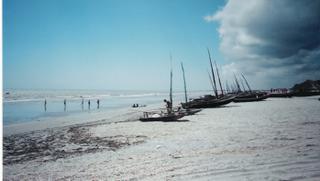
OK, the funding options and studentships may have gone to pot, but I can still bask in the fact that I spent some of the summer in Brazil. Some of the photos have now come throgh from that, including from Jericoacoara. I may add another one later.
It's enough to make me give up London to relocate there...
Into the home straight
The end of the dissertation is in sight. A read through, review and now I'm in the process of tacking on the bibliography, glossary and acknowledgments. But I can't seem to get the table of contents function on Word to work properly - it insists on cutting out particular sections.
Of course I'm still not happy with it - but will I ever be? I keep feeling I could improve it, but every time I look at it I can't see how unless I scrap large sections and replace them with...
...well what exactly?
Tip
If the PhD interview went belly up the one for a research analyst position went better (also on the same day) - although I have yet to hear whether I made the short list for that one. But I noticed that as an interviewee taking notes while the interviewer talks seems to redress the balance of power between the two. That's about the only tip I picked up during last week's interviews.
If the PhD interview went belly up the one for a research analyst position went better (also on the same day) - although I have yet to hear whether I made the short list for that one. But I noticed that as an interviewee taking notes while the interviewer talks seems to redress the balance of power between the two. That's about the only tip I picked up during last week's interviews.
Overlooked
As I suspected - I didn't get the gig at the UCL for the Brazilian history PhD. The silence which dragged on over the weekend prepared me for the worst.
THe frustrating thing about that interview last week was that I thought I was doing really well until they dropped the question: 'So what philosophical influences drive your academic work?'
Come again? And it came from the one member of staff who I assumed wasn't taking part in the panel discussion - she was the admissions tutor.
As might be imagined, after a question like that the interview started to unravel. And with it three years of potential work and full funding.
Bugger.
Still, it's nice to have options and it looks like it's the LSE for me (I'm sure there's a verse in there somewhere...).
Unexpected
What do you do on Saturday night when it's nearly 11.30 and most of the places charge you to get in?
A friend and I had this dilemma, which was made worse by the fact that we hadn't drunk at all - so faving the free bars at O'Neills or the Phoenix on Charing Cross Road were no-nos.
But then we found what looked like a conservatory-cum-bar at the back of Centrepoint. It called itself a Late Bar. Why not give it a go?
And that's how we walked - accidentally - into a lesbian bar.
I have been on this planet for 29 years and never been in one before. More surprising though, we actually got served.
But I reckon they probably thought that like them, us being two blokes, we were probably fellow travellers.
Wednesday, August 17, 2005
An empty pedestal
Well, that was that. I bombed.
It was all going so wel, my interview at UCL for this PhD on Brazil. I was making the right noises and points and the panel seemed to be nodding its collective head in approval.
But there's always one question, isn't there? And once it's asked the whole think unravels.
"Who have been your biggest influences on your conceptualisation of your work?"
Huh? Excuse me?
Yes, I was forced to think of intellectuals that I had 'looked up' to, or been influenced by. And the answer? Well, I struggled and then claimed I was an Enlightenment sort of chap.
Which is not what they wanted to hear; after all, they want someone who is going to consider post-colonial studies and alternative approaches for this project.
And so the project disappears into the breeze.
Bugger.
Sunday, August 14, 2005
First match blues
Not a good start at all.
But at least there's another 41 games to go. And they had better improve is all I'm saying...
Not a good start at all.
But at least there's another 41 games to go. And they had better improve is all I'm saying...
Passing away?
Having been immersed in my dissertation and preparations for Wednesday's interview, I haven't commented much on the current shenanigans going on in Brazil. But a couple of stories in the Folha and among the London-based PT made me sit up and take note. It would seem there are two political deaths - the PT (probably overstated) and that of Miguel Arraes - dominating the Brazilian scene this week.
First, what is happening to the PT? There's been an interesting email exchange going on among London petistas regarding what exactly is the PT. While there is general disillusion with the path taken by the present government, what is intriguing is the perception group members have of the PT's mission. For some the PT has sold out, failing to deliver socialism. But for others the PT was never a socialist party in the traditional sense. Indeed, as one very articulate contribution points out, the wording in the PT's documents are vague. What is advocates is radical democracy, or democratic socialism (whatever that is).
At the same time some in the PT are considering abandoning the party, like Christovam Buarque. He's been feted internationally and his administration of Brasilia with its introduction of the bolsa escola is usually offered as an example of good governance. Interesting then that some in the London PT seem critical of hmn, accusing him of opportunism. Could this be because of his background and social-democratic orientation? After all, Christovam has never really been a red, dyed-in-the-wool petista. Might this also be a moment to plug my work on his administration in this book? Available at all good bookshops!
If he does leave the party there is a real question of where he could go. The Folha piece says the options are limited and beyond the PT there is no other party on the left which can offer the prospects of change for Brazil.
Troubling too is the suggestion that the PT in Rio Grande do Sul are also being caught up in this whole 'cash-for-influence' scandal. Of all the regional sections of the PT, I thought (perhaps naively) that the gauchos would be the least involved, due to the relative independent strength of the party down there. As a personal observation, I also met David Stival, the PT chairman who had to make a statement to the police, briefly while carrying out fieldwork there in June. It just gets more depressing...
And so finally we also say goodbye to one of the last great populists. After Brizola's death last year, this week Miguel Arraes passed away - yet another of the politicians who dominated the 'Populist Republic' between 1945 and 1964 before being booted out by the military and into exile before returning again in the 1980s. He's not of historical interest though; others, like Garotinho, owe their political style to him (more's the pity...).
Monday, August 08, 2005
Two strikes
When you're coming to the end of your Masters, summer should be a satisfying time. After the hard slog of winter, with its essays and seminars to prepare for, the months leading to August should be a time of celebration.
But it's not happening that way at the moment. The last few days have been up and down. Friday I received notification that the LSE would offer me a research grant. But which would only cover half the tuition fees - and if I registered as a full time student.
OK... And I'm going to do that with precisely what other funds?
And then today the other scholarship result finally came through - and no, I didn't get it. Even making the short list doesn't seem much of an achievement. In a race for one, you either get it or your don't.
So it looks like I've got several years of badly paid work ahead of me.
What joy!
I've already taken out my bad mood on the ESRC by writing them a letter of appeal on their utterly misguided decision to reject my application. It won't make any difference, but at least I felt better about it.
Friday, August 05, 2005
Light at the end of the tunnel?
Yes, I've been quiet of late. I've been getting my head down on the dissertation. Whereas before it looked unclear, unstructured and unfocused, slowly it's starting to come together. Only a week ago it was a series of disparate, unlinked sections and paragraphs floating across three separate files. Now it's startting to gain some kind of order. Long may it last!
I've also been trying to sort out my rather dire financial situation. This has involved registering at various employment agencies and sending my CV off to possible openings as and when I hear them. Fingers crossed, but I may have something which would last a few weeks from Monday. That would definitely help, while just now I've completed an hour-long writing test to produce an essay for a job as a country analyst at a news service. The amusing thing is that I know of several others at the Institute going for the same position as well, so whoever gets it will have to buy the others drinks!
And now I have another place to fire a CV off to. Excuse me if I disappear...
Monday, August 01, 2005
New series of events
Saturday I went down to the Latin American Bureau for the first of their country-themed afternoons - on Brazil. I had gone because a friend at the Institute had said I should come since the organiser was worried no-one would turn up. A bit of solidarity, in other words.
I needn't have bothered though. The place was fit to bursting for the entire afternoon and evening which included Sue Branford's presentation on the current political situation there (her view: pessimistic to the point that she, a long-time left-wing supporter, is considering abandoning Lula), a film, O Caminho das Nuvens which followed a family's journey from the Northeast to Rio by bicycle (an antidote to other Brazilians films involving violence, drugs and the favela), a capoeira demonstration (which I was persuaded to have a go in...) and plenty of beer and salgadinhos (alright, bolinhos de bacalhau, coxinhas, kibe).
The audience was quite diverse, from those who didn't know who Lula was to people like me and others from the Institute. As a first effort I thought it went extremely well and look forward to the next - on Cuba at the end of August, I think.
Friday, July 29, 2005
Rejection Part 2
Apparently there is. I'm being blown out from a drinking session tonight by a friend (who shall rename nameless lest he be subjected to ridicule from the two readers of this blog) who is off to play...
...I can't even bring myself to say it...
...rounders on Primrose Hill.
I would go and drown my sorrows except that (1) it's barely midday, (2) drinking now might be the first signs of me turning into an alcoholic and (3) I've got no-one to drink with...
Grumble, grumble.
One rejection - any more to come?
One funding opportunity down, one more to go. And it's not looking good. After months of waiting the ESRC letter dropped onto my mat this morning.
Apparently I 'have not received sufficient relevant [research] training' to justify funding. Which I would suggest (and obviously I'm biased) doesn't cast my previous academic, employment and personal experiences in a positive light. Apparently studying Latin American Politics at the Institute, and proposing doctoral work in the same field isn't good enough for the ESRC.
I've got half a mind to appeal. Oh, I see, they've given me details on how to do that.
Ungracious commentary
So the IRA has announced an end to the armed struggle?
Is it just me or do they just seem largely irrelevant in the current climate?
I find myself imagining Gerry Adams, Martin McGuinness and the rest sitting around after the last few weeks and saying they can't really top the efforts of the current crop of fanatics. How many republicans would be willing to blow themselves up?
Time to call it a day, boys.
Thursday, July 28, 2005
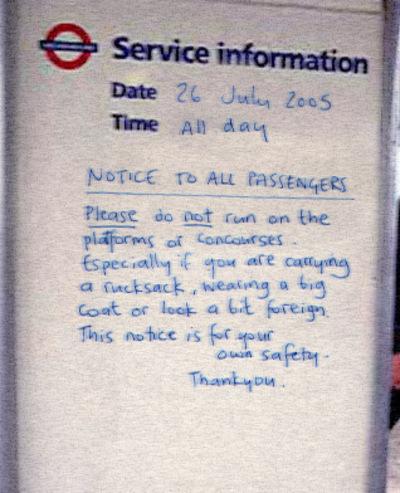
Thursday...
Couldn't have put it better myself.
Simple and to the point.
As if to reinforce that, here's something sent by a friend of mine.
But it has to be doctored...
Surely?
Good capitalism?
Last night's Newsnight had a piece on how South Korea is becoming 'cool' on account of its cultural exports through music, fashion and film. Apparently Seoul is the place to go if you want to be with the in crowd in Asia.
What was interesting though was the explanation and analysis given for this transformation. Apparently after the financial crisis of the late 1990s the country was forced to 'modernise' by breaking down state-owned industries and laying off workers, fostering an environment for private sector entrepreneurialism and a consumer culture open to it. The underlying message then was that it was capitalism - of the free market variety as opposed to the old-fashioned state-directed form dominant in East Asia for the past half-century - which had spawned all this.
Which does beg the unasked - and unanswered - question: can a different form of social and economic organisation (alright, socialism) offer such 'dynamism' in the cultural sphere?
Tuesday, July 26, 2005
Despair
Chaos in London and Brazil - one related to the bombings and trigger happy police, the other with this ongoing scandal that's tearing the government in Brasilia apart.
And that's before you consider what we're facing in the next few months: Fernanda Karina, the secretary at the centre of this whole political corruption story, is considering posing nude in Brazilian Playboy.
What is the world coming to?
I think I need to lie down...
Non-appearance
Off the back of this tragedy I was emailed yesterday by CNN asking if I would be willing to be interviewed on the differences between policing in Brazil and Britain and how the Brazilian community was responding to the shooting. I think they must have got my details off a few articles I've written on the web about Brazilians in the UK.
I declined, mainly because I know other people far better qualified to speak on these matters; and I would hardly claim that I can speak for a whole community. No, I'm not going to become a self-appointed spokesman.
Exploitation and cheap answers
Last night I went down to Stockwell to take part in a demonstration against the police killing of the Brazilian, Jean Charles de Menezes. I got there about half an hour after it started. The street outside the station was packed and the front entrance closed so it didn't spill over inside the station.
There were speeches being made, but I and most others couldn't hear what was being said; the sound was awful and wasn't helped by the noise from the passing traffic. But it was probably just as well. Of the few speakers I tried to listen to, there was one who bellowed out his words. He was making a link between this killing and the government's involvement in Iraq and Afghanistan.
Indeed, the way it was presented you would think that if Blair removed the troops tomorrow we would see an end to tragedies like the one at Stockwell. Nothing was mentioned about the context which led to de Menezes's death, in particular the bombings on the tubes and buses. That made me angry.
There were plenty of people from various communities there - white British, Muslim, Brazilian, Trotskyists and other assorted socialists, human rights organisations - and nothing was said about the terrorist attacks. No doubt this was due in part to the demonstration having been organised by Lambeth's Stop the War coalition - who claim everything is due to our Government's actions in Iraq; that was their attitude after the tube and bus bombings and it's now the case after the Stockwell tragedy. But if that's the best we can come up with we risk coming up with platitudes of the worst kind as I witnessed yesterday.
But I was also angry for another reason: I was there because I was revolted about the way individual police officers held down and man and shot him at point blank range. That is the crux of the matter and what needs to be addressed. Yet instead what we got was a naked attempt to tie this killing to the political axes being ground by the organisers (e.g. people protesting that 'we express our solidarity with the Iraqi people', 'we want civil disobedience now', 'shoot to kill is the result of Israeli policy against the Palestinians' - cue loud cheers).
There was also a demand by the organisers for an end to the 'shoot-to-kill' policy. While that generated the response expected, I couldn't help but feel that once again a simplistic solution had been sought and found. What if the next time the police weren't in the wrong? I don't know. I can't decide how I feel about that.
Only later, after I had been to visit my brothers at their house nearby, did I come back to the station and find what I had come for. An impromptu memorial had been laid out, with posters, flags and flowers asking for peace and protesting against the killing. There were a few local people standing around, but unlike earlier, no-one out to exploit the situation for their own interest.
I spent a few moments there, reflecting on the injustice of de Menezes's death and the wider public indifference - almost acceptance - of the police's claims that the world has changed, that these things will happen in the future and that we had better get used to it.
But that's not something I either want to get used to or accept.
Monday, July 25, 2005
An unnecessary tragedy
So the man shot by the police at Stockwell tube station (near where my brothers live) on Friday was Brazilian. When the news came out we were assured he was a bomb suspect which has steadily been downgraded to an innocent civilian. Worse, I was under the impression he had been shot running away when it now transpires he was bundled to the ground, held down and then shot - five times.
Something is seriously amiss when that happens. I've been trying to think how it might have happened that he got shot. He walked out of the same block of flat under surveillance by the police. But why would it only be people linked to the bombings who would live there? He had a bulky jacket on. But in Brazil it only needs to be 17 degrees and the coats go on. He was followed and became agitated. That's understandable - whenever I'm in Brazil I'm always looking over my shoulder. It's one of those things you do. And apparently the police followed him onto a bus. Excuse me? If they were suspicious why on earth was he allowed to get on there?
Then we have the police shouting a warning. But were they plain-clothed? If so how can we differentiate them from people who might want to do you harm? That might explain why he ran away yet was legally allowed to live here. Yet even if he ran, jumped over the ticket barrier and jumped on the train, surely if he was held down there was absolutely no reason to shoot him?
Looking through some of the messages which have been going around the Brazilian community over the last few days it's clear that there's a lot of anger. There's concern that 'morenos' (dark people) are being targeted by the police, regardless of race or faith. While there is recognition that the police are under extreme pressure at the moment, there's additional frustration that following this tragedy the community has no political voice. As one member said, rather than listening to what Brazilians in the UK think about this incident the first commentators on the scene are Asian Muslims. Yet what the case shows is how concerned all of us who don't fit the national stereotype - white and blond or ginger-haired - may face in this time of high tension.
I have other less-tragic experience of this differentiation. Last week at the rock festival in Tin Pan Alley the police came looking for a barman who had thrown a drunk out and who fell on top of me and two girls sitting by the kerb. One of the girls tried to give a description of the man responsible, calling him 'foreign looking'. But as I mentioned to a friend the other day, he may well have been British-born of Greek parents. But because he didn't look 'English' he had to be 'foreign'.
One final observation: another friend and I were speaking about this shooting on Friday, before any of the details had come out. We both agreed that there would probably be public acceptance for this kind of action, but one mistake would make the whole fight against terrorism that much harder. And there was a case to be made against ID cards in this respect; you could just imagine a 'foreign-looking' illegal immigrant being stopped by the police, running away and the same shoot-to-kill policy being applied. And that has to be unacceptable.
There was a demonstration by the Brazilian community at Scotland Yard yesterday afternoon. There will be another at Stockwell tube station today at 6pm.
Update: There's now conflicting accounts about whether de Menezes's visa had expired. That may well explain why he ran away from the police. But this doesn't change those points I made above regarding ID cards.
I dislike the undertone of all this, which is that if he was here illegally, his death has less meaning than if his papers were in order.
No it bloody doesn't.
Friday, July 22, 2005
Further incidences
Once again, bomb scares and threats throughout London. Along with two others, his time there was one at Warren Street (near the Institute where I was yesterday) and on the number 26 bus on Hackney Road - from what I can tell from the photos, it was close to where I go past on my way to capoeira.
Grim.
We were at lunch in SOAS when the reports first started coming through. But not knowing how serious they were, I was unsure whether I should call people and unduly alarm them. Then when I decided to call it was impossible to get through; the phone network was down once again, creating yet more chaos for people. Thank God for email then - that was still working and most foreign friends were reassured (usually it's those abroad who worry the most since London presumably seems smaller from that perspective). The only positive aspect of these events is that I copy everyone into the email, and so I'm now talking more frequently to people that I have failed to keep in touch with for awhile.
The police advice was for everyone to stay where they were and not move. But that's a bit difficult if the tube lines are down. I walked over to UCL to hand in my application for a position there and found a constant stream of people walking up Gordon Square, pulling suitcases and trying to get people on their mobile phones. As with two weeks ago everyone seemed remarkably calm and the silence resulting from an absence of traffic was eerie.
The contrast with my personal experience later in the afternoon couldn't be more telling. A few of us went for a pint in a nearby pub. The cricket was on the TV and England were failing to capitalise on their first inning success against the Australians. You could also have forgotten anything had happened at lunch time. But getting home in the evening I saw the news bulletins were full of the day's events.
Yet you can imagine that if this happens more often it will come to be seen as a regular event - and people will emphasise the cricket rather than the disruptions caused by these failed bombings.
Wednesday, July 20, 2005
Not quite what I was expecting...
Yesterday I found myself in Mohammed's grotto. No reason to go into the details - a phone call which I was awaiting today has yet to be received and the longer it remains silent the more I suspect that my visit to Knightsbridge was a fleeting one.
Apparently my visit overlapped with my parents, although we didn't know we had been there until the evening. My mother was being apologetic - "we wanted to do something cultural and we ended up in Harrods".
But she needn't have felt guilty. As I pointed out, al-Fayed has got his own cultural icons there. I actually went down to the 'lower ground floor' and discovered the most kitch, over-the-top tribute-display-contraption with Princess Diana's and Dodi al-Fayed's photos in them. Apparently this is al-Fayed keeping his son's memory alive. Tourists were happily snapping away.
It may not be to everyone's taste. But it looks like Harrod's basement is now on London's cultural map...
Monday, July 18, 2005
London activity
There was plenty going on in town during the heatwave yesterday - and all minutes from each other. In Trafalgar Square there was an Indian festival taking place, although hari krishna music seemed to be the order of the day. Up in Leicester Square the area had been turned over by media types to announce the premiere of Charlie and the Chocolate Factory. From the screens on the north side it was apparent that director Tim Burton was meeting and greeting; I can't imagine how much noisier it would have been when Johnny Depp made his appearance there.
Further up Charing Cross Road a street had been closed. Tin Pan Alley was hosting its annual rock festival so I hung around for awhile, listening to one of the bands (nothing special). The only downside was a drunk being thrown out of a bar and onto me. But if you go to a music gig you have to expect the unexpected I suppose.
An oasis of tranquility
I am firmly convinced that when the revolution comes one place in London will be passed over. On Saturday I was with friends having a picnic in Holland Park and playing with some of the kids there. Nearby other sun worshippers had laid out their rugs to place their food - some with candles, others with a vase of flowers as ornaments. Meanwhile behind a wall the strains of the latest offering from the opera theatre was making its way over to us.
I am firmly convinced that when the revolution comes one place in London will be passed over. On Saturday I was with friends having a picnic in Holland Park and playing with some of the kids there. Nearby other sun worshippers had laid out their rugs to place their food - some with candles, others with a vase of flowers as ornaments. Meanwhile behind a wall the strains of the latest offering from the opera theatre was making its way over to us.
Thursday, July 14, 2005
Buses
More drama this morning. I was at the front of a the top deck on a number 8 bus at the end of Bethnal Green Road when a truck drove dangerously close to us at the lights. The bus driver honked his horn, warning the driver - probably inexperienced - to get out of the way. Instead he panicked and maintained a steady course, whacking the bus on the side.
We all trooped off while the drivers started comparing notes and taking details - although I think the truck driver just wished he could drive away.
Unreal
A week on and it's odd how easily the unreal becomes the norm. Yesterday I was using the computer room in the Institute for Historical Research when an old man with a marshall armband entered the room. Apparently a suspect package had been found in Russell Square (now open, although traffic continues to be diverted) and the police were debating whether to carry out a controlled explosion.
Walking through the Square this morning I saw a big pile of flowers with various dedications to those who died. Judging by the dates on the notes they have been arriving all week.
Monday, July 11, 2005
Latest article
Contrary to the email which I received last month, it seems the Liberator collective did use my article on the forthcoming Lib Dem policy review. The latest edition has dropped through my letter box, but it's not yet up on the web. Anyway, keep an eye out for it on the left side of the home page here.
In hindsight there may be too much name dropping in it and a few too many ideas for one article. Maybe I might persuade them to let me address specific themes over a given period?!
No, that would be too self-aggrandising!
Intense
Last Monday I was in Rio and the Linha Vermelha, the main road between the city and the airport was closed for several hours on account of a shootout between police and drug traffickers in one of the nearby favelas. Which made getting to the airport a speedier proposition on Tuesday because, according to my taxi driver, people were scared to take the road.
Then to get back to London just as the Olympic victory is announced and hear the Red Arrows fly over my flat just as the radio announcer is describing them, followed by the chaos of Thursday and the difficulty in contacting friends and family after the bombings - two of which occurred in places I use virtually every day - Russell Square tube and Tavistock Square.
As of Monday morning Tavistock Square and the Institute remains closed.
Then the temperature climbed at the weekend here, bringing out the hot and sunny weather and making it possible to walk around the city at 10pm with nothing more than a T-shirt.
What a week.
Friday, July 08, 2005
I'm OK. I was at home all morning and much of the afternoon yesterday, so missed any of the events which happened in Liverpool Street and central London. It didn't seem real to me until I started to see on the news that Russell Square tube station had been closed and that a bus had been blown up in Tavistock Square - on the opposite side of the Institute.
I tried to call people but found it almost impossible - the lines were down and when they weren't I could get through. Even then, it still seemed all rather distant from me.
After I had to to drive down to Wimbledon because the tube system (and most of the buses into central London) had been knocked out, it still seemed incredibly far away - aside from the horrendous traffic jams and the constant wailing sirens as ambulances and police (many in unmarked cars) sped past.
Only today did I start to sense the full gravity of the situation. The tube was more than half empty at 9 this morning and there was an uneasy quiet. Virtually everyone had a newspaper which was carrying details of the events of yesterday which can't have been good for confidence: photos full of carnage, injured people, bucked carriages and seats.
Having done some reading at the LSE I walked up towards Russell Square - for some strange reason I assumed only the immediate vicinity of the bomb site would be cordoned off. Maybe it was because much of the tube service had returned with some few exceptions.
But Southampton Row was almost empty of cars while the whole of Russell Square itself was cordoned off, forcing the public to walk around the pavements. As for Tavistock Square, it was completely closed off, with a vast tarpaulin sheet blocking the view of the BMA building in front of which the bus had been destroyed. The entire area was a crime scene and presumably will remain so until Monday. Constantly I came back home to type this up - and get on with the other work which I need to make a start on.
Just as yesterday when the transport system was at a standstill and there were thousands of people walking the streets home, there doesn't seem to be a sense of urgency or panic. Instead there just seems to be steely resolve that life goes on. But there are signs which show that things aren't the same. Along Southampton Road afixed to the side of phone boxes was a poster carrying a photocopied picture of a man and a request from his friends for information about his whereabouts.
It was then, after I saw this, that I realised there must be many more such cases around the city. And that just like New York, Madrid, Iraq and Bali, London has now played host to the same awful experience of terrorism without warning.
We've been hearing for years that this was going to one day happen here. But acceptance still doesn't prepare you when it does finally occur.
Wednesday, July 06, 2005
A tale of two cities
I think I know why Paris didn't get the 2012 Olympics. Forget Chirac's remarks about British food. No, I suspect the IOC delegates were worried that the athletes would get lost.
As someone who had to experience the joys of Charles de Gaulle airport for himself this morning, I speak from personal knowledge. Being met off the plane by a chap bearing a sign for Rome and assuring me that the bus he was touting for was also going to take me to the London-bound plane, I duly stepped on. Only to discover when we arrived that I was at the wrong terminal. With less than 30 minutes before departure I and several other passengers then had to wait for another bus to turn up, which took a leisurely circuit of the airport and its environs.
Unhelpfully there was no announcement to say which terminal we were approaching, or indeed any signs or posters on the terminal itself. And inside the terminal there were two escalators, leading in opposite directions to different gate numbers - and no computer screen to inform us which escalator to take.
And to think that for the last few years London's Olympic bid team has been trying to live up to the image of Paris as having a far better infrastructure.
Don't make me laugh.
Tuesday, July 05, 2005
Last day
This time tomorrow I'll be back in the hurly burly of London life. It's been a month and time is pressing to return to normality and two months of writing ahead of me! No that writing the dissertation won't be enjoyable - but doing fieldwork is infinitely more preferable.
Silence over the last few days can be explained by various visits to friends and family. Hopefully normal service will now be resumed.
Friday, July 01, 2005
Brass neck
I had to laugh really. With pages 1, 2, 3, 4 and 5 of the Folha de Sao Paulo taken up with the post office scandal/corruption story, I found yet anothger case of dubious public office activity in Brazil. But this time it was the bare cheek of the people involved.
Apparently in a town not far from Rio, Itaboari, the mayor passed a law through the council that ties his salary to the tax take, at 0.5%. This means that he earns around R$30,000 a month (over GBP6000). This apparently is in contravention of the constitution which states that no public office salary can be more than that for a Supreme Court minister, set at just over R$17,000 (nearly GBP4000). The president only gets R$8900 a month (nearly GBP2000).
When the Folha tried to contact the mayor they were told he was away on a fishing trip with friends until the end of next week - and both mobile phones failed to work.
If only these people were as good at taking care of matters as they are with lining their pockets then Brazil would have nothing to worry about. But it's the sheer arrogance and contempt for ethics which in a way you almost have to admire (as an addition, Jefferson's allegations don't make him innocent - he freely admits to having engaged in dodgy accounting of his party's election campaigns, using it as his justification to speak with some authority on the matter).
Grim viewing
The cousins I've been staying in with Porto Alegre have been riveted by the scandals emanating from Brasilia this month. And Roberto Jefferson, who I've written about the other week, was back before the cameras last night, this time giving evidence of corruption and misuse of public funds by the PT and its allies in the parliamentary inquiry on the Post Office here.
We went out to dinner at around 8 and came back two and half hours later, to find he was still giving evidence. When I went to bed at around 12.30-1am he was still before the committee (which was made up of the last ew congressmen who had yet to be called).
Jefferson looked like he had been put straight by a few heavies - his left cheek was bandaged up, following a 'domestic incident' in which a cupboard apparently fell on him. All the way through he was puttin an icepack on his cheek while hovering behind him we could make out the surgically gloved hands of the congressional doctors.
As for the questioning, there was plenty of discussion about his involvement in the legislation to allow civil unions between homosexuals and his theatrical qualities, but of substantial questions, very little.
Enlightening in a rather depressing way, really.
Unlikely
Another Esther Grossi tale, this time from another second cousin who I met for the first time yesterday - and who lives around the corner from this famous lady.
Apparently when my second cousin's eldest son was a boy, he used to be terrified when he saw Esther Grossi cycling around the neighbourhood (at the time without the coloured hair). Apparently he was convinced that she would kidnap him!
You look at her now and you can't imagine that she would get away with it. 'Excuse me officer, but did you see a woman with pink, green and blue hair go past with a small child?'
At an end
Last two interviews yesterday, first with the teachers' union, the second with the parents-teachers association in Rio Grande do Sul. Some qualified support from the first interviewee and a more pessimistic view of the PT from the latter, who claim this was due to their organisation being apolitical and autonomous in their dealings with Olivio's government.
I may have to make a few calls on Monday to clarify some matters with previous informants, but now it seems as if the fieldwork part is over.
And now on to the writing...
Subscribe to:
Posts (Atom)