Latin America and the 'credit crunch'
Earlier this year I had a small job taking notes and writing up a report about the financial crisis and its impact on Latin America that was sponsored by the Foreign Office and hosted by the Insitute for the Study of the Americas. This went up on their website in July and with the anniversary of the Lehman Brothers' collapse this month, it seems appropriate to make the link available here:
http://americas.sas.ac.uk/events/docs/EconomicCrisisPapers/RapporteurReport.pdf
Tuesday, September 29, 2009
Other work I've been doing
Even if some of my writings aren't easily available at the moment, I do have some other material that is up on the web. This includes two projects that I worked on for the LSE during the three years I was doing my PhD. They included a project on social scientists' attitudes to digital repositories (i.e. online databases which house both publications and the research used to produce them) and electronic identity management systems (meaning systems to control people logging on and accessing electronic data at universities). If this grabs you, the material can be found here:
Social scientists and repositories: http://www.era.lib.ed.ac.uk/bitstream/1842/1418/1/SocialScienceFinalReport.pdf
Electronic management systems: http://www.angel.ac.uk/identity-project/index.html
Even if some of my writings aren't easily available at the moment, I do have some other material that is up on the web. This includes two projects that I worked on for the LSE during the three years I was doing my PhD. They included a project on social scientists' attitudes to digital repositories (i.e. online databases which house both publications and the research used to produce them) and electronic identity management systems (meaning systems to control people logging on and accessing electronic data at universities). If this grabs you, the material can be found here:
Social scientists and repositories: http://www.era.lib.ed.ac.uk/bitstream/1842/1418/1/SocialScienceFinalReport.pdf
Electronic management systems: http://www.angel.ac.uk/identity-project/index.html
Other writings (and shameless self-promotion)
The past few years has also resulted in a few other publications, either online or in print that I've been working on. Alongside the PhD I've published a few articles related to my research, including on social democracy at both state and national level in Brazil and on left-wing education policy across the region.
Last June Zed Books published a chapter on social democratic education policies in the Ceara and Rio Grande do Sul governments in Brazil in this book, http://www.zedbooks.co.uk/book.asp?bookdetail=4302, while in 2008 I published articles on education policy and the Latin American Left and differences between the Cardoso and Lula governments' educational approaches in Enfoques Educacionales in Chile and the International Journal of Contemporary Sociology respectively. Unfortunately neither journal has updated their site in years, so once I've worked out the new-fangled (at least for me) blogger site, then maybe I can post them myself. Until then, if anyone wants a copy, just email me!
The past few years has also resulted in a few other publications, either online or in print that I've been working on. Alongside the PhD I've published a few articles related to my research, including on social democracy at both state and national level in Brazil and on left-wing education policy across the region.
Last June Zed Books published a chapter on social democratic education policies in the Ceara and Rio Grande do Sul governments in Brazil in this book, http://www.zedbooks.co.uk/book.asp?bookdetail=4302, while in 2008 I published articles on education policy and the Latin American Left and differences between the Cardoso and Lula governments' educational approaches in Enfoques Educacionales in Chile and the International Journal of Contemporary Sociology respectively. Unfortunately neither journal has updated their site in years, so once I've worked out the new-fangled (at least for me) blogger site, then maybe I can post them myself. Until then, if anyone wants a copy, just email me!
Accounting for my absence
Since I stopped this blog I have spent most of that time researching and writing my PhD, which I passed earlier this year. However, I noticed during the course of it that a number of my respondents had their own blogs, which suggested that I should get back to mine at some point. One of those, Jose Joaquin Brunner, an academic and former official in the Chilean education department, very generously posted my dissertation when I sent him a copy recently. Since he's done it I suppose it makes sense for me to do the same and let anyone who happens across know what I spent the last few years slaving over.
http://mt.educarchile.cl/MT/jjbrunner/archives/2009/09/chile_y_brasil.html
Since I stopped this blog I have spent most of that time researching and writing my PhD, which I passed earlier this year. However, I noticed during the course of it that a number of my respondents had their own blogs, which suggested that I should get back to mine at some point. One of those, Jose Joaquin Brunner, an academic and former official in the Chilean education department, very generously posted my dissertation when I sent him a copy recently. Since he's done it I suppose it makes sense for me to do the same and let anyone who happens across know what I spent the last few years slaving over.
http://mt.educarchile.cl/MT/jjbrunner/archives/2009/09/chile_y_brasil.html
Return of the Blog... For Now.
Hi and welcome back. I doubt anyone's reading this after all the three-year 'sabbatical' I've taken from this blog - although there were good reasons for doing so. At the time I last wrote I felt the blog had lost focus. I'd originally set it up as an election campaign blog (back in the heady days when IT was supposedly going to change politics) and eventually it shifted towards interests in Brazilian politics that I pursued prior to and during my postgraduate studies (along with observations on my fellow doctoral colleagues' work during our first year). Eventually I lost interest and wasn't sure what to do with the blog.
So why am I back? Who knows how long it'll last time time. But I feel I have things to say (after all, that's what a blog's for, right?), I've now finished my PhD and I have time on my hands as I search for the right job. And given the lack of another space to do it in, this will do - for now.
Hi and welcome back. I doubt anyone's reading this after all the three-year 'sabbatical' I've taken from this blog - although there were good reasons for doing so. At the time I last wrote I felt the blog had lost focus. I'd originally set it up as an election campaign blog (back in the heady days when IT was supposedly going to change politics) and eventually it shifted towards interests in Brazilian politics that I pursued prior to and during my postgraduate studies (along with observations on my fellow doctoral colleagues' work during our first year). Eventually I lost interest and wasn't sure what to do with the blog.
So why am I back? Who knows how long it'll last time time. But I feel I have things to say (after all, that's what a blog's for, right?), I've now finished my PhD and I have time on my hands as I search for the right job. And given the lack of another space to do it in, this will do - for now.
Friday, July 28, 2006
Massive apologies!
Yes, I've been slack. There's no excuse. More than two monthe since my last posting. But I fear it may continue for awhile yet. Am off to Brazil next week to start my fieldwork, with stops in Rio, Sao Paulo and Brasilia. The last few months have been taken up with preparing for the annual upgrade (passed thankfully), seeking funding for the impending trip and trying to get my part time job completed before I go.
But not to worry, I will be back. Isn't everyone entitled to a break from blogging from time to time?!
Yes, I've been slack. There's no excuse. More than two monthe since my last posting. But I fear it may continue for awhile yet. Am off to Brazil next week to start my fieldwork, with stops in Rio, Sao Paulo and Brasilia. The last few months have been taken up with preparing for the annual upgrade (passed thankfully), seeking funding for the impending trip and trying to get my part time job completed before I go.
But not to worry, I will be back. Isn't everyone entitled to a break from blogging from time to time?!
Wednesday, May 10, 2006
I do hereby declare...
It won't come as any surprise that last week I managed not to be elected as councillor for Spitalfields and Banglatown. I polled 354 votes - not so bad given the lack of campaigning I was able to do and the three winners' totals of between 850-900 or so.
It's a relief it's over though. Not just because it means I have Saturdays free again! Last Thursday I went down to the count at Canary Wharf, but at 5.30am gave up to go home as it was taking forever. In fact the first I heard of my result was from an eagle-eyed friend of mine, who saw it on the Respect website before it went on Tower Hamlets's and texted me!
It won't come as any surprise that last week I managed not to be elected as councillor for Spitalfields and Banglatown. I polled 354 votes - not so bad given the lack of campaigning I was able to do and the three winners' totals of between 850-900 or so.
It's a relief it's over though. Not just because it means I have Saturdays free again! Last Thursday I went down to the count at Canary Wharf, but at 5.30am gave up to go home as it was taking forever. In fact the first I heard of my result was from an eagle-eyed friend of mine, who saw it on the Respect website before it went on Tower Hamlets's and texted me!
Debating social democracy
The Latin American research seminar is also up and running again as well. Last week I presented my chapter on differences within and between Left and Right in Latin America and its implications for education policy. I had an audience of around 6, which was heartening, although I had to explain my way through the project and the way I intended to do it. Not everyone had read the paper, but at least it was a good exercise in preparing and defending myself. I now have my annual review interview scheduled for 31 May, so this was an excellent time to think about potential questions and pitfalls that I might face later in the month.
Yesterday it was Francisco Panizza to present. His article, on the Frente Amplio's first year in government in Uruguay, was the topic for discussion. Again, I don't presume there were many who read the paper, so he spoke for half an hour before taking questions. Francisco had mentioned that the manifesto that the FA was elected on was rather vague in targets, giving Danilo Astori (the economy minister) free reign to develop it in a third way direction (rather than towards the more neo-liberal and radical end of the FA spectrum). What I didn't really understand was why his approach was not challenged by the other currents within the coalition. Furthermore, I was curious to know whether there was any drive to a set of 'hird generation' reforms in public services (as is happening in the UK) and after the 'second generation' market reforms. Francisco said no, the unions were in the way.
One other interesting comments from the discussion was Sara Motta's view that the 'moulding' of the present system in Uruguay was less social democratic than neo-liberal, since there didn't seem to be any corresponding efforts to make Uruguay's political system more democratic and citizen-inclusive. It was a fair point, since to what extent does the third way really engage the grassroots compared to other, more participatory versions of social democracy (this seems to be my oen insight into the subject, e.g. the PT or Evo Morales). Sara, of course, has just been studying the grassroots in Venezuela, so is naturally quite excited about what she sees as a 'juncture' in history there.
The Latin American research seminar is also up and running again as well. Last week I presented my chapter on differences within and between Left and Right in Latin America and its implications for education policy. I had an audience of around 6, which was heartening, although I had to explain my way through the project and the way I intended to do it. Not everyone had read the paper, but at least it was a good exercise in preparing and defending myself. I now have my annual review interview scheduled for 31 May, so this was an excellent time to think about potential questions and pitfalls that I might face later in the month.
Yesterday it was Francisco Panizza to present. His article, on the Frente Amplio's first year in government in Uruguay, was the topic for discussion. Again, I don't presume there were many who read the paper, so he spoke for half an hour before taking questions. Francisco had mentioned that the manifesto that the FA was elected on was rather vague in targets, giving Danilo Astori (the economy minister) free reign to develop it in a third way direction (rather than towards the more neo-liberal and radical end of the FA spectrum). What I didn't really understand was why his approach was not challenged by the other currents within the coalition. Furthermore, I was curious to know whether there was any drive to a set of 'hird generation' reforms in public services (as is happening in the UK) and after the 'second generation' market reforms. Francisco said no, the unions were in the way.
One other interesting comments from the discussion was Sara Motta's view that the 'moulding' of the present system in Uruguay was less social democratic than neo-liberal, since there didn't seem to be any corresponding efforts to make Uruguay's political system more democratic and citizen-inclusive. It was a fair point, since to what extent does the third way really engage the grassroots compared to other, more participatory versions of social democracy (this seems to be my oen insight into the subject, e.g. the PT or Evo Morales). Sara, of course, has just been studying the grassroots in Venezuela, so is naturally quite excited about what she sees as a 'juncture' in history there.
First year round-ups
It's been awhile, so time for a roundup of the various research projects being undertaken by first year Government Department students. Two weeks' worth to be getting on with, so here goes!
Last week Eva-Maria Asari presented her ideas on multiculturalism in Canada and Estonia. She wants to examine how minorities are treated and the way they relate to state policies. Questions were asked about the usefulness of comparing these two coutnries, which Eva-Maria explained by saying that Canada had been at the forefront of developing multicultural citizenship. But there are still some issues to be resolved, including the fact that unlike Russian speakers in Estonia, the French in Canada form a majority in Quebec as well as a minority in the rest of the country. Would she take into account that fact? I asked. In addition, to what extent has Estonia's government introduced a more 'liberal' notion of citizenship as a result of external pressures (e.g. EU, OECD, Canada) compared to the Canadians' own 1960s-70s internal drive for reform? Would that affect the substance of the policies?
This week Miika Tervonen explained that he was looking at the way the Roma in Finland had been historically marginalised between the late 19th and mid-20th century. As a visiting student, he's in the advantageous position of not having to do an annual review at the end of this month. However, we were able to get into a discussion about the nature of Roma identity and the reasons behind it - namely that the Roma have always been seen as a problem group, even though many of them can be labelled as Finnish. He also talked about them in social terms rather than cultural/national ones - they speak Finnish and are notable for their mobility. Some questions were made about the Swedish minostiry in Finland and the way in which they are not marginalised.
Finally Umit Sonmez showed his work on electricity and gas liberalisation and regulation in Britain and Turkey. For Umit the interesting thing is that effective liberalisation did not take place until after the independent regulatory bodies were put in place. In both countries' cases that was in the last ten years, despite a 15-20 year difference in the pace of liberalisation reform. I asked whether there were substantial differences between different governments (e.g. Tory and Labour here, secular and Islamist in Turkey) in approaching these themes and the extent to which the regulatory agencies (which became 'culpable' for the process at one remove from government) was either a reflection of government interests or captured by the private sector (probably less the latter since the natural tendency was to create a monopoly).
It's been awhile, so time for a roundup of the various research projects being undertaken by first year Government Department students. Two weeks' worth to be getting on with, so here goes!
Last week Eva-Maria Asari presented her ideas on multiculturalism in Canada and Estonia. She wants to examine how minorities are treated and the way they relate to state policies. Questions were asked about the usefulness of comparing these two coutnries, which Eva-Maria explained by saying that Canada had been at the forefront of developing multicultural citizenship. But there are still some issues to be resolved, including the fact that unlike Russian speakers in Estonia, the French in Canada form a majority in Quebec as well as a minority in the rest of the country. Would she take into account that fact? I asked. In addition, to what extent has Estonia's government introduced a more 'liberal' notion of citizenship as a result of external pressures (e.g. EU, OECD, Canada) compared to the Canadians' own 1960s-70s internal drive for reform? Would that affect the substance of the policies?
This week Miika Tervonen explained that he was looking at the way the Roma in Finland had been historically marginalised between the late 19th and mid-20th century. As a visiting student, he's in the advantageous position of not having to do an annual review at the end of this month. However, we were able to get into a discussion about the nature of Roma identity and the reasons behind it - namely that the Roma have always been seen as a problem group, even though many of them can be labelled as Finnish. He also talked about them in social terms rather than cultural/national ones - they speak Finnish and are notable for their mobility. Some questions were made about the Swedish minostiry in Finland and the way in which they are not marginalised.
Finally Umit Sonmez showed his work on electricity and gas liberalisation and regulation in Britain and Turkey. For Umit the interesting thing is that effective liberalisation did not take place until after the independent regulatory bodies were put in place. In both countries' cases that was in the last ten years, despite a 15-20 year difference in the pace of liberalisation reform. I asked whether there were substantial differences between different governments (e.g. Tory and Labour here, secular and Islamist in Turkey) in approaching these themes and the extent to which the regulatory agencies (which became 'culpable' for the process at one remove from government) was either a reflection of government interests or captured by the private sector (probably less the latter since the natural tendency was to create a monopoly).
Sunday, April 30, 2006

Thursday, April 27, 2006
Euro-monitoring in Greece
First seminar of the summer term brough Zivanna Mourmouri to the class to present her research on the Europeanisation of Greek public space. Instead of being on Monday the seminar has been shifted to Wednesday for this and next week. Consequently there was plenty of time lost as people wandered around, trying to find the right classroom, since we had relocated as well! Also, it was only one person this week, so a later start, at 11.
Zivanna aims to assess the extent to which Greece's media has become Europeanised through a content analysis of stories about the EU. A number of questions were raised, including what was meant by 'Europeanisation' (which was loosely defined but appeared to be a process of change by which European issues become discussed nationally - I think) and how a study of the media could identify changes in societal views and attitudes about Europe.
Added to this were methodological questions about the suitability of a one-country case study and an emphasis on periods where the EU was bound to be discussed (i.e. monetary union, etc). If Greece - which Zivanna claims has an instrumental view of the EU - was not going to be compared against a pro- or anti-EU state (e.g. France and the UK), then shouldn't 'controls' be placed in the analysis of media between periods where there was a lot of discussion about the EU against those which didn't?
Still, it has the makings of an interesting project and could provide an useful insight into how the EU is reported.
First seminar of the summer term brough Zivanna Mourmouri to the class to present her research on the Europeanisation of Greek public space. Instead of being on Monday the seminar has been shifted to Wednesday for this and next week. Consequently there was plenty of time lost as people wandered around, trying to find the right classroom, since we had relocated as well! Also, it was only one person this week, so a later start, at 11.
Zivanna aims to assess the extent to which Greece's media has become Europeanised through a content analysis of stories about the EU. A number of questions were raised, including what was meant by 'Europeanisation' (which was loosely defined but appeared to be a process of change by which European issues become discussed nationally - I think) and how a study of the media could identify changes in societal views and attitudes about Europe.
Added to this were methodological questions about the suitability of a one-country case study and an emphasis on periods where the EU was bound to be discussed (i.e. monetary union, etc). If Greece - which Zivanna claims has an instrumental view of the EU - was not going to be compared against a pro- or anti-EU state (e.g. France and the UK), then shouldn't 'controls' be placed in the analysis of media between periods where there was a lot of discussion about the EU against those which didn't?
Still, it has the makings of an interesting project and could provide an useful insight into how the EU is reported.
Wednesday, April 26, 2006

On the ballot
Attended two seminar yesterday related to elections. The first was at the ODI where George Philip (LSE), Victor Bulmer-Thomas and Duncan Green (Oxfam) all spoke about the Latin American elections. Is it a turn to the left and if so is it substantial or only skin deep. I managed to arrive late and missed George's contribution. But the general impression given was that while macro-economic policy won't change, there's the possibility of reform in social policy by these governments as well as the now obvious comment that Venezuela's Chavez and Chile's Bachelet are different creatures.
Duncan Green drew on Francisco Panizza's typology of the contemporary Left, claiming that there are three models: the liberal-republican, social movement-based and populist. A government or party can occupy more than one model and fluctuate according to their experience. Consequently, Brazil's PT and Uruguay's Frente Amplio may have been labelled as social movement-based but are probably now liberal-republican (like Bachelet). Where then, does Morales in Bolivia sit? He comes from the social movement Left, but will he govern like that? Or will he end up like Lula and the PT? Furthermore, will Bolivia go the way of Ecuador, where social and indigenous movements ended up splitting with 'their' government?
The other contibition to note about the ODI seminar was Bulmer-Thomas's observation that economic paradigms in Latin America generally last about 50 years - which means we're currently halfway through the current model. So don't expect any major changes yet.
I left early to catch a bus to Oxford for the Brazil Centre's seminar on the Brazilian elections. The panel consisted of Leslie Bethell (who always has a few good anecdotes up his sleeve), Jairo Nicolau (a renowned political scientist in Brazil), Tim Power and Leany Barreiro Lemos (a visiting research associate and legislative advisor in the Senate in Brasilia).
The general consensus was that Lula looks like he'll win. Although he hasn't declared yet, his polls have recovered after the corruption scandals and Alckmin, the main challenger, hasn't made a dent in his numbers yet. Power (loosely) likened Lula to Reagan as a hands-off, teflon-like president. Interesting though, Jairo showed that Lula's support has fallen among the richer classes and that his base is now among the poorer sections of society. This means that if Garotinho gets the PMDB nomination he could create problems for Lula, since he's drawing the same sort of support. It also means that the suggested impeachment of Lula probably won't go through, since the poor will think it's the political class trying to get 'our man'.
Also notable is the feeling in Brazil that Lula does better without the PT - hence his distancing himself from the party. That made me ask a question about a post-Lula PT in 2010. If Lula wins now, what happens then? The interesting thing about all the scandal last year was how it swept away the group behind Lula, from whom one might have expected his successor to have been groomed. And former finance minister, Palocci, is just the latest case.
Attended two seminar yesterday related to elections. The first was at the ODI where George Philip (LSE), Victor Bulmer-Thomas and Duncan Green (Oxfam) all spoke about the Latin American elections. Is it a turn to the left and if so is it substantial or only skin deep. I managed to arrive late and missed George's contribution. But the general impression given was that while macro-economic policy won't change, there's the possibility of reform in social policy by these governments as well as the now obvious comment that Venezuela's Chavez and Chile's Bachelet are different creatures.
Duncan Green drew on Francisco Panizza's typology of the contemporary Left, claiming that there are three models: the liberal-republican, social movement-based and populist. A government or party can occupy more than one model and fluctuate according to their experience. Consequently, Brazil's PT and Uruguay's Frente Amplio may have been labelled as social movement-based but are probably now liberal-republican (like Bachelet). Where then, does Morales in Bolivia sit? He comes from the social movement Left, but will he govern like that? Or will he end up like Lula and the PT? Furthermore, will Bolivia go the way of Ecuador, where social and indigenous movements ended up splitting with 'their' government?
The other contibition to note about the ODI seminar was Bulmer-Thomas's observation that economic paradigms in Latin America generally last about 50 years - which means we're currently halfway through the current model. So don't expect any major changes yet.
I left early to catch a bus to Oxford for the Brazil Centre's seminar on the Brazilian elections. The panel consisted of Leslie Bethell (who always has a few good anecdotes up his sleeve), Jairo Nicolau (a renowned political scientist in Brazil), Tim Power and Leany Barreiro Lemos (a visiting research associate and legislative advisor in the Senate in Brasilia).
The general consensus was that Lula looks like he'll win. Although he hasn't declared yet, his polls have recovered after the corruption scandals and Alckmin, the main challenger, hasn't made a dent in his numbers yet. Power (loosely) likened Lula to Reagan as a hands-off, teflon-like president. Interesting though, Jairo showed that Lula's support has fallen among the richer classes and that his base is now among the poorer sections of society. This means that if Garotinho gets the PMDB nomination he could create problems for Lula, since he's drawing the same sort of support. It also means that the suggested impeachment of Lula probably won't go through, since the poor will think it's the political class trying to get 'our man'.
Also notable is the feeling in Brazil that Lula does better without the PT - hence his distancing himself from the party. That made me ask a question about a post-Lula PT in 2010. If Lula wins now, what happens then? The interesting thing about all the scandal last year was how it swept away the group behind Lula, from whom one might have expected his successor to have been groomed. And former finance minister, Palocci, is just the latest case.
Sunday, April 23, 2006
Saudades
Yes, I'm pining a bit for Brazil - the beaches and a more relaxed existence (probably due to the fact that I know I have work and studies to be getting on with).
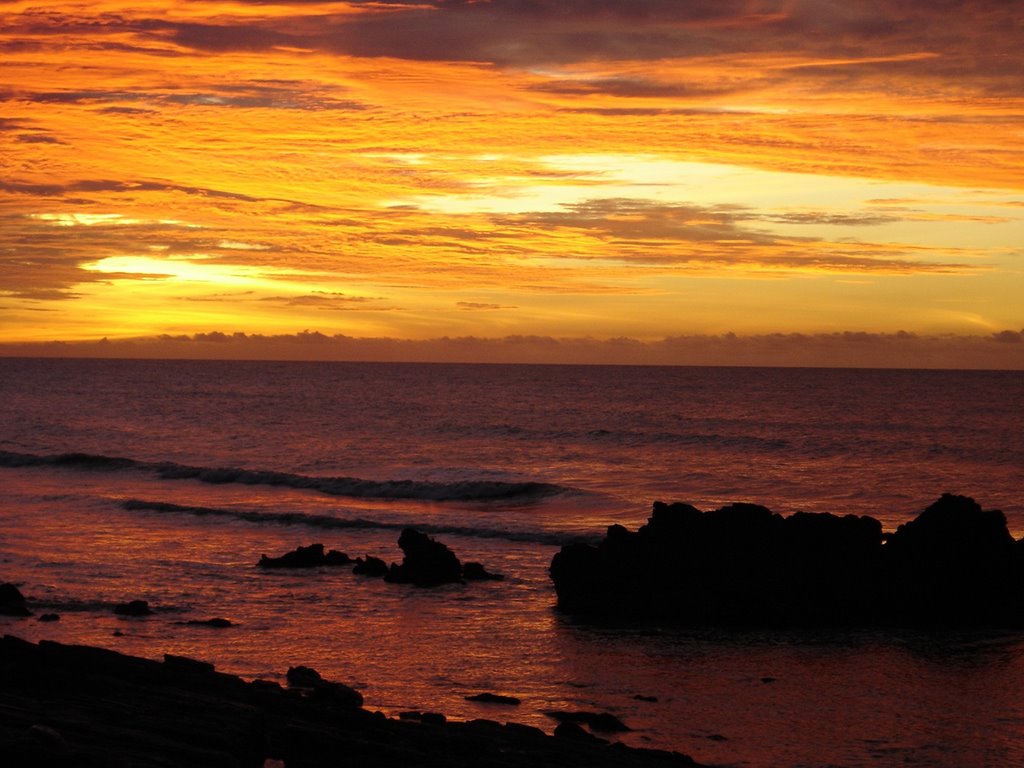
In the absence of any prospect - at least until the summer (fingers crossed), I attach a photo of one of the more beautiful places I've been to: an image of Jericoacoara at sunset (thanks Pati).
Yes, I'm pining a bit for Brazil - the beaches and a more relaxed existence (probably due to the fact that I know I have work and studies to be getting on with).
In the absence of any prospect - at least until the summer (fingers crossed), I attach a photo of one of the more beautiful places I've been to: an image of Jericoacoara at sunset (thanks Pati).
Anglified Braziliana
To Guanabara club/bar in the evening for my brother's birthday party. Yet having been in Rio just a few days ago, the vibe was definitely less Brazilian than one might expect.
Sure, Guanabara has gained a reputation as arguably the most vibrantly Brazilian venue in London. And perhaps if you haven't been to Brazil - or it's been awhile since you were last there - it may catch the vibe. But there's plenty there to remind you that you're definitely in London. It's not just the number of white people, but the sense of busy-ness around you. Added to that the music before the big samba school came on was definitively not Brazilian and the presence of a toilet attendent, which really winds me up something chronic, all points out that we're in the UK.
And is it just me or are there a growing number of Ben Sherman shirts that I saw in there last night? I'm coming to the conclusion that toilet attendents and Ben Sherman fashionwear is something that is quite closely correlated.
To Guanabara club/bar in the evening for my brother's birthday party. Yet having been in Rio just a few days ago, the vibe was definitely less Brazilian than one might expect.
Sure, Guanabara has gained a reputation as arguably the most vibrantly Brazilian venue in London. And perhaps if you haven't been to Brazil - or it's been awhile since you were last there - it may catch the vibe. But there's plenty there to remind you that you're definitely in London. It's not just the number of white people, but the sense of busy-ness around you. Added to that the music before the big samba school came on was definitively not Brazilian and the presence of a toilet attendent, which really winds me up something chronic, all points out that we're in the UK.
And is it just me or are there a growing number of Ben Sherman shirts that I saw in there last night? I'm coming to the conclusion that toilet attendents and Ben Sherman fashionwear is something that is quite closely correlated.
Election round-up
Yesterday was one of the two (possibly three) ventures into the Spitalfields and Banglatown ward election. Along with my two colleagues we visited several estates and houses near Hanbury Street to plug ourselves. We had a leaflet with details about ourselves and the party (although one of the leaflets had a statement about me that was slightly out of date). No matter though. We managed to introduce ourselves to a number of people and even if it wasn't really canvassing, the general impression was good. Only a few people refused to take our leaflet or said they wouldn't vote Lib Dem.
It's less than two weeks until polling day and there was quite a lot of acitivity inthe area. As we doorknocked one estate the local Tory candidate was seen driving around the block and back again (so much for his party's claims of green-ness!), while several Labour candidates and activists stopped to talk to us. Meanwhile on the other side of the street there were three Respect activists whi were clearly not from the area, trying to work out which estate was which from one of the maps.
Yesterday was one of the two (possibly three) ventures into the Spitalfields and Banglatown ward election. Along with my two colleagues we visited several estates and houses near Hanbury Street to plug ourselves. We had a leaflet with details about ourselves and the party (although one of the leaflets had a statement about me that was slightly out of date). No matter though. We managed to introduce ourselves to a number of people and even if it wasn't really canvassing, the general impression was good. Only a few people refused to take our leaflet or said they wouldn't vote Lib Dem.
It's less than two weeks until polling day and there was quite a lot of acitivity inthe area. As we doorknocked one estate the local Tory candidate was seen driving around the block and back again (so much for his party's claims of green-ness!), while several Labour candidates and activists stopped to talk to us. Meanwhile on the other side of the street there were three Respect activists whi were clearly not from the area, trying to work out which estate was which from one of the maps.
A-begging for money
It looks like being ridiculously expensive to get a flight for Brazil this summer. A quick check of online travel agencies suggests around £800-£1000. Quite steep. The last time I sought a flight to Brazil in the summer (August time) it was around £550 - and that was considered expensive three years ago. Presumably it's something to do with the fuel tax?
Which makes it all the more imperative that I apply for funding for the flight. I managed to get some money last year from London University which covered my flight out. Today I'm going to be making an effort to apply again - and hopefully be successful once more.
Although judging by my last few funding applications (almost a job in themselves for PhD students), I may well be unsuccessful. This month alone has seen rejections from the Government Department to support my ESRC application and from the Wingate scholarship foundation.
Once the travel application is done there's also internal LSE funds to apply for before the end of June, including the Miliband scholarship (worth £5000 and only available once every two years) and the research grant (that cuts my tuition fees in half as it did this year).
It looks like being ridiculously expensive to get a flight for Brazil this summer. A quick check of online travel agencies suggests around £800-£1000. Quite steep. The last time I sought a flight to Brazil in the summer (August time) it was around £550 - and that was considered expensive three years ago. Presumably it's something to do with the fuel tax?
Which makes it all the more imperative that I apply for funding for the flight. I managed to get some money last year from London University which covered my flight out. Today I'm going to be making an effort to apply again - and hopefully be successful once more.
Although judging by my last few funding applications (almost a job in themselves for PhD students), I may well be unsuccessful. This month alone has seen rejections from the Government Department to support my ESRC application and from the Wingate scholarship foundation.
Once the travel application is done there's also internal LSE funds to apply for before the end of June, including the Miliband scholarship (worth £5000 and only available once every two years) and the research grant (that cuts my tuition fees in half as it did this year).
Thursday, April 20, 2006
Time to be off?
Only one other thing to say after my absence. Despite carrying around my digital camera for three weeks in Brazil, it's was only on the last flight home that the LCD screen cracked. Added to that the hot water in the kitchen is not working while the shower is barely a trickle. Meanwhile the bank has charged for going over my limit and refuses to allow me an increase.
With a welcome back like that is it any wonder I'm counting the days until I next go back to Brazil for fieldwork (ideally this summer)?
Only one other thing to say after my absence. Despite carrying around my digital camera for three weeks in Brazil, it's was only on the last flight home that the LCD screen cracked. Added to that the hot water in the kitchen is not working while the shower is barely a trickle. Meanwhile the bank has charged for going over my limit and refuses to allow me an increase.
With a welcome back like that is it any wonder I'm counting the days until I next go back to Brazil for fieldwork (ideally this summer)?
Back to business as usual
I'm back after a three-week absence. I was away in Brazil, ostensibly for a friend's wedding in Rio before then heading out to the Amazon with friends for some serious slumming. Then back to Rio via a detour in the African-feeling city of Salvador. Plenty that could be written about - and which might appear gratuitous and boring to some. I reckon the best way to address this might be to post the occasional photo rather than wax lyrical. Also, because I simply don't have the time! It's back to work, both PhD-related and work-related, for me.
But I will leave this thought: the jungle is much noisier than I anticipated. Sitting silently one can hear dozens of things, from howler monkeys to buzzing mosquitos and grasshoppers, through to strange sounding birds - particularly those that make a 'thwip-thweeough' side, like a builder to a passing woman!
I'm back after a three-week absence. I was away in Brazil, ostensibly for a friend's wedding in Rio before then heading out to the Amazon with friends for some serious slumming. Then back to Rio via a detour in the African-feeling city of Salvador. Plenty that could be written about - and which might appear gratuitous and boring to some. I reckon the best way to address this might be to post the occasional photo rather than wax lyrical. Also, because I simply don't have the time! It's back to work, both PhD-related and work-related, for me.
But I will leave this thought: the jungle is much noisier than I anticipated. Sitting silently one can hear dozens of things, from howler monkeys to buzzing mosquitos and grasshoppers, through to strange sounding birds - particularly those that make a 'thwip-thweeough' side, like a builder to a passing woman!
Subscribe to:
Posts (Atom)