Light at the end of the tunnel?
Yes, I've been quiet of late. I've been getting my head down on the dissertation. Whereas before it looked unclear, unstructured and unfocused, slowly it's starting to come together. Only a week ago it was a series of disparate, unlinked sections and paragraphs floating across three separate files. Now it's startting to gain some kind of order. Long may it last!
I've also been trying to sort out my rather dire financial situation. This has involved registering at various employment agencies and sending my CV off to possible openings as and when I hear them. Fingers crossed, but I may have something which would last a few weeks from Monday. That would definitely help, while just now I've completed an hour-long writing test to produce an essay for a job as a country analyst at a news service. The amusing thing is that I know of several others at the Institute going for the same position as well, so whoever gets it will have to buy the others drinks!
And now I have another place to fire a CV off to. Excuse me if I disappear...
Monday, August 01, 2005
New series of events
Saturday I went down to the Latin American Bureau for the first of their country-themed afternoons - on Brazil. I had gone because a friend at the Institute had said I should come since the organiser was worried no-one would turn up. A bit of solidarity, in other words.
I needn't have bothered though. The place was fit to bursting for the entire afternoon and evening which included Sue Branford's presentation on the current political situation there (her view: pessimistic to the point that she, a long-time left-wing supporter, is considering abandoning Lula), a film, O Caminho das Nuvens which followed a family's journey from the Northeast to Rio by bicycle (an antidote to other Brazilians films involving violence, drugs and the favela), a capoeira demonstration (which I was persuaded to have a go in...) and plenty of beer and salgadinhos (alright, bolinhos de bacalhau, coxinhas, kibe).
The audience was quite diverse, from those who didn't know who Lula was to people like me and others from the Institute. As a first effort I thought it went extremely well and look forward to the next - on Cuba at the end of August, I think.
Saturday I went down to the Latin American Bureau for the first of their country-themed afternoons - on Brazil. I had gone because a friend at the Institute had said I should come since the organiser was worried no-one would turn up. A bit of solidarity, in other words.
I needn't have bothered though. The place was fit to bursting for the entire afternoon and evening which included Sue Branford's presentation on the current political situation there (her view: pessimistic to the point that she, a long-time left-wing supporter, is considering abandoning Lula), a film, O Caminho das Nuvens which followed a family's journey from the Northeast to Rio by bicycle (an antidote to other Brazilians films involving violence, drugs and the favela), a capoeira demonstration (which I was persuaded to have a go in...) and plenty of beer and salgadinhos (alright, bolinhos de bacalhau, coxinhas, kibe).
The audience was quite diverse, from those who didn't know who Lula was to people like me and others from the Institute. As a first effort I thought it went extremely well and look forward to the next - on Cuba at the end of August, I think.
Friday, July 29, 2005
Rejection Part 2
Apparently there is. I'm being blown out from a drinking session tonight by a friend (who shall rename nameless lest he be subjected to ridicule from the two readers of this blog) who is off to play...
...I can't even bring myself to say it...
...rounders on Primrose Hill.
I would go and drown my sorrows except that (1) it's barely midday, (2) drinking now might be the first signs of me turning into an alcoholic and (3) I've got no-one to drink with...
Grumble, grumble.
Apparently there is. I'm being blown out from a drinking session tonight by a friend (who shall rename nameless lest he be subjected to ridicule from the two readers of this blog) who is off to play...
...I can't even bring myself to say it...
...rounders on Primrose Hill.
I would go and drown my sorrows except that (1) it's barely midday, (2) drinking now might be the first signs of me turning into an alcoholic and (3) I've got no-one to drink with...
Grumble, grumble.
One rejection - any more to come?
One funding opportunity down, one more to go. And it's not looking good. After months of waiting the ESRC letter dropped onto my mat this morning.
Apparently I 'have not received sufficient relevant [research] training' to justify funding. Which I would suggest (and obviously I'm biased) doesn't cast my previous academic, employment and personal experiences in a positive light. Apparently studying Latin American Politics at the Institute, and proposing doctoral work in the same field isn't good enough for the ESRC.
I've got half a mind to appeal. Oh, I see, they've given me details on how to do that.
One funding opportunity down, one more to go. And it's not looking good. After months of waiting the ESRC letter dropped onto my mat this morning.
Apparently I 'have not received sufficient relevant [research] training' to justify funding. Which I would suggest (and obviously I'm biased) doesn't cast my previous academic, employment and personal experiences in a positive light. Apparently studying Latin American Politics at the Institute, and proposing doctoral work in the same field isn't good enough for the ESRC.
I've got half a mind to appeal. Oh, I see, they've given me details on how to do that.
Ungracious commentary
So the IRA has announced an end to the armed struggle?
Is it just me or do they just seem largely irrelevant in the current climate?
I find myself imagining Gerry Adams, Martin McGuinness and the rest sitting around after the last few weeks and saying they can't really top the efforts of the current crop of fanatics. How many republicans would be willing to blow themselves up?
Time to call it a day, boys.
So the IRA has announced an end to the armed struggle?
Is it just me or do they just seem largely irrelevant in the current climate?
I find myself imagining Gerry Adams, Martin McGuinness and the rest sitting around after the last few weeks and saying they can't really top the efforts of the current crop of fanatics. How many republicans would be willing to blow themselves up?
Time to call it a day, boys.
Thursday, July 28, 2005
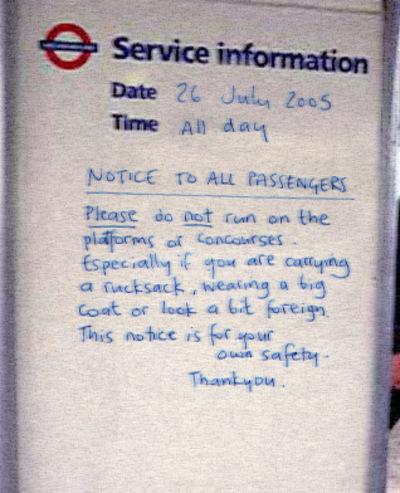
Thursday...
Couldn't have put it better myself.
Simple and to the point.
As if to reinforce that, here's something sent by a friend of mine.
But it has to be doctored...
Surely?
Good capitalism?
Last night's Newsnight had a piece on how South Korea is becoming 'cool' on account of its cultural exports through music, fashion and film. Apparently Seoul is the place to go if you want to be with the in crowd in Asia.
What was interesting though was the explanation and analysis given for this transformation. Apparently after the financial crisis of the late 1990s the country was forced to 'modernise' by breaking down state-owned industries and laying off workers, fostering an environment for private sector entrepreneurialism and a consumer culture open to it. The underlying message then was that it was capitalism - of the free market variety as opposed to the old-fashioned state-directed form dominant in East Asia for the past half-century - which had spawned all this.
Which does beg the unasked - and unanswered - question: can a different form of social and economic organisation (alright, socialism) offer such 'dynamism' in the cultural sphere?
Last night's Newsnight had a piece on how South Korea is becoming 'cool' on account of its cultural exports through music, fashion and film. Apparently Seoul is the place to go if you want to be with the in crowd in Asia.
What was interesting though was the explanation and analysis given for this transformation. Apparently after the financial crisis of the late 1990s the country was forced to 'modernise' by breaking down state-owned industries and laying off workers, fostering an environment for private sector entrepreneurialism and a consumer culture open to it. The underlying message then was that it was capitalism - of the free market variety as opposed to the old-fashioned state-directed form dominant in East Asia for the past half-century - which had spawned all this.
Which does beg the unasked - and unanswered - question: can a different form of social and economic organisation (alright, socialism) offer such 'dynamism' in the cultural sphere?
Tuesday, July 26, 2005
Despair
Chaos in London and Brazil - one related to the bombings and trigger happy police, the other with this ongoing scandal that's tearing the government in Brasilia apart.
And that's before you consider what we're facing in the next few months: Fernanda Karina, the secretary at the centre of this whole political corruption story, is considering posing nude in Brazilian Playboy.
What is the world coming to?
I think I need to lie down...
Chaos in London and Brazil - one related to the bombings and trigger happy police, the other with this ongoing scandal that's tearing the government in Brasilia apart.
And that's before you consider what we're facing in the next few months: Fernanda Karina, the secretary at the centre of this whole political corruption story, is considering posing nude in Brazilian Playboy.
What is the world coming to?
I think I need to lie down...
Non-appearance
Off the back of this tragedy I was emailed yesterday by CNN asking if I would be willing to be interviewed on the differences between policing in Brazil and Britain and how the Brazilian community was responding to the shooting. I think they must have got my details off a few articles I've written on the web about Brazilians in the UK.
I declined, mainly because I know other people far better qualified to speak on these matters; and I would hardly claim that I can speak for a whole community. No, I'm not going to become a self-appointed spokesman.
Off the back of this tragedy I was emailed yesterday by CNN asking if I would be willing to be interviewed on the differences between policing in Brazil and Britain and how the Brazilian community was responding to the shooting. I think they must have got my details off a few articles I've written on the web about Brazilians in the UK.
I declined, mainly because I know other people far better qualified to speak on these matters; and I would hardly claim that I can speak for a whole community. No, I'm not going to become a self-appointed spokesman.
Exploitation and cheap answers
Last night I went down to Stockwell to take part in a demonstration against the police killing of the Brazilian, Jean Charles de Menezes. I got there about half an hour after it started. The street outside the station was packed and the front entrance closed so it didn't spill over inside the station.
There were speeches being made, but I and most others couldn't hear what was being said; the sound was awful and wasn't helped by the noise from the passing traffic. But it was probably just as well. Of the few speakers I tried to listen to, there was one who bellowed out his words. He was making a link between this killing and the government's involvement in Iraq and Afghanistan.
Indeed, the way it was presented you would think that if Blair removed the troops tomorrow we would see an end to tragedies like the one at Stockwell. Nothing was mentioned about the context which led to de Menezes's death, in particular the bombings on the tubes and buses. That made me angry.
There were plenty of people from various communities there - white British, Muslim, Brazilian, Trotskyists and other assorted socialists, human rights organisations - and nothing was said about the terrorist attacks. No doubt this was due in part to the demonstration having been organised by Lambeth's Stop the War coalition - who claim everything is due to our Government's actions in Iraq; that was their attitude after the tube and bus bombings and it's now the case after the Stockwell tragedy. But if that's the best we can come up with we risk coming up with platitudes of the worst kind as I witnessed yesterday.
But I was also angry for another reason: I was there because I was revolted about the way individual police officers held down and man and shot him at point blank range. That is the crux of the matter and what needs to be addressed. Yet instead what we got was a naked attempt to tie this killing to the political axes being ground by the organisers (e.g. people protesting that 'we express our solidarity with the Iraqi people', 'we want civil disobedience now', 'shoot to kill is the result of Israeli policy against the Palestinians' - cue loud cheers).
There was also a demand by the organisers for an end to the 'shoot-to-kill' policy. While that generated the response expected, I couldn't help but feel that once again a simplistic solution had been sought and found. What if the next time the police weren't in the wrong? I don't know. I can't decide how I feel about that.
Only later, after I had been to visit my brothers at their house nearby, did I come back to the station and find what I had come for. An impromptu memorial had been laid out, with posters, flags and flowers asking for peace and protesting against the killing. There were a few local people standing around, but unlike earlier, no-one out to exploit the situation for their own interest.
I spent a few moments there, reflecting on the injustice of de Menezes's death and the wider public indifference - almost acceptance - of the police's claims that the world has changed, that these things will happen in the future and that we had better get used to it.
But that's not something I either want to get used to or accept.
Last night I went down to Stockwell to take part in a demonstration against the police killing of the Brazilian, Jean Charles de Menezes. I got there about half an hour after it started. The street outside the station was packed and the front entrance closed so it didn't spill over inside the station.
There were speeches being made, but I and most others couldn't hear what was being said; the sound was awful and wasn't helped by the noise from the passing traffic. But it was probably just as well. Of the few speakers I tried to listen to, there was one who bellowed out his words. He was making a link between this killing and the government's involvement in Iraq and Afghanistan.
Indeed, the way it was presented you would think that if Blair removed the troops tomorrow we would see an end to tragedies like the one at Stockwell. Nothing was mentioned about the context which led to de Menezes's death, in particular the bombings on the tubes and buses. That made me angry.
There were plenty of people from various communities there - white British, Muslim, Brazilian, Trotskyists and other assorted socialists, human rights organisations - and nothing was said about the terrorist attacks. No doubt this was due in part to the demonstration having been organised by Lambeth's Stop the War coalition - who claim everything is due to our Government's actions in Iraq; that was their attitude after the tube and bus bombings and it's now the case after the Stockwell tragedy. But if that's the best we can come up with we risk coming up with platitudes of the worst kind as I witnessed yesterday.
But I was also angry for another reason: I was there because I was revolted about the way individual police officers held down and man and shot him at point blank range. That is the crux of the matter and what needs to be addressed. Yet instead what we got was a naked attempt to tie this killing to the political axes being ground by the organisers (e.g. people protesting that 'we express our solidarity with the Iraqi people', 'we want civil disobedience now', 'shoot to kill is the result of Israeli policy against the Palestinians' - cue loud cheers).
There was also a demand by the organisers for an end to the 'shoot-to-kill' policy. While that generated the response expected, I couldn't help but feel that once again a simplistic solution had been sought and found. What if the next time the police weren't in the wrong? I don't know. I can't decide how I feel about that.
Only later, after I had been to visit my brothers at their house nearby, did I come back to the station and find what I had come for. An impromptu memorial had been laid out, with posters, flags and flowers asking for peace and protesting against the killing. There were a few local people standing around, but unlike earlier, no-one out to exploit the situation for their own interest.
I spent a few moments there, reflecting on the injustice of de Menezes's death and the wider public indifference - almost acceptance - of the police's claims that the world has changed, that these things will happen in the future and that we had better get used to it.
But that's not something I either want to get used to or accept.
Monday, July 25, 2005
An unnecessary tragedy
So the man shot by the police at Stockwell tube station (near where my brothers live) on Friday was Brazilian. When the news came out we were assured he was a bomb suspect which has steadily been downgraded to an innocent civilian. Worse, I was under the impression he had been shot running away when it now transpires he was bundled to the ground, held down and then shot - five times.
Something is seriously amiss when that happens. I've been trying to think how it might have happened that he got shot. He walked out of the same block of flat under surveillance by the police. But why would it only be people linked to the bombings who would live there? He had a bulky jacket on. But in Brazil it only needs to be 17 degrees and the coats go on. He was followed and became agitated. That's understandable - whenever I'm in Brazil I'm always looking over my shoulder. It's one of those things you do. And apparently the police followed him onto a bus. Excuse me? If they were suspicious why on earth was he allowed to get on there?
Then we have the police shouting a warning. But were they plain-clothed? If so how can we differentiate them from people who might want to do you harm? That might explain why he ran away yet was legally allowed to live here. Yet even if he ran, jumped over the ticket barrier and jumped on the train, surely if he was held down there was absolutely no reason to shoot him?
Looking through some of the messages which have been going around the Brazilian community over the last few days it's clear that there's a lot of anger. There's concern that 'morenos' (dark people) are being targeted by the police, regardless of race or faith. While there is recognition that the police are under extreme pressure at the moment, there's additional frustration that following this tragedy the community has no political voice. As one member said, rather than listening to what Brazilians in the UK think about this incident the first commentators on the scene are Asian Muslims. Yet what the case shows is how concerned all of us who don't fit the national stereotype - white and blond or ginger-haired - may face in this time of high tension.
I have other less-tragic experience of this differentiation. Last week at the rock festival in Tin Pan Alley the police came looking for a barman who had thrown a drunk out and who fell on top of me and two girls sitting by the kerb. One of the girls tried to give a description of the man responsible, calling him 'foreign looking'. But as I mentioned to a friend the other day, he may well have been British-born of Greek parents. But because he didn't look 'English' he had to be 'foreign'.
One final observation: another friend and I were speaking about this shooting on Friday, before any of the details had come out. We both agreed that there would probably be public acceptance for this kind of action, but one mistake would make the whole fight against terrorism that much harder. And there was a case to be made against ID cards in this respect; you could just imagine a 'foreign-looking' illegal immigrant being stopped by the police, running away and the same shoot-to-kill policy being applied. And that has to be unacceptable.
There was a demonstration by the Brazilian community at Scotland Yard yesterday afternoon. There will be another at Stockwell tube station today at 6pm.
Update: There's now conflicting accounts about whether de Menezes's visa had expired. That may well explain why he ran away from the police. But this doesn't change those points I made above regarding ID cards.
I dislike the undertone of all this, which is that if he was here illegally, his death has less meaning than if his papers were in order.
No it bloody doesn't.
So the man shot by the police at Stockwell tube station (near where my brothers live) on Friday was Brazilian. When the news came out we were assured he was a bomb suspect which has steadily been downgraded to an innocent civilian. Worse, I was under the impression he had been shot running away when it now transpires he was bundled to the ground, held down and then shot - five times.
Something is seriously amiss when that happens. I've been trying to think how it might have happened that he got shot. He walked out of the same block of flat under surveillance by the police. But why would it only be people linked to the bombings who would live there? He had a bulky jacket on. But in Brazil it only needs to be 17 degrees and the coats go on. He was followed and became agitated. That's understandable - whenever I'm in Brazil I'm always looking over my shoulder. It's one of those things you do. And apparently the police followed him onto a bus. Excuse me? If they were suspicious why on earth was he allowed to get on there?
Then we have the police shouting a warning. But were they plain-clothed? If so how can we differentiate them from people who might want to do you harm? That might explain why he ran away yet was legally allowed to live here. Yet even if he ran, jumped over the ticket barrier and jumped on the train, surely if he was held down there was absolutely no reason to shoot him?
Looking through some of the messages which have been going around the Brazilian community over the last few days it's clear that there's a lot of anger. There's concern that 'morenos' (dark people) are being targeted by the police, regardless of race or faith. While there is recognition that the police are under extreme pressure at the moment, there's additional frustration that following this tragedy the community has no political voice. As one member said, rather than listening to what Brazilians in the UK think about this incident the first commentators on the scene are Asian Muslims. Yet what the case shows is how concerned all of us who don't fit the national stereotype - white and blond or ginger-haired - may face in this time of high tension.
I have other less-tragic experience of this differentiation. Last week at the rock festival in Tin Pan Alley the police came looking for a barman who had thrown a drunk out and who fell on top of me and two girls sitting by the kerb. One of the girls tried to give a description of the man responsible, calling him 'foreign looking'. But as I mentioned to a friend the other day, he may well have been British-born of Greek parents. But because he didn't look 'English' he had to be 'foreign'.
One final observation: another friend and I were speaking about this shooting on Friday, before any of the details had come out. We both agreed that there would probably be public acceptance for this kind of action, but one mistake would make the whole fight against terrorism that much harder. And there was a case to be made against ID cards in this respect; you could just imagine a 'foreign-looking' illegal immigrant being stopped by the police, running away and the same shoot-to-kill policy being applied. And that has to be unacceptable.
There was a demonstration by the Brazilian community at Scotland Yard yesterday afternoon. There will be another at Stockwell tube station today at 6pm.
Update: There's now conflicting accounts about whether de Menezes's visa had expired. That may well explain why he ran away from the police. But this doesn't change those points I made above regarding ID cards.
I dislike the undertone of all this, which is that if he was here illegally, his death has less meaning than if his papers were in order.
No it bloody doesn't.
Friday, July 22, 2005
Further incidences
Once again, bomb scares and threats throughout London. Along with two others, his time there was one at Warren Street (near the Institute where I was yesterday) and on the number 26 bus on Hackney Road - from what I can tell from the photos, it was close to where I go past on my way to capoeira.
Grim.
We were at lunch in SOAS when the reports first started coming through. But not knowing how serious they were, I was unsure whether I should call people and unduly alarm them. Then when I decided to call it was impossible to get through; the phone network was down once again, creating yet more chaos for people. Thank God for email then - that was still working and most foreign friends were reassured (usually it's those abroad who worry the most since London presumably seems smaller from that perspective). The only positive aspect of these events is that I copy everyone into the email, and so I'm now talking more frequently to people that I have failed to keep in touch with for awhile.
The police advice was for everyone to stay where they were and not move. But that's a bit difficult if the tube lines are down. I walked over to UCL to hand in my application for a position there and found a constant stream of people walking up Gordon Square, pulling suitcases and trying to get people on their mobile phones. As with two weeks ago everyone seemed remarkably calm and the silence resulting from an absence of traffic was eerie.
The contrast with my personal experience later in the afternoon couldn't be more telling. A few of us went for a pint in a nearby pub. The cricket was on the TV and England were failing to capitalise on their first inning success against the Australians. You could also have forgotten anything had happened at lunch time. But getting home in the evening I saw the news bulletins were full of the day's events.
Yet you can imagine that if this happens more often it will come to be seen as a regular event - and people will emphasise the cricket rather than the disruptions caused by these failed bombings.
Once again, bomb scares and threats throughout London. Along with two others, his time there was one at Warren Street (near the Institute where I was yesterday) and on the number 26 bus on Hackney Road - from what I can tell from the photos, it was close to where I go past on my way to capoeira.
Grim.
We were at lunch in SOAS when the reports first started coming through. But not knowing how serious they were, I was unsure whether I should call people and unduly alarm them. Then when I decided to call it was impossible to get through; the phone network was down once again, creating yet more chaos for people. Thank God for email then - that was still working and most foreign friends were reassured (usually it's those abroad who worry the most since London presumably seems smaller from that perspective). The only positive aspect of these events is that I copy everyone into the email, and so I'm now talking more frequently to people that I have failed to keep in touch with for awhile.
The police advice was for everyone to stay where they were and not move. But that's a bit difficult if the tube lines are down. I walked over to UCL to hand in my application for a position there and found a constant stream of people walking up Gordon Square, pulling suitcases and trying to get people on their mobile phones. As with two weeks ago everyone seemed remarkably calm and the silence resulting from an absence of traffic was eerie.
The contrast with my personal experience later in the afternoon couldn't be more telling. A few of us went for a pint in a nearby pub. The cricket was on the TV and England were failing to capitalise on their first inning success against the Australians. You could also have forgotten anything had happened at lunch time. But getting home in the evening I saw the news bulletins were full of the day's events.
Yet you can imagine that if this happens more often it will come to be seen as a regular event - and people will emphasise the cricket rather than the disruptions caused by these failed bombings.
Wednesday, July 20, 2005
Not quite what I was expecting...
Yesterday I found myself in Mohammed's grotto. No reason to go into the details - a phone call which I was awaiting today has yet to be received and the longer it remains silent the more I suspect that my visit to Knightsbridge was a fleeting one.
Apparently my visit overlapped with my parents, although we didn't know we had been there until the evening. My mother was being apologetic - "we wanted to do something cultural and we ended up in Harrods".
But she needn't have felt guilty. As I pointed out, al-Fayed has got his own cultural icons there. I actually went down to the 'lower ground floor' and discovered the most kitch, over-the-top tribute-display-contraption with Princess Diana's and Dodi al-Fayed's photos in them. Apparently this is al-Fayed keeping his son's memory alive. Tourists were happily snapping away.
It may not be to everyone's taste. But it looks like Harrod's basement is now on London's cultural map...
Yesterday I found myself in Mohammed's grotto. No reason to go into the details - a phone call which I was awaiting today has yet to be received and the longer it remains silent the more I suspect that my visit to Knightsbridge was a fleeting one.
Apparently my visit overlapped with my parents, although we didn't know we had been there until the evening. My mother was being apologetic - "we wanted to do something cultural and we ended up in Harrods".
But she needn't have felt guilty. As I pointed out, al-Fayed has got his own cultural icons there. I actually went down to the 'lower ground floor' and discovered the most kitch, over-the-top tribute-display-contraption with Princess Diana's and Dodi al-Fayed's photos in them. Apparently this is al-Fayed keeping his son's memory alive. Tourists were happily snapping away.
It may not be to everyone's taste. But it looks like Harrod's basement is now on London's cultural map...
Monday, July 18, 2005
London activity
There was plenty going on in town during the heatwave yesterday - and all minutes from each other. In Trafalgar Square there was an Indian festival taking place, although hari krishna music seemed to be the order of the day. Up in Leicester Square the area had been turned over by media types to announce the premiere of Charlie and the Chocolate Factory. From the screens on the north side it was apparent that director Tim Burton was meeting and greeting; I can't imagine how much noisier it would have been when Johnny Depp made his appearance there.
Further up Charing Cross Road a street had been closed. Tin Pan Alley was hosting its annual rock festival so I hung around for awhile, listening to one of the bands (nothing special). The only downside was a drunk being thrown out of a bar and onto me. But if you go to a music gig you have to expect the unexpected I suppose.
There was plenty going on in town during the heatwave yesterday - and all minutes from each other. In Trafalgar Square there was an Indian festival taking place, although hari krishna music seemed to be the order of the day. Up in Leicester Square the area had been turned over by media types to announce the premiere of Charlie and the Chocolate Factory. From the screens on the north side it was apparent that director Tim Burton was meeting and greeting; I can't imagine how much noisier it would have been when Johnny Depp made his appearance there.
Further up Charing Cross Road a street had been closed. Tin Pan Alley was hosting its annual rock festival so I hung around for awhile, listening to one of the bands (nothing special). The only downside was a drunk being thrown out of a bar and onto me. But if you go to a music gig you have to expect the unexpected I suppose.
An oasis of tranquility
I am firmly convinced that when the revolution comes one place in London will be passed over. On Saturday I was with friends having a picnic in Holland Park and playing with some of the kids there. Nearby other sun worshippers had laid out their rugs to place their food - some with candles, others with a vase of flowers as ornaments. Meanwhile behind a wall the strains of the latest offering from the opera theatre was making its way over to us.
I am firmly convinced that when the revolution comes one place in London will be passed over. On Saturday I was with friends having a picnic in Holland Park and playing with some of the kids there. Nearby other sun worshippers had laid out their rugs to place their food - some with candles, others with a vase of flowers as ornaments. Meanwhile behind a wall the strains of the latest offering from the opera theatre was making its way over to us.
Thursday, July 14, 2005
Buses
More drama this morning. I was at the front of a the top deck on a number 8 bus at the end of Bethnal Green Road when a truck drove dangerously close to us at the lights. The bus driver honked his horn, warning the driver - probably inexperienced - to get out of the way. Instead he panicked and maintained a steady course, whacking the bus on the side.
We all trooped off while the drivers started comparing notes and taking details - although I think the truck driver just wished he could drive away.
More drama this morning. I was at the front of a the top deck on a number 8 bus at the end of Bethnal Green Road when a truck drove dangerously close to us at the lights. The bus driver honked his horn, warning the driver - probably inexperienced - to get out of the way. Instead he panicked and maintained a steady course, whacking the bus on the side.
We all trooped off while the drivers started comparing notes and taking details - although I think the truck driver just wished he could drive away.
Unreal
A week on and it's odd how easily the unreal becomes the norm. Yesterday I was using the computer room in the Institute for Historical Research when an old man with a marshall armband entered the room. Apparently a suspect package had been found in Russell Square (now open, although traffic continues to be diverted) and the police were debating whether to carry out a controlled explosion.
Walking through the Square this morning I saw a big pile of flowers with various dedications to those who died. Judging by the dates on the notes they have been arriving all week.
A week on and it's odd how easily the unreal becomes the norm. Yesterday I was using the computer room in the Institute for Historical Research when an old man with a marshall armband entered the room. Apparently a suspect package had been found in Russell Square (now open, although traffic continues to be diverted) and the police were debating whether to carry out a controlled explosion.
Walking through the Square this morning I saw a big pile of flowers with various dedications to those who died. Judging by the dates on the notes they have been arriving all week.
Monday, July 11, 2005
Latest article
Contrary to the email which I received last month, it seems the Liberator collective did use my article on the forthcoming Lib Dem policy review. The latest edition has dropped through my letter box, but it's not yet up on the web. Anyway, keep an eye out for it on the left side of the home page here.
In hindsight there may be too much name dropping in it and a few too many ideas for one article. Maybe I might persuade them to let me address specific themes over a given period?!
No, that would be too self-aggrandising!
Contrary to the email which I received last month, it seems the Liberator collective did use my article on the forthcoming Lib Dem policy review. The latest edition has dropped through my letter box, but it's not yet up on the web. Anyway, keep an eye out for it on the left side of the home page here.
In hindsight there may be too much name dropping in it and a few too many ideas for one article. Maybe I might persuade them to let me address specific themes over a given period?!
No, that would be too self-aggrandising!
Intense
Last Monday I was in Rio and the Linha Vermelha, the main road between the city and the airport was closed for several hours on account of a shootout between police and drug traffickers in one of the nearby favelas. Which made getting to the airport a speedier proposition on Tuesday because, according to my taxi driver, people were scared to take the road.
Then to get back to London just as the Olympic victory is announced and hear the Red Arrows fly over my flat just as the radio announcer is describing them, followed by the chaos of Thursday and the difficulty in contacting friends and family after the bombings - two of which occurred in places I use virtually every day - Russell Square tube and Tavistock Square.
As of Monday morning Tavistock Square and the Institute remains closed.
Then the temperature climbed at the weekend here, bringing out the hot and sunny weather and making it possible to walk around the city at 10pm with nothing more than a T-shirt.
What a week.
Last Monday I was in Rio and the Linha Vermelha, the main road between the city and the airport was closed for several hours on account of a shootout between police and drug traffickers in one of the nearby favelas. Which made getting to the airport a speedier proposition on Tuesday because, according to my taxi driver, people were scared to take the road.
Then to get back to London just as the Olympic victory is announced and hear the Red Arrows fly over my flat just as the radio announcer is describing them, followed by the chaos of Thursday and the difficulty in contacting friends and family after the bombings - two of which occurred in places I use virtually every day - Russell Square tube and Tavistock Square.
As of Monday morning Tavistock Square and the Institute remains closed.
Then the temperature climbed at the weekend here, bringing out the hot and sunny weather and making it possible to walk around the city at 10pm with nothing more than a T-shirt.
What a week.
Friday, July 08, 2005
I'm OK. I was at home all morning and much of the afternoon yesterday, so missed any of the events which happened in Liverpool Street and central London. It didn't seem real to me until I started to see on the news that Russell Square tube station had been closed and that a bus had been blown up in Tavistock Square - on the opposite side of the Institute.
I tried to call people but found it almost impossible - the lines were down and when they weren't I could get through. Even then, it still seemed all rather distant from me.
After I had to to drive down to Wimbledon because the tube system (and most of the buses into central London) had been knocked out, it still seemed incredibly far away - aside from the horrendous traffic jams and the constant wailing sirens as ambulances and police (many in unmarked cars) sped past.
Only today did I start to sense the full gravity of the situation. The tube was more than half empty at 9 this morning and there was an uneasy quiet. Virtually everyone had a newspaper which was carrying details of the events of yesterday which can't have been good for confidence: photos full of carnage, injured people, bucked carriages and seats.
Having done some reading at the LSE I walked up towards Russell Square - for some strange reason I assumed only the immediate vicinity of the bomb site would be cordoned off. Maybe it was because much of the tube service had returned with some few exceptions.
But Southampton Row was almost empty of cars while the whole of Russell Square itself was cordoned off, forcing the public to walk around the pavements. As for Tavistock Square, it was completely closed off, with a vast tarpaulin sheet blocking the view of the BMA building in front of which the bus had been destroyed. The entire area was a crime scene and presumably will remain so until Monday. Constantly I came back home to type this up - and get on with the other work which I need to make a start on.
Just as yesterday when the transport system was at a standstill and there were thousands of people walking the streets home, there doesn't seem to be a sense of urgency or panic. Instead there just seems to be steely resolve that life goes on. But there are signs which show that things aren't the same. Along Southampton Road afixed to the side of phone boxes was a poster carrying a photocopied picture of a man and a request from his friends for information about his whereabouts.
It was then, after I saw this, that I realised there must be many more such cases around the city. And that just like New York, Madrid, Iraq and Bali, London has now played host to the same awful experience of terrorism without warning.
We've been hearing for years that this was going to one day happen here. But acceptance still doesn't prepare you when it does finally occur.
I tried to call people but found it almost impossible - the lines were down and when they weren't I could get through. Even then, it still seemed all rather distant from me.
After I had to to drive down to Wimbledon because the tube system (and most of the buses into central London) had been knocked out, it still seemed incredibly far away - aside from the horrendous traffic jams and the constant wailing sirens as ambulances and police (many in unmarked cars) sped past.
Only today did I start to sense the full gravity of the situation. The tube was more than half empty at 9 this morning and there was an uneasy quiet. Virtually everyone had a newspaper which was carrying details of the events of yesterday which can't have been good for confidence: photos full of carnage, injured people, bucked carriages and seats.
Having done some reading at the LSE I walked up towards Russell Square - for some strange reason I assumed only the immediate vicinity of the bomb site would be cordoned off. Maybe it was because much of the tube service had returned with some few exceptions.
But Southampton Row was almost empty of cars while the whole of Russell Square itself was cordoned off, forcing the public to walk around the pavements. As for Tavistock Square, it was completely closed off, with a vast tarpaulin sheet blocking the view of the BMA building in front of which the bus had been destroyed. The entire area was a crime scene and presumably will remain so until Monday. Constantly I came back home to type this up - and get on with the other work which I need to make a start on.
Just as yesterday when the transport system was at a standstill and there were thousands of people walking the streets home, there doesn't seem to be a sense of urgency or panic. Instead there just seems to be steely resolve that life goes on. But there are signs which show that things aren't the same. Along Southampton Road afixed to the side of phone boxes was a poster carrying a photocopied picture of a man and a request from his friends for information about his whereabouts.
It was then, after I saw this, that I realised there must be many more such cases around the city. And that just like New York, Madrid, Iraq and Bali, London has now played host to the same awful experience of terrorism without warning.
We've been hearing for years that this was going to one day happen here. But acceptance still doesn't prepare you when it does finally occur.
Wednesday, July 06, 2005
A tale of two cities
I think I know why Paris didn't get the 2012 Olympics. Forget Chirac's remarks about British food. No, I suspect the IOC delegates were worried that the athletes would get lost.
As someone who had to experience the joys of Charles de Gaulle airport for himself this morning, I speak from personal knowledge. Being met off the plane by a chap bearing a sign for Rome and assuring me that the bus he was touting for was also going to take me to the London-bound plane, I duly stepped on. Only to discover when we arrived that I was at the wrong terminal. With less than 30 minutes before departure I and several other passengers then had to wait for another bus to turn up, which took a leisurely circuit of the airport and its environs.
Unhelpfully there was no announcement to say which terminal we were approaching, or indeed any signs or posters on the terminal itself. And inside the terminal there were two escalators, leading in opposite directions to different gate numbers - and no computer screen to inform us which escalator to take.
And to think that for the last few years London's Olympic bid team has been trying to live up to the image of Paris as having a far better infrastructure.
Don't make me laugh.
I think I know why Paris didn't get the 2012 Olympics. Forget Chirac's remarks about British food. No, I suspect the IOC delegates were worried that the athletes would get lost.
As someone who had to experience the joys of Charles de Gaulle airport for himself this morning, I speak from personal knowledge. Being met off the plane by a chap bearing a sign for Rome and assuring me that the bus he was touting for was also going to take me to the London-bound plane, I duly stepped on. Only to discover when we arrived that I was at the wrong terminal. With less than 30 minutes before departure I and several other passengers then had to wait for another bus to turn up, which took a leisurely circuit of the airport and its environs.
Unhelpfully there was no announcement to say which terminal we were approaching, or indeed any signs or posters on the terminal itself. And inside the terminal there were two escalators, leading in opposite directions to different gate numbers - and no computer screen to inform us which escalator to take.
And to think that for the last few years London's Olympic bid team has been trying to live up to the image of Paris as having a far better infrastructure.
Don't make me laugh.
Tuesday, July 05, 2005
Last day
This time tomorrow I'll be back in the hurly burly of London life. It's been a month and time is pressing to return to normality and two months of writing ahead of me! No that writing the dissertation won't be enjoyable - but doing fieldwork is infinitely more preferable.
Silence over the last few days can be explained by various visits to friends and family. Hopefully normal service will now be resumed.
This time tomorrow I'll be back in the hurly burly of London life. It's been a month and time is pressing to return to normality and two months of writing ahead of me! No that writing the dissertation won't be enjoyable - but doing fieldwork is infinitely more preferable.
Silence over the last few days can be explained by various visits to friends and family. Hopefully normal service will now be resumed.
Friday, July 01, 2005
Brass neck
I had to laugh really. With pages 1, 2, 3, 4 and 5 of the Folha de Sao Paulo taken up with the post office scandal/corruption story, I found yet anothger case of dubious public office activity in Brazil. But this time it was the bare cheek of the people involved.
Apparently in a town not far from Rio, Itaboari, the mayor passed a law through the council that ties his salary to the tax take, at 0.5%. This means that he earns around R$30,000 a month (over GBP6000). This apparently is in contravention of the constitution which states that no public office salary can be more than that for a Supreme Court minister, set at just over R$17,000 (nearly GBP4000). The president only gets R$8900 a month (nearly GBP2000).
When the Folha tried to contact the mayor they were told he was away on a fishing trip with friends until the end of next week - and both mobile phones failed to work.
If only these people were as good at taking care of matters as they are with lining their pockets then Brazil would have nothing to worry about. But it's the sheer arrogance and contempt for ethics which in a way you almost have to admire (as an addition, Jefferson's allegations don't make him innocent - he freely admits to having engaged in dodgy accounting of his party's election campaigns, using it as his justification to speak with some authority on the matter).
I had to laugh really. With pages 1, 2, 3, 4 and 5 of the Folha de Sao Paulo taken up with the post office scandal/corruption story, I found yet anothger case of dubious public office activity in Brazil. But this time it was the bare cheek of the people involved.
Apparently in a town not far from Rio, Itaboari, the mayor passed a law through the council that ties his salary to the tax take, at 0.5%. This means that he earns around R$30,000 a month (over GBP6000). This apparently is in contravention of the constitution which states that no public office salary can be more than that for a Supreme Court minister, set at just over R$17,000 (nearly GBP4000). The president only gets R$8900 a month (nearly GBP2000).
When the Folha tried to contact the mayor they were told he was away on a fishing trip with friends until the end of next week - and both mobile phones failed to work.
If only these people were as good at taking care of matters as they are with lining their pockets then Brazil would have nothing to worry about. But it's the sheer arrogance and contempt for ethics which in a way you almost have to admire (as an addition, Jefferson's allegations don't make him innocent - he freely admits to having engaged in dodgy accounting of his party's election campaigns, using it as his justification to speak with some authority on the matter).
Grim viewing
The cousins I've been staying in with Porto Alegre have been riveted by the scandals emanating from Brasilia this month. And Roberto Jefferson, who I've written about the other week, was back before the cameras last night, this time giving evidence of corruption and misuse of public funds by the PT and its allies in the parliamentary inquiry on the Post Office here.
We went out to dinner at around 8 and came back two and half hours later, to find he was still giving evidence. When I went to bed at around 12.30-1am he was still before the committee (which was made up of the last ew congressmen who had yet to be called).
Jefferson looked like he had been put straight by a few heavies - his left cheek was bandaged up, following a 'domestic incident' in which a cupboard apparently fell on him. All the way through he was puttin an icepack on his cheek while hovering behind him we could make out the surgically gloved hands of the congressional doctors.
As for the questioning, there was plenty of discussion about his involvement in the legislation to allow civil unions between homosexuals and his theatrical qualities, but of substantial questions, very little.
Enlightening in a rather depressing way, really.
The cousins I've been staying in with Porto Alegre have been riveted by the scandals emanating from Brasilia this month. And Roberto Jefferson, who I've written about the other week, was back before the cameras last night, this time giving evidence of corruption and misuse of public funds by the PT and its allies in the parliamentary inquiry on the Post Office here.
We went out to dinner at around 8 and came back two and half hours later, to find he was still giving evidence. When I went to bed at around 12.30-1am he was still before the committee (which was made up of the last ew congressmen who had yet to be called).
Jefferson looked like he had been put straight by a few heavies - his left cheek was bandaged up, following a 'domestic incident' in which a cupboard apparently fell on him. All the way through he was puttin an icepack on his cheek while hovering behind him we could make out the surgically gloved hands of the congressional doctors.
As for the questioning, there was plenty of discussion about his involvement in the legislation to allow civil unions between homosexuals and his theatrical qualities, but of substantial questions, very little.
Enlightening in a rather depressing way, really.
Unlikely
Another Esther Grossi tale, this time from another second cousin who I met for the first time yesterday - and who lives around the corner from this famous lady.
Apparently when my second cousin's eldest son was a boy, he used to be terrified when he saw Esther Grossi cycling around the neighbourhood (at the time without the coloured hair). Apparently he was convinced that she would kidnap him!
You look at her now and you can't imagine that she would get away with it. 'Excuse me officer, but did you see a woman with pink, green and blue hair go past with a small child?'
Another Esther Grossi tale, this time from another second cousin who I met for the first time yesterday - and who lives around the corner from this famous lady.
Apparently when my second cousin's eldest son was a boy, he used to be terrified when he saw Esther Grossi cycling around the neighbourhood (at the time without the coloured hair). Apparently he was convinced that she would kidnap him!
You look at her now and you can't imagine that she would get away with it. 'Excuse me officer, but did you see a woman with pink, green and blue hair go past with a small child?'
At an end
Last two interviews yesterday, first with the teachers' union, the second with the parents-teachers association in Rio Grande do Sul. Some qualified support from the first interviewee and a more pessimistic view of the PT from the latter, who claim this was due to their organisation being apolitical and autonomous in their dealings with Olivio's government.
I may have to make a few calls on Monday to clarify some matters with previous informants, but now it seems as if the fieldwork part is over.
And now on to the writing...
Last two interviews yesterday, first with the teachers' union, the second with the parents-teachers association in Rio Grande do Sul. Some qualified support from the first interviewee and a more pessimistic view of the PT from the latter, who claim this was due to their organisation being apolitical and autonomous in their dealings with Olivio's government.
I may have to make a few calls on Monday to clarify some matters with previous informants, but now it seems as if the fieldwork part is over.
And now on to the writing...
Thursday, June 30, 2005
Distracting
Two interviews yesterday, the second of which took place in the fashionable area of Mont´serrat. I went to the house of Esther Grozzi, a 60-odd year old woman who has been education secretary for Porto Alegre in the first PT administration (1989-92), a member of Congress and now runs a institute tackling illiteracy.
While it wasn´t one of my best interviews, she made a few useful points for the purposes of my research. But it was rather distracting listening to her quoting Gramsci and Brecht while I stared at her hair which was coloured pink, green and blue.
It was like discussing school choices with Carmen Miranda...
Two interviews yesterday, the second of which took place in the fashionable area of Mont´serrat. I went to the house of Esther Grozzi, a 60-odd year old woman who has been education secretary for Porto Alegre in the first PT administration (1989-92), a member of Congress and now runs a institute tackling illiteracy.
While it wasn´t one of my best interviews, she made a few useful points for the purposes of my research. But it was rather distracting listening to her quoting Gramsci and Brecht while I stared at her hair which was coloured pink, green and blue.
It was like discussing school choices with Carmen Miranda...
Wednesday, June 29, 2005
Grungy viewing
Watched a local documentary about the female penal system here in Porto Alegre at the Casa da Cultura in town this evening. Hardly cheery stuff, but it was the only thing on at the time. A Cacera e A Rua follows three women from the closed to the semi-open system which operates in the state. One tries to make it work while another absconds and the third remains in the closed prison, at risk from other inmates, since she is accused of killing her own child.
It´s a pretty grim side of Porto Alegre which is shown, but compared to the prison scenes which many Brazilian men experience (e.g. Bus 174, Carandiru), the system down here looks far more humane. There may be overcrowding but the sense of underlying menace (except for the girl accused of child murder) is comparatively absent while the half-way houses look more like extremely run down dormitories (and an improvement on the shack that one of the girls escapes to).
Watched a local documentary about the female penal system here in Porto Alegre at the Casa da Cultura in town this evening. Hardly cheery stuff, but it was the only thing on at the time. A Cacera e A Rua follows three women from the closed to the semi-open system which operates in the state. One tries to make it work while another absconds and the third remains in the closed prison, at risk from other inmates, since she is accused of killing her own child.
It´s a pretty grim side of Porto Alegre which is shown, but compared to the prison scenes which many Brazilian men experience (e.g. Bus 174, Carandiru), the system down here looks far more humane. There may be overcrowding but the sense of underlying menace (except for the girl accused of child murder) is comparatively absent while the half-way houses look more like extremely run down dormitories (and an improvement on the shack that one of the girls escapes to).
Tuesday, June 28, 2005
Odd place for a gig
Was passing the Mercado Publica last night when I noticed something going on the top level. I went upthere to find a musician, Karine Cunha, launching her latest album, Fluida. So sat through some of the performance with a beer on the table in front of me. Quite good, although since I was sitting further back than the rest and at a different bar I had a cacophony of music, what with her tunes mingling with those of the samba/pagode act inside my bar.
Also I could hear the sound of cleaners hosing down the back of the market. I have to wonder why she chose that particular spot...
Was passing the Mercado Publica last night when I noticed something going on the top level. I went upthere to find a musician, Karine Cunha, launching her latest album, Fluida. So sat through some of the performance with a beer on the table in front of me. Quite good, although since I was sitting further back than the rest and at a different bar I had a cacophony of music, what with her tunes mingling with those of the samba/pagode act inside my bar.
Also I could hear the sound of cleaners hosing down the back of the market. I have to wonder why she chose that particular spot...
Interviews
Couple of interviews yesterday - one with the ex-education secretary of Rio Grande do Sul, Lucia Camini, followed by a later chat with Maria Jose Vasconcelos, who is education editor for the Correio do Povo, one of the main newspapers in this state.
Interviewing Lucia was like speaking to Antenor Naspolini in Ceara the other week. You know what you´re going to hear, mainly because you´ve read most of their policies and achievements in state-published material. Personally I find the interviews with people who have less of a vested interest in presenting a positive image more rewarding - like unionists, public workers and journalists. However, having a few interviews like Lucia and Antenor is still useful, if only because of these people´s profiles when I get back to London and file the report for the university on how I spent the travel grant.
With Maria Jose I was being interviewed - primarily why I was interesting in studying education in Porto Alegre and the state of the education system in Britain. But I was able to turn the discussion around to her perception of what had happened during Lucia´s administration.
And I think I have a better idea what they were trying to achieve when they disbanded the state evalution system in favour of models which were determined by the schools themselves.
I´m also hoping to line up a few more interviews tomorrow, but it all depends on who is available.
PS For the record, my Correio do Povo interview should appear this weekend - hope they didn´t misquote me!
Couple of interviews yesterday - one with the ex-education secretary of Rio Grande do Sul, Lucia Camini, followed by a later chat with Maria Jose Vasconcelos, who is education editor for the Correio do Povo, one of the main newspapers in this state.
Interviewing Lucia was like speaking to Antenor Naspolini in Ceara the other week. You know what you´re going to hear, mainly because you´ve read most of their policies and achievements in state-published material. Personally I find the interviews with people who have less of a vested interest in presenting a positive image more rewarding - like unionists, public workers and journalists. However, having a few interviews like Lucia and Antenor is still useful, if only because of these people´s profiles when I get back to London and file the report for the university on how I spent the travel grant.
With Maria Jose I was being interviewed - primarily why I was interesting in studying education in Porto Alegre and the state of the education system in Britain. But I was able to turn the discussion around to her perception of what had happened during Lucia´s administration.
And I think I have a better idea what they were trying to achieve when they disbanded the state evalution system in favour of models which were determined by the schools themselves.
I´m also hoping to line up a few more interviews tomorrow, but it all depends on who is available.
PS For the record, my Correio do Povo interview should appear this weekend - hope they didn´t misquote me!
Utopia?
Sunday my second cousin´s daughter took me on a drive around southern Porto Alegre. This included a drive through a new condominium which she´s quite taken with.
The wierd thing about it is that the houses and remaining lots (of which there are still plenty to go) are located in the middle of a golf course. There´s security guards on every road and we had to drive around with someone from the showroom to show we were legit.
The place highlights to me one of the realities of contemporary Brazil. Over the past 20-30 years the middle class have put up fences in front of their houses and apartment blocks, set up surveillance cameras and taken on 24-hour security in a bid to seal themselves off from the perceived violence and chaos outside.
The golf course-condominium theme takes the idea one stage further. Now you can live in an American style house without a fence, maintaining the illusion of peace and security - except this time the fences don´t happen to be around your immediate premises, but at the edge of the condominium.
Sunday my second cousin´s daughter took me on a drive around southern Porto Alegre. This included a drive through a new condominium which she´s quite taken with.
The wierd thing about it is that the houses and remaining lots (of which there are still plenty to go) are located in the middle of a golf course. There´s security guards on every road and we had to drive around with someone from the showroom to show we were legit.
The place highlights to me one of the realities of contemporary Brazil. Over the past 20-30 years the middle class have put up fences in front of their houses and apartment blocks, set up surveillance cameras and taken on 24-hour security in a bid to seal themselves off from the perceived violence and chaos outside.
The golf course-condominium theme takes the idea one stage further. Now you can live in an American style house without a fence, maintaining the illusion of peace and security - except this time the fences don´t happen to be around your immediate premises, but at the edge of the condominium.
Saturday, June 25, 2005
A touch closer
Lunch with my great uncle and aunt this afternoon. Unfortunately he´s going deaf, but it´s still impressive that at the age of 93 he´s still mentally all there.
We had a good long chat about the family (my grandmother´s side) and a look at the various photos of them from the early part of the 20th century. What was difficult to imagine was how the older generation (my grandmother´s parents and grand-parents) could put up with wearing heavy, English-style suits and dresses in the heat of a Brazilian summer.
Also had a look at various documents which my great uncle has relating to his great gradnfather and his own time as honourary consul in Porto Alegre. They included correspondence signed by the Brazilian emperor Pedro II and the most prominent 20th century Brazilian presidents, Getulio Vargas and Juscelino Kubitschek. Looking at them on my great uncle´s desk these individuals ceased to be distant and historical figures and far more tangible.
Fascinating.
Lunch with my great uncle and aunt this afternoon. Unfortunately he´s going deaf, but it´s still impressive that at the age of 93 he´s still mentally all there.
We had a good long chat about the family (my grandmother´s side) and a look at the various photos of them from the early part of the 20th century. What was difficult to imagine was how the older generation (my grandmother´s parents and grand-parents) could put up with wearing heavy, English-style suits and dresses in the heat of a Brazilian summer.
Also had a look at various documents which my great uncle has relating to his great gradnfather and his own time as honourary consul in Porto Alegre. They included correspondence signed by the Brazilian emperor Pedro II and the most prominent 20th century Brazilian presidents, Getulio Vargas and Juscelino Kubitschek. Looking at them on my great uncle´s desk these individuals ceased to be distant and historical figures and far more tangible.
Fascinating.
Sitting out
Visited the Education Ministry in Porto Alegre yesterday after the library. It was like walking into a giant concrete warehouse. It took awhile before I realised that it was all open-plan, but you could barely make out one end from the other.
Managed to find some material I need, relating to exam results. But interestingly, the middle-aged ladies who worked in the planning department (including one with very badly smudged lipstick) told me that the PT had opted out of the state evaluation exercise during its time in office.
I hope to verify this on Monday when I interview Lucia Camini, mainly because the women who I spoke to were al political appointees made after the PT left office. However, the thought that the PT wouldn´t want to assess students or the quality of their reforms staggers me. Definitely one for the dissertation if it´s confirmed.
Visited the Education Ministry in Porto Alegre yesterday after the library. It was like walking into a giant concrete warehouse. It took awhile before I realised that it was all open-plan, but you could barely make out one end from the other.
Managed to find some material I need, relating to exam results. But interestingly, the middle-aged ladies who worked in the planning department (including one with very badly smudged lipstick) told me that the PT had opted out of the state evaluation exercise during its time in office.
I hope to verify this on Monday when I interview Lucia Camini, mainly because the women who I spoke to were al political appointees made after the PT left office. However, the thought that the PT wouldn´t want to assess students or the quality of their reforms staggers me. Definitely one for the dissertation if it´s confirmed.
The never-ending story
You know the government´s worried when the president takes to the airwaves. That happened here the night before last when Lula made an appearance on national TV to condemn corruption.
More than two weeks on after arriving in Brazil, still this story won´t end. The PT treasurer has been hauled through the press, the president´s chief of staff has resigned and now Lula announces political reforms and invites the PMDB (a big catch all party) to join the government.
Jut once I would like to open the newspaper here or turn the TV on without having yet more accusations of payments for votes gracing the page or screen.
But it has generated some good material. The most memorable cartoon for me was a few weeks ago in the JB with the politicians portrayed hanging on the street corner, holding their handbags. A ker crawler drives up and asks ´How much is it, congressman?´ To which the politician replies ´30,000 [the amount they are supposed to have received] but I won´t kiss.´
You know the government´s worried when the president takes to the airwaves. That happened here the night before last when Lula made an appearance on national TV to condemn corruption.
More than two weeks on after arriving in Brazil, still this story won´t end. The PT treasurer has been hauled through the press, the president´s chief of staff has resigned and now Lula announces political reforms and invites the PMDB (a big catch all party) to join the government.
Jut once I would like to open the newspaper here or turn the TV on without having yet more accusations of payments for votes gracing the page or screen.
But it has generated some good material. The most memorable cartoon for me was a few weeks ago in the JB with the politicians portrayed hanging on the street corner, holding their handbags. A ker crawler drives up and asks ´How much is it, congressman?´ To which the politician replies ´30,000 [the amount they are supposed to have received] but I won´t kiss.´
Watching myself
Down at the state public library opposite the legislature yesterday. It has an old worldy feel, with faded wallpaper, wooden interiors - the usual sort of place in Brazil which should be preserved but so often isn´t.
Except for once it was. Found a few books to wade through on the PT and education in the state. When I stepped out after I had to be careful since the square it´s on is dangerous according to the cousin I´m staying with - he told me to watch out since I might be accosted by deputies from the legislature opposite in search of mensalao (a payment which certain politicians have been getting for votes and which is rocking the political establishment here).
Down at the state public library opposite the legislature yesterday. It has an old worldy feel, with faded wallpaper, wooden interiors - the usual sort of place in Brazil which should be preserved but so often isn´t.
Except for once it was. Found a few books to wade through on the PT and education in the state. When I stepped out after I had to be careful since the square it´s on is dangerous according to the cousin I´m staying with - he told me to watch out since I might be accosted by deputies from the legislature opposite in search of mensalao (a payment which certain politicians have been getting for votes and which is rocking the political establishment here).
Thursday, June 23, 2005
One more time...
In search of culture I headed out to a university production of ´The Death of Trotsky´ on Av. Salgado Filho last night. It was advertised as a comedy, involving the various ways in which Trotsky might have died other than the way in which he did, in hospital. The main selling point was that it was free.
What I was subjected to was mercifully short - at around 40 minutes or so for a three-actor play - but gave the Trotsky actor the opportunity to die nine times in that period.
Not even actors playing Hamlet and his death scene can match that.
In search of culture I headed out to a university production of ´The Death of Trotsky´ on Av. Salgado Filho last night. It was advertised as a comedy, involving the various ways in which Trotsky might have died other than the way in which he did, in hospital. The main selling point was that it was free.
What I was subjected to was mercifully short - at around 40 minutes or so for a three-actor play - but gave the Trotsky actor the opportunity to die nine times in that period.
Not even actors playing Hamlet and his death scene can match that.
A nation of tea drinkers?
I should also mention that I´m not just in any Brazilian state. This place is (teasingly) better known as the Republic of Rio Grande do Sul.
Of all Brazilian states, Rio Grande has had the greatest seperatist tendency and history. The legacy is seen in the extent to which the state flag colours - red, green and yellow - predominate compared to those in other states.
As if to assert their independence of spirit, macho gauchos are less likely to reach for a packet of fags. Insteas they take their gourd and fill it up with local mate tea and hot water, which they slurp through a metal straw.
While mate is an acquired taste (I like it weak), the point of this macho trick is in not giving concern to the inevitable burns you get from drinking a hot drink through an already hot straw.
I should also mention that I´m not just in any Brazilian state. This place is (teasingly) better known as the Republic of Rio Grande do Sul.
Of all Brazilian states, Rio Grande has had the greatest seperatist tendency and history. The legacy is seen in the extent to which the state flag colours - red, green and yellow - predominate compared to those in other states.
As if to assert their independence of spirit, macho gauchos are less likely to reach for a packet of fags. Insteas they take their gourd and fill it up with local mate tea and hot water, which they slurp through a metal straw.
While mate is an acquired taste (I like it weak), the point of this macho trick is in not giving concern to the inevitable burns you get from drinking a hot drink through an already hot straw.
A tale of Brazilian cities
I haven´t said anything about Porto Alegre yet. But let me. It´s an odd place, not quite Brazilian and yet quintessentially so. Sometimes I imagine I´m in Buenos Aires (or what I imagine Buenos Aires would be like if I had actually been there before) given the preponderance of white German and Italian faces I see.
But at the same time it´s a city which can be as grungy as the rest, especially around the Praça XV. OK, it´s not quite as run down and forgotten as parts of Fortaleza, but the whole open-street market scene is similar to that in Rio´s city centre: lots of noise and bustle, usually pierced by some bloke on a microphone telling passers-by that if you buy five pieces of soap from his shop you´ll get the sixth free. Or something like that.
Some effort has been made to maintain the older, neo-classical buildings around town. But there still remains a plethora of greying, soulless, concrete office blocks which blight most Brazilian cities.
And like Fortaleza, I have yet to work out the bus system.
I haven´t said anything about Porto Alegre yet. But let me. It´s an odd place, not quite Brazilian and yet quintessentially so. Sometimes I imagine I´m in Buenos Aires (or what I imagine Buenos Aires would be like if I had actually been there before) given the preponderance of white German and Italian faces I see.
But at the same time it´s a city which can be as grungy as the rest, especially around the Praça XV. OK, it´s not quite as run down and forgotten as parts of Fortaleza, but the whole open-street market scene is similar to that in Rio´s city centre: lots of noise and bustle, usually pierced by some bloke on a microphone telling passers-by that if you buy five pieces of soap from his shop you´ll get the sixth free. Or something like that.
Some effort has been made to maintain the older, neo-classical buildings around town. But there still remains a plethora of greying, soulless, concrete office blocks which blight most Brazilian cities.
And like Fortaleza, I have yet to work out the bus system.
Making plans
I´ve organised my first interview for the beginning of next week. I´m meeting Lucia Calini, who was the education secretary here in Rio Grande do Sul during the PT administration. I met her yesterday afternoon and we fixed the time.
I also popped into the teachers´ union here, but they´re in the middle of leadership elections so Selene, the president, won´t be free until after Tuesday. No matter, her secretary now knows me and we´ll fix a time later.
Also made an appearance at the documentary section of the Legislative Assembly. May have some people to talk to there this afternoon.
I´ve organised my first interview for the beginning of next week. I´m meeting Lucia Calini, who was the education secretary here in Rio Grande do Sul during the PT administration. I met her yesterday afternoon and we fixed the time.
I also popped into the teachers´ union here, but they´re in the middle of leadership elections so Selene, the president, won´t be free until after Tuesday. No matter, her secretary now knows me and we´ll fix a time later.
Also made an appearance at the documentary section of the Legislative Assembly. May have some people to talk to there this afternoon.
Incentives
As an aside, perhaps the other reason why the PT here is so popular is the close proximity it has to one of the better churrascarias in town. It´s opposite and I popped in for lunch - although not in the more expensive downstairs section. Instead I headed upstairs, to their buffet section which has some amazing cuts of meat and desserts to die for, including passion fruit pudding and white chocolate mousse.
As an aside, perhaps the other reason why the PT here is so popular is the close proximity it has to one of the better churrascarias in town. It´s opposite and I popped in for lunch - although not in the more expensive downstairs section. Instead I headed upstairs, to their buffet section which has some amazing cuts of meat and desserts to die for, including passion fruit pudding and white chocolate mousse.
Preliminary observations
So far I´ve waded through one box relating to principles and proposed policies relating to the PT´s experience of state government in Rio Grande do Sul. Already I´ve noticed some themes which distinguish it from the concurrent PSDB administration in Ceara in the late 1990s and early 2000s. Whereas the Ceara PSDB didn´t criticise FUNDEF (a rejigging of the funding formula for primary education), the PT set itself against. Both states pressed for universal primary education and increases in secondary education - but Ceara had a greater distance to make up compared to Rio Grande do Sul.
It´s also noticeable that the same idea can mean different things to the two: both states introduced elections for school principals, but the PSDB favoured a training and selection course for aspiring candidates while the PT rejected those, claiming it limited democracy to the ´pre-selected´. Furthermore, the PSDB pressed on with the process of municipalisation of schools, which the PT claimed was ´neo-liberal´, constituting a withdrawal of the state from this arena.
Both states have institutions which enable the state to reach into the municipal school environment: Ceara reconstituted them under the new acronym, CREDES, while the PT made do with the existing Delegacias de Educaçao. Both parties sought to make them less bureaucratic, but whereas the PSDB-run education ministry saw its role as co-ordinating the work of different municipalities and schools, the PT saw the institutions as ways of contributing towards developments in pedagogy.
There´s also a marked difference in official material relating to performance. The PT´s material focuses on the role of getting greater democracy in schools and involcing all sectors including - explicitly - ´social movements´ (as opposed to just the ´school community´ or ´civil society´) while the Ceara material points to actual examination results - which show that while primary school access rose, quality measured by results fell. So far I haven´t found anything equivalent in terms of statistics for the PT in Rio Grande do Sul.
That´s my next project.
So far I´ve waded through one box relating to principles and proposed policies relating to the PT´s experience of state government in Rio Grande do Sul. Already I´ve noticed some themes which distinguish it from the concurrent PSDB administration in Ceara in the late 1990s and early 2000s. Whereas the Ceara PSDB didn´t criticise FUNDEF (a rejigging of the funding formula for primary education), the PT set itself against. Both states pressed for universal primary education and increases in secondary education - but Ceara had a greater distance to make up compared to Rio Grande do Sul.
It´s also noticeable that the same idea can mean different things to the two: both states introduced elections for school principals, but the PSDB favoured a training and selection course for aspiring candidates while the PT rejected those, claiming it limited democracy to the ´pre-selected´. Furthermore, the PSDB pressed on with the process of municipalisation of schools, which the PT claimed was ´neo-liberal´, constituting a withdrawal of the state from this arena.
Both states have institutions which enable the state to reach into the municipal school environment: Ceara reconstituted them under the new acronym, CREDES, while the PT made do with the existing Delegacias de Educaçao. Both parties sought to make them less bureaucratic, but whereas the PSDB-run education ministry saw its role as co-ordinating the work of different municipalities and schools, the PT saw the institutions as ways of contributing towards developments in pedagogy.
There´s also a marked difference in official material relating to performance. The PT´s material focuses on the role of getting greater democracy in schools and involcing all sectors including - explicitly - ´social movements´ (as opposed to just the ´school community´ or ´civil society´) while the Ceara material points to actual examination results - which show that while primary school access rose, quality measured by results fell. So far I haven´t found anything equivalent in terms of statistics for the PT in Rio Grande do Sul.
That´s my next project.
As I suspected...
Began the research down at the PT´s regional offices yesterday. And just as I suspected, they have a far better set-up than many other regional offices I´ve visited.
Izabel, who runs the archives, showed me the amount of space which they have got. They have stacks of shelves and boxes and are due to take over even more space. All this dates not just from the recent past but right back to 1982 and ever earlier, relating both to Porto Alegre and the wider state. There´s material enough waiting for a historian to write the definitive volume of the party in the state.
No wonder the PT gets such a favourable response from researchers. If all Brazilian political parties were like this life would be so much easier. Instead we usually rely on interview material and official publications.
Began the research down at the PT´s regional offices yesterday. And just as I suspected, they have a far better set-up than many other regional offices I´ve visited.
Izabel, who runs the archives, showed me the amount of space which they have got. They have stacks of shelves and boxes and are due to take over even more space. All this dates not just from the recent past but right back to 1982 and ever earlier, relating both to Porto Alegre and the wider state. There´s material enough waiting for a historian to write the definitive volume of the party in the state.
No wonder the PT gets such a favourable response from researchers. If all Brazilian political parties were like this life would be so much easier. Instead we usually rely on interview material and official publications.
Wednesday, June 22, 2005
Luxury
Can I just say how wonderful it is to be staying in a home where everything works?
In Ceara alone, I can confirm having experienced the following in pousdas:
-cold water in the shower when there should be hot water
-air conditioning which doesn´t work (rather necessary in 30 degree heat, n´est pas?)
-windows which are sealed shut and painted over
-windows which won´t close
-rooms which smell of mould
-insects
-shower taps which aren´t earthed
And that was all in the space of just over a week.
Can I just say how wonderful it is to be staying in a home where everything works?
In Ceara alone, I can confirm having experienced the following in pousdas:
-cold water in the shower when there should be hot water
-air conditioning which doesn´t work (rather necessary in 30 degree heat, n´est pas?)
-windows which are sealed shut and painted over
-windows which won´t close
-rooms which smell of mould
-insects
-shower taps which aren´t earthed
And that was all in the space of just over a week.
Going nowhere, fast
I was convinced the cearense accent was impenetrable. That was until I heard my taxi driver speak last night. I couldn´t make head nor tail of what he was going on about.
But that was the least of my worries. When I got in the cab he told me he was on the 22nd hour of a 24-hour shift - straight and with no breaks. Just what you want to hear as you tear through Porto Alegre´s streets and red lights after midnight.
He then promptly got lost and it required a phone call to my second cousin (who I´m staying with), a visit to two petrol stations and a fire station before we finally made it.
Porto Alegre is commonly thought as different to the rest of Brazil, as being more socially organised and economically developed. But the first words from my cousin´s husband, who met me at the gate to the house was: ´´Why didn´t the boy have a map in the back of his cab?´´
One more myth bites the dust, methinks...
I was convinced the cearense accent was impenetrable. That was until I heard my taxi driver speak last night. I couldn´t make head nor tail of what he was going on about.
But that was the least of my worries. When I got in the cab he told me he was on the 22nd hour of a 24-hour shift - straight and with no breaks. Just what you want to hear as you tear through Porto Alegre´s streets and red lights after midnight.
He then promptly got lost and it required a phone call to my second cousin (who I´m staying with), a visit to two petrol stations and a fire station before we finally made it.
Porto Alegre is commonly thought as different to the rest of Brazil, as being more socially organised and economically developed. But the first words from my cousin´s husband, who met me at the gate to the house was: ´´Why didn´t the boy have a map in the back of his cab?´´
One more myth bites the dust, methinks...
Back in the cold
Am now in Porto Alegre which is a serious shock to the system, having arrived last night.
Yesterday afternoon I stepped out of the brilliant sunlight of Fortaleza where the temperature was touching 30 degrees. Nine hours later I walked off the plane (after two stops in Salvador and Sao Paulo) into (relatively) arctic conditions of 7 degrees. Everyone is dressed in sweaters and coats - I think I may have to go out and buy some myself.
Bugger.
As if that wasn´t enough I can barely feel my fingers as I type this.
Thus begins Projeto Dois Invernos (Operation Two Winters), in marked contrast to Julia´s much more sensible Two Summers Project in London.
Am now in Porto Alegre which is a serious shock to the system, having arrived last night.
Yesterday afternoon I stepped out of the brilliant sunlight of Fortaleza where the temperature was touching 30 degrees. Nine hours later I walked off the plane (after two stops in Salvador and Sao Paulo) into (relatively) arctic conditions of 7 degrees. Everyone is dressed in sweaters and coats - I think I may have to go out and buy some myself.
Bugger.
As if that wasn´t enough I can barely feel my fingers as I type this.
Thus begins Projeto Dois Invernos (Operation Two Winters), in marked contrast to Julia´s much more sensible Two Summers Project in London.
Women trouble
Fortaleza is an impossible place to be a single male visitor. In at least two pousadas in the Praia de Iracema area over the last week I´ve been met with incredulous looks when I ask for a room. For myself. Alone.
´´Where´s your companion?´´ one proprietor asked. I asked him who he meant. A woman, obviously. No, I wasn´t with anyone, I replied. I just wanted a room for myself. But maybe I would bring one back with me later, he continued.
No, I said. But he insisted on telling me it would raise the cost of my room by R$10 (around GBP2.50) if I did.
Then there was the chap behind the reception desk in last week´s pousada. I was taking money out of my money belt which had been put in their safe box to pay for the trip to Jericoacoara at the travel agent down the road. He seemed askance when I replied that it wasn´t.
Fortaleza is an impossible place to be a single male visitor. In at least two pousadas in the Praia de Iracema area over the last week I´ve been met with incredulous looks when I ask for a room. For myself. Alone.
´´Where´s your companion?´´ one proprietor asked. I asked him who he meant. A woman, obviously. No, I wasn´t with anyone, I replied. I just wanted a room for myself. But maybe I would bring one back with me later, he continued.
No, I said. But he insisted on telling me it would raise the cost of my room by R$10 (around GBP2.50) if I did.
Then there was the chap behind the reception desk in last week´s pousada. I was taking money out of my money belt which had been put in their safe box to pay for the trip to Jericoacoara at the travel agent down the road. He seemed askance when I replied that it wasn´t.
Sunday, June 19, 2005
Blogging in Jericoacoara
Why am I even finding the time to do this? Quite frankly, I should be outside, basking in the constant and balmy 25-30 degrees - and it´s night time.
Frankly, Jericoacoara is one of the most vizually stunning and amazing places I have visited. Ever. The town is a small fishing village but is increasingly being taken over by tourism. That is it´s downside.
We´re about five hours from the state capital in Fortaleza but the last 45 minutes is spent reaching the town by truck - there´s no roads as we´re in a national park.
The park surrounds the town and is basically a series of sand dunes about ten stories high, interspersed with shurb land and lagoons. The sunsets into the sea from the top of the dunes are amazing while it´s still possible to see the stars at night - there´s relatively little illumination; apparently electricity only arrived seven years ago.
I thinking of jacking in my Masters degree and opening a pousada.
Well, maybe not. But I´m definitely coming back here.
Why am I even finding the time to do this? Quite frankly, I should be outside, basking in the constant and balmy 25-30 degrees - and it´s night time.
Frankly, Jericoacoara is one of the most vizually stunning and amazing places I have visited. Ever. The town is a small fishing village but is increasingly being taken over by tourism. That is it´s downside.
We´re about five hours from the state capital in Fortaleza but the last 45 minutes is spent reaching the town by truck - there´s no roads as we´re in a national park.
The park surrounds the town and is basically a series of sand dunes about ten stories high, interspersed with shurb land and lagoons. The sunsets into the sea from the top of the dunes are amazing while it´s still possible to see the stars at night - there´s relatively little illumination; apparently electricity only arrived seven years ago.
I thinking of jacking in my Masters degree and opening a pousada.
Well, maybe not. But I´m definitely coming back here.
Friday, June 17, 2005
Leave of absence?
I´m taking a well-earned (well I think so) break tomorrow and over the weekend. I´ve booked my place on a fast bus and accommodation in Jericoacoara this evening. I´m leaving at 8.15 tomorrow which will mean not being able to have too big a night tonight - a shame as I was told at the Pirata on Monday that there´s a good forro night in town on Thursdays. However, I want to get away from Fortaleza and see the Ceara coast which is supposed to be sensational. After all, you can´t come all the way here and stay in the city for 9 days in a row.
If it means that a former state minister of planning being fobbed off from an interview on Saturday, I´m happy to do that. You got to get your priorities right!
I´ll try to blog from the coast, but for obvious reasons (beach, sun, sand, cold drinks, partying - oh, and a four hour trip both ways), coverage may be light.
I´m taking a well-earned (well I think so) break tomorrow and over the weekend. I´ve booked my place on a fast bus and accommodation in Jericoacoara this evening. I´m leaving at 8.15 tomorrow which will mean not being able to have too big a night tonight - a shame as I was told at the Pirata on Monday that there´s a good forro night in town on Thursdays. However, I want to get away from Fortaleza and see the Ceara coast which is supposed to be sensational. After all, you can´t come all the way here and stay in the city for 9 days in a row.
If it means that a former state minister of planning being fobbed off from an interview on Saturday, I´m happy to do that. You got to get your priorities right!
I´ll try to blog from the coast, but for obvious reasons (beach, sun, sand, cold drinks, partying - oh, and a four hour trip both ways), coverage may be light.
Looks like goodbye...
Effectively finished my research at the Legislative Assembly this afternoon as well. I went through about 8 years of education commission transcipts on the computer´s archives. Fatima, the head of the department, was a little sad to see me go. She´s grown quite fond of me. In fact her and her colleagues. They´re all middle-aged women and I seem to have developed a small fan base. The only thing missing was a big departure on my part!
Effectively finished my research at the Legislative Assembly this afternoon as well. I went through about 8 years of education commission transcipts on the computer´s archives. Fatima, the head of the department, was a little sad to see me go. She´s grown quite fond of me. In fact her and her colleagues. They´re all middle-aged women and I seem to have developed a small fan base. The only thing missing was a big departure on my part!
Possible dissertation titles?
Very enjoyable afternoon interviewing Gardenia, one of the collective which organises Sindiute, the independent teachers´union here in Ceara. Enjoyable because I followed most of what she said and because she kept within the limits of my tape (unlike my interviewee on Monday).
We had a coffee afterwards and chatted about some of the things they´re doing. Gardenia was at pains to point out that while what she said was negative about the state government, they weren´t in anyone´s pockets. Even though she campaigned for Luizianne Lins, who is now the PT mayor in Fortaleza, they were protesting about teachers´conditions down at city hall this week.
She also made a couple of good quotes which I may be able to use, including that while the current state education secretary had made a good analysis of the problems here before taking up her post, she had made it clear that ´before she was Professora Sofia. Now she was Secretary Sofia´ (echoes of Fernando Henrique Cardoso´s alleged statement to ´forget everything I wrote´ when he became president. Also the notion of Ceara being a ´neoliberal laboratory´. How we might describe Rio Grande do Sul under the PT I´ll find out next week.
Very enjoyable afternoon interviewing Gardenia, one of the collective which organises Sindiute, the independent teachers´union here in Ceara. Enjoyable because I followed most of what she said and because she kept within the limits of my tape (unlike my interviewee on Monday).
We had a coffee afterwards and chatted about some of the things they´re doing. Gardenia was at pains to point out that while what she said was negative about the state government, they weren´t in anyone´s pockets. Even though she campaigned for Luizianne Lins, who is now the PT mayor in Fortaleza, they were protesting about teachers´conditions down at city hall this week.
She also made a couple of good quotes which I may be able to use, including that while the current state education secretary had made a good analysis of the problems here before taking up her post, she had made it clear that ´before she was Professora Sofia. Now she was Secretary Sofia´ (echoes of Fernando Henrique Cardoso´s alleged statement to ´forget everything I wrote´ when he became president. Also the notion of Ceara being a ´neoliberal laboratory´. How we might describe Rio Grande do Sul under the PT I´ll find out next week.
Politicking Ceara-style
I think I found Fortaleza´s most political street today. Avenida da Universidade houses at least four different trade union headquarters, including the state´s civil servants and federal workers as well as the teachers´union which I visisted this afternoon.
Also there´s the PCB (Brazilian Communist Party), which is different from the PCdoB (the Communist Party of Brazil - don´t ask me what´s the difference) and is situated in a small old house hidden between two, relatively newer buildings. It´s distinctive by being painted red from top to bottom with a great big hammer and sickle plastered on the side. It was looking rather empty when I passed.
By contrast, the PT´s offices were a little further down the road and were busy. I walked in, on the off chance they might have material relating to the 1990s - no such luck. But first I was waved away to an office further down the passageway; I´d walked into the municipal section while the state´s HQ was the second door down. Je-sus...
But beyond the passageway I discovered a little courtyard and a small kitchen which did food by the plate for the workers there. They were all sitting at tables under a large tree offering shade. And one of the women working there told me that they served food every day except Saturdays and held forro parties there on Friday nights!
That´s one way of attracting party members and votes, I suppose. But haven´t I heard about this somewhere else? Ah yes, rotten boroughs springs to mind...
I think I found Fortaleza´s most political street today. Avenida da Universidade houses at least four different trade union headquarters, including the state´s civil servants and federal workers as well as the teachers´union which I visisted this afternoon.
Also there´s the PCB (Brazilian Communist Party), which is different from the PCdoB (the Communist Party of Brazil - don´t ask me what´s the difference) and is situated in a small old house hidden between two, relatively newer buildings. It´s distinctive by being painted red from top to bottom with a great big hammer and sickle plastered on the side. It was looking rather empty when I passed.
By contrast, the PT´s offices were a little further down the road and were busy. I walked in, on the off chance they might have material relating to the 1990s - no such luck. But first I was waved away to an office further down the passageway; I´d walked into the municipal section while the state´s HQ was the second door down. Je-sus...
But beyond the passageway I discovered a little courtyard and a small kitchen which did food by the plate for the workers there. They were all sitting at tables under a large tree offering shade. And one of the women working there told me that they served food every day except Saturdays and held forro parties there on Friday nights!
That´s one way of attracting party members and votes, I suppose. But haven´t I heard about this somewhere else? Ah yes, rotten boroughs springs to mind...
Thursday, June 16, 2005
A strange sort of compliment
Brazilian TV is odd. Last night I watched some of the novelas (soap operas) which are currently on. They have something for everyone: a casts of thousands - mostly white (quite a shock after walking among mostly dark, mixed-race Brazilians here in Fortaleza every day) - improbable locations and living circumstances (e.g. a maid living in a plush house on Ipanema´s beach front), love, anger, betrayal, passion and over the top acting. And if that wasn´t enough, a drag queen thrown in for good measure.
I´m convinced that if Shakespeare was alive today and was Brazilian he too would be writing novelas.
Brazilian TV is odd. Last night I watched some of the novelas (soap operas) which are currently on. They have something for everyone: a casts of thousands - mostly white (quite a shock after walking among mostly dark, mixed-race Brazilians here in Fortaleza every day) - improbable locations and living circumstances (e.g. a maid living in a plush house on Ipanema´s beach front), love, anger, betrayal, passion and over the top acting. And if that wasn´t enough, a drag queen thrown in for good measure.
I´m convinced that if Shakespeare was alive today and was Brazilian he too would be writing novelas.
I thought I´d seen him somewhere before...
You knew I had to come back to politics at some point. Well, I´m only doing so because after a week the scandal about the PT government´s treasurer paying backhandersto congressmen continues. Yesterday the chief denunciator, Roberto Jefferson, was in front of the cameras and the ethics committeemaking his claims. But apparently he didn´t produce any evidence and the sharp exchanges recorded between him and the accused made for compulsive viewing.
But Jefferson is an odd chap. His hair is perfectly coiffured and he turns himself out well (even if he has poor choice in dress sense with a matching tie and shirt and no cufflinks). He´s got a penchant for the theatrical, waving his hands all over the place, raising an eyebrow here, curling the edge of his lips there. And the language he uses! ´When I told Lula about this, he raised his hand and a tear felldown his cheek´.
I think I´ve found Brazil´s answer to Tony Blair.
You knew I had to come back to politics at some point. Well, I´m only doing so because after a week the scandal about the PT government´s treasurer paying backhandersto congressmen continues. Yesterday the chief denunciator, Roberto Jefferson, was in front of the cameras and the ethics committeemaking his claims. But apparently he didn´t produce any evidence and the sharp exchanges recorded between him and the accused made for compulsive viewing.
But Jefferson is an odd chap. His hair is perfectly coiffured and he turns himself out well (even if he has poor choice in dress sense with a matching tie and shirt and no cufflinks). He´s got a penchant for the theatrical, waving his hands all over the place, raising an eyebrow here, curling the edge of his lips there. And the language he uses! ´When I told Lula about this, he raised his hand and a tear felldown his cheek´.
I think I´ve found Brazil´s answer to Tony Blair.
Rock the Bus
Apart from Fortaleza´s bus system being about as transparent as my skin currently is (i.e. not much), one thing I do like about them are the drivers´ willingness to share their musical tastes with the passengers. Some go for the obvious, like forro or samba. Others plump for the radio while another this morning opted for Coldplay´s latest offering. This afternoon however, I was taken back in time to 1990 and a badly advised period of fashion sense involving a shell suit and trainers. Yes, he had Roxette on, belting out ´She´s Got the Look´.
Just what you want when the bus is belting down the main street at a top speed of 35 miles an hour.
Expect we were sitting in the bus terminal. And we weren´t moving.
Apart from Fortaleza´s bus system being about as transparent as my skin currently is (i.e. not much), one thing I do like about them are the drivers´ willingness to share their musical tastes with the passengers. Some go for the obvious, like forro or samba. Others plump for the radio while another this morning opted for Coldplay´s latest offering. This afternoon however, I was taken back in time to 1990 and a badly advised period of fashion sense involving a shell suit and trainers. Yes, he had Roxette on, belting out ´She´s Got the Look´.
Just what you want when the bus is belting down the main street at a top speed of 35 miles an hour.
Expect we were sitting in the bus terminal. And we weren´t moving.
Not a wasted trip
Second interview done and dusted today. It was supposed to be with Ceara´s education minister, but she was called away to Brasilia at the last minute to be alongside President Lula as he signed a new law relating to education into force. You see, I only make allowances for absolutely necessary cases!
However, trying to contact the education ministry here proved elusive. Emails bounced back while phone calls ended up in the ether. So I had to make the long journey out to SEDUC (that´s the acronym) to find out about this. Not to worry though; the head of the communication team, Jacqueline, was a star, and rummaged around, producing a civil servant to interview. And not just any, but the head of planning. Exactly who I wanted to talk to too.
She was a bit hesitant on some of my questions. Being a teacher by profession (and apolitical, I suspect) she seemed a bit uncomfortable when I posed directly political questions; e.g. what are relations like between SEDUC and the unions? Some deciphering of the responses may be necessary.
And I recorganised my meeting with the education secretary- between four of them, the ministyr´s femal staff effectively organised my life for me over the next few days. I´ll be meeting Professora Sofia - as the minister´s called - 8.30 on Tuesday morning. May have to set my alarm for that one...
I also made use of the ministry´s library before hading back to the state legislature to get on with the archival research I started yesterday. Only to then jump on a bus which went round and round the same houses and streets - literally.
Second interview done and dusted today. It was supposed to be with Ceara´s education minister, but she was called away to Brasilia at the last minute to be alongside President Lula as he signed a new law relating to education into force. You see, I only make allowances for absolutely necessary cases!
However, trying to contact the education ministry here proved elusive. Emails bounced back while phone calls ended up in the ether. So I had to make the long journey out to SEDUC (that´s the acronym) to find out about this. Not to worry though; the head of the communication team, Jacqueline, was a star, and rummaged around, producing a civil servant to interview. And not just any, but the head of planning. Exactly who I wanted to talk to too.
She was a bit hesitant on some of my questions. Being a teacher by profession (and apolitical, I suspect) she seemed a bit uncomfortable when I posed directly political questions; e.g. what are relations like between SEDUC and the unions? Some deciphering of the responses may be necessary.
And I recorganised my meeting with the education secretary- between four of them, the ministyr´s femal staff effectively organised my life for me over the next few days. I´ll be meeting Professora Sofia - as the minister´s called - 8.30 on Tuesday morning. May have to set my alarm for that one...
I also made use of the ministry´s library before hading back to the state legislature to get on with the archival research I started yesterday. Only to then jump on a bus which went round and round the same houses and streets - literally.
Each to their own
For some reason Fortaleza seems to be the Dutch capital of Brazil. I haven´t mentioned this until now, but so far the only non-Brazilians I´ve met have been Dutch - and both on the same evening. One was struggling to order dinner, the other having run out of money was fortifying himself to leaflet and raise some needed cash. Just around the corner from where I´m staying there is a bar whose definining feature is a large clog.
Rio is always flooded with Americans and increasing numbers of Brits (unfortunately). While the the last time I was in Brazil, two years ago, Porto Seguro was overrun by Israelis, with Hebrew signs written on every street corner.
I wonder who Porto Alegre attracts?
PS I realise I was a little hasty. After all, the Duth did spend a bit of time running the place in the 17th century. So that is what all these Dutch are doing in Fortaleza. Before they tried to take it by force; this time they´re doing it by stealth...
For some reason Fortaleza seems to be the Dutch capital of Brazil. I haven´t mentioned this until now, but so far the only non-Brazilians I´ve met have been Dutch - and both on the same evening. One was struggling to order dinner, the other having run out of money was fortifying himself to leaflet and raise some needed cash. Just around the corner from where I´m staying there is a bar whose definining feature is a large clog.
Rio is always flooded with Americans and increasing numbers of Brits (unfortunately). While the the last time I was in Brazil, two years ago, Porto Seguro was overrun by Israelis, with Hebrew signs written on every street corner.
I wonder who Porto Alegre attracts?
PS I realise I was a little hasty. After all, the Duth did spend a bit of time running the place in the 17th century. So that is what all these Dutch are doing in Fortaleza. Before they tried to take it by force; this time they´re doing it by stealth...
Strumming along
Just come back from an open air concert at Fortaleza´s Dragao do Mar cultural centre - about a five minute walk away from my pousada (hotel) and Internet cafe. Miucha, Chico Buarque´s sister, was performing the last leg of a government-sponsored music tour, Projeto de Pixinguinha.
The cultural centre has an open-air amphitheatre which wasa perfect venue. It´s 25 degrees outside and cloudless - you can even see the stars because it´s only a half moon. Miucha did a number of bossa nova numbers, including classics like Vinicius de Moraes´s ´Carta ao Tom´and others including ´OsBeijos Nunca Mais´ and ´A gente vai levanto´ (I may have the titles wrong, but those are the choruses). She was a good show woman too, saying that Vinicius knew about love - he had to, after getting married 9 times! She looked a bit like an energetic grandmother, decked out in a cocktail dress and heavy necklace,with an unlikely dark head of hair.
By the end of the evening everyone was singing along with her and dancing down by the stage. Supporting here Everton dos Andes who played a few ragae-influenced tunes and Quarteto Maogani, a guitar foursome who played some acoustic chorinho, ´Agua de Beber´, Ari Barroso sambas and an ensemble put together by Jobim and Chico nearly 40 years ago.
And for all this I paid the half-priced student fee: R$2.5 - around 50p.
It´s evenings like this I´m glad I chose Brazil as a place to research...
Just come back from an open air concert at Fortaleza´s Dragao do Mar cultural centre - about a five minute walk away from my pousada (hotel) and Internet cafe. Miucha, Chico Buarque´s sister, was performing the last leg of a government-sponsored music tour, Projeto de Pixinguinha.
The cultural centre has an open-air amphitheatre which wasa perfect venue. It´s 25 degrees outside and cloudless - you can even see the stars because it´s only a half moon. Miucha did a number of bossa nova numbers, including classics like Vinicius de Moraes´s ´Carta ao Tom´and others including ´OsBeijos Nunca Mais´ and ´A gente vai levanto´ (I may have the titles wrong, but those are the choruses). She was a good show woman too, saying that Vinicius knew about love - he had to, after getting married 9 times! She looked a bit like an energetic grandmother, decked out in a cocktail dress and heavy necklace,with an unlikely dark head of hair.
By the end of the evening everyone was singing along with her and dancing down by the stage. Supporting here Everton dos Andes who played a few ragae-influenced tunes and Quarteto Maogani, a guitar foursome who played some acoustic chorinho, ´Agua de Beber´, Ari Barroso sambas and an ensemble put together by Jobim and Chico nearly 40 years ago.
And for all this I paid the half-priced student fee: R$2.5 - around 50p.
It´s evenings like this I´m glad I chose Brazil as a place to research...
Tuesday, June 14, 2005
Walking is the safe option...
I do have a bee in my bonnet. Just one. That´s the Fortaleza bus system.
Although there always seem to be plenty of people on them, no-one - and I mean no-one - seems to know which one I need to take to get from one side of town to the other.
And the attendants on the bus are no better. Yesterday I asked one if we went to the beach. Yes, he said, only for the bus to turn around at the next junction and go back on itself, AWAY from the beach.
I do have a bee in my bonnet. Just one. That´s the Fortaleza bus system.
Although there always seem to be plenty of people on them, no-one - and I mean no-one - seems to know which one I need to take to get from one side of town to the other.
And the attendants on the bus are no better. Yesterday I asked one if we went to the beach. Yes, he said, only for the bus to turn around at the next junction and go back on itself, AWAY from the beach.
Fieldwork - first reflections
Interviewed my first cearense today, a professor of sociology at the Federal and State Universities here in Ceara. He could have talked the hind legs off a horse and there didn´t seem to be any way of politely interrupting him. I gave up recording him afte an hour - and he carried on for a further two.
Tomorrow I´m supposed to interview the current state education secretary but for some reason the person organising it hasn´t received my emails and now the webmaster is bouncing them back. Open government? Don´t make mke laugh!
I´ve also been at the state legislature yesterday and today. On Monday I met the adviser to the main opposition spokesman on education (who just happens to be PT). Having read through the government´s self-congratulatory spin I was hoping he might direct me towards some alternative perspectives. Unfortunately he had nothing - and then suggested I contact the education ministry since they would have more information about this sort of thing than the PT! It´s at times like this I don´t know whether to laugh or cry. And then I think there might be some scope for making money. If I could organise a bunch of Lib Dems - well versed in opposition and how to extract material from the government and then use it against that very source - to arrange a series of ´how to be an effective opposition´ sessions in Brazil I would become a rich man. Well, maybe not rich, but satisfied with business trips to places like Fortaleza.
Today I tried an alternative tack. They do have trabscripts of debates in the legislature, a la Hansard, but that is where the similarities end. Before 1998 it´s all paper-based, which means wading through summaries of 130+ legislative sessions a year to identify those which I need.
Brazil may have plenty of internautas (internet users), but its political institutions are way behind the electronic revolution, I can tell you. If you don´t believe me, look at the federal government websites. Even though that level is better connected than the state governments, they aren´t user-friendly, with plenty of acronyms and no definitions dominating the pages.
Interviewed my first cearense today, a professor of sociology at the Federal and State Universities here in Ceara. He could have talked the hind legs off a horse and there didn´t seem to be any way of politely interrupting him. I gave up recording him afte an hour - and he carried on for a further two.
Tomorrow I´m supposed to interview the current state education secretary but for some reason the person organising it hasn´t received my emails and now the webmaster is bouncing them back. Open government? Don´t make mke laugh!
I´ve also been at the state legislature yesterday and today. On Monday I met the adviser to the main opposition spokesman on education (who just happens to be PT). Having read through the government´s self-congratulatory spin I was hoping he might direct me towards some alternative perspectives. Unfortunately he had nothing - and then suggested I contact the education ministry since they would have more information about this sort of thing than the PT! It´s at times like this I don´t know whether to laugh or cry. And then I think there might be some scope for making money. If I could organise a bunch of Lib Dems - well versed in opposition and how to extract material from the government and then use it against that very source - to arrange a series of ´how to be an effective opposition´ sessions in Brazil I would become a rich man. Well, maybe not rich, but satisfied with business trips to places like Fortaleza.
Today I tried an alternative tack. They do have trabscripts of debates in the legislature, a la Hansard, but that is where the similarities end. Before 1998 it´s all paper-based, which means wading through summaries of 130+ legislative sessions a year to identify those which I need.
Brazil may have plenty of internautas (internet users), but its political institutions are way behind the electronic revolution, I can tell you. If you don´t believe me, look at the federal government websites. Even though that level is better connected than the state governments, they aren´t user-friendly, with plenty of acronyms and no definitions dominating the pages.
Holidaying in Hell?
I thought I´d got a bargain yesterday when I moved from the first pousada. What swung the move down the road were two factors: first, having a shower which wasn´t separated from the rest of the bathroom meaning that the entire floor gets wet; second, being in a place which fronts on the beach.
OK, so the place I´m in is only R$5 more, at R$40 (reduced from R$50 if I stay three night). But already I´ve electrocuted myself on the shower tap, a regular hazard in bargain budget Brazilian accommodation. Yet more unforgiveable are the sealed shutters which front darkened windows. Consequently, it´s permanent night-time in that place. Anyone who wants to know what isolation in prison is, just come visit me.
And I haven´t even started on the resident Colonel Blimp in the pousada who have views on everything including the inferior nature of Brazilians as a result of its inferior stock, including lazy blacks (who are ´only good for playing football and music´) and Portuguese (who believe the world owes them a living)...
I thought I´d got a bargain yesterday when I moved from the first pousada. What swung the move down the road were two factors: first, having a shower which wasn´t separated from the rest of the bathroom meaning that the entire floor gets wet; second, being in a place which fronts on the beach.
OK, so the place I´m in is only R$5 more, at R$40 (reduced from R$50 if I stay three night). But already I´ve electrocuted myself on the shower tap, a regular hazard in bargain budget Brazilian accommodation. Yet more unforgiveable are the sealed shutters which front darkened windows. Consequently, it´s permanent night-time in that place. Anyone who wants to know what isolation in prison is, just come visit me.
And I haven´t even started on the resident Colonel Blimp in the pousada who have views on everything including the inferior nature of Brazilians as a result of its inferior stock, including lazy blacks (who are ´only good for playing football and music´) and Portuguese (who believe the world owes them a living)...
Fortaleza-on-sea
Arrived in Fortaleza on Sunday and haven´t stopped since. Plenty to be saying about this place which is growing on me, even if the accommodation isn´t. Initially I wasn´t impressed, sitting on the beach and wondering why it was being treated as a rubbish heap with piles of papr plates and plastic cups being discarded by all and sundry. Also I couldn´t decide whether the city wanted to be Ipanema (there´s a lot of new buildings sprouting up down by the main beaches in Mereilles) or a English beachside resort (Southend springs to mind when walking along the cracked promenade on the west side of Iracema beach.
But at night this area - which is deserted during the day - becomes another place. It´s rather like Brighton, with lots of bars and one club in particular: the dubiously named Pirata (Pirate) bar. However, the Pirata´s big night is not the weekend, but on Mondays, apparently being the ´craziest Monday in the world´. And for those of you who haven´t seen it (i.e. almost all) it really does look like a pirate ship. Which seems appropriate when you see the number of lecherous older men propositing girls barely out of their teens. Yet it all sits oddly with the music they play: the Pirata is through and through a forro (a kind of country music from the Northeast) venue.
Already we´ve had rain - today it was almost every hour. On Sunday it rained intermittently during the evening which was amusing to experience, especially as I was at the Dragao do Mar cultural centre where different dance troupes were putting on exhibitions of forro. Every time the heavens opened the public fled from the open air stage, abandoning these poor dancers and depriving them of an audience! But really it was little more than a drizzle - nothing that someone used to English weather couldn´t manage. As you might guess, I found I had my pick of the seats!
Arrived in Fortaleza on Sunday and haven´t stopped since. Plenty to be saying about this place which is growing on me, even if the accommodation isn´t. Initially I wasn´t impressed, sitting on the beach and wondering why it was being treated as a rubbish heap with piles of papr plates and plastic cups being discarded by all and sundry. Also I couldn´t decide whether the city wanted to be Ipanema (there´s a lot of new buildings sprouting up down by the main beaches in Mereilles) or a English beachside resort (Southend springs to mind when walking along the cracked promenade on the west side of Iracema beach.
But at night this area - which is deserted during the day - becomes another place. It´s rather like Brighton, with lots of bars and one club in particular: the dubiously named Pirata (Pirate) bar. However, the Pirata´s big night is not the weekend, but on Mondays, apparently being the ´craziest Monday in the world´. And for those of you who haven´t seen it (i.e. almost all) it really does look like a pirate ship. Which seems appropriate when you see the number of lecherous older men propositing girls barely out of their teens. Yet it all sits oddly with the music they play: the Pirata is through and through a forro (a kind of country music from the Northeast) venue.
Already we´ve had rain - today it was almost every hour. On Sunday it rained intermittently during the evening which was amusing to experience, especially as I was at the Dragao do Mar cultural centre where different dance troupes were putting on exhibitions of forro. Every time the heavens opened the public fled from the open air stage, abandoning these poor dancers and depriving them of an audience! But really it was little more than a drizzle - nothing that someone used to English weather couldn´t manage. As you might guess, I found I had my pick of the seats!
Saturday, June 11, 2005
Bohemian happenings
Last night I went up to Lapa to check out the night life and immerse myself in hip Rio. Initially I had thought of going to an electro-samba event going on in the Fundicao de Progresso, but since it hadn't begun by 11pm I walked on beyond the Arcos to one of the three bars nearby, Cariolapa, which had a four-strong band, one of whom looked like the actor Billy Bob Thornton after a fight, playing bosa nova and samba classics.
I think I must have wandered into someone's birthday party because the tables around me filled up rapidly with couples who all seemed associated with one of the girls there. The crowd was mixed age, but generally all middle class and well dressed. Well, when I say well dressed, that's a relative term.
Carioca women definitely known how to dress; their men less so. The women make a bit of an effort although quite a few might have taken some advice about wearing those frilly blouses which billow out. In some cases it was hard to tell whether they were pregnant or not. And the men? Well, Carioca men seem to think that a clean T-shirt with jeans and trainers is enough - I felt overdressed and I'd only put on a polo shirt!
Both inside and outside the bar though it was almost impossible to discern one common uniform as it is in England. Wthout fail you an go into almost any bar in London or the North and find men dressed in Ben Sherman or Tommy Hilfiger shirts and their girlfriends dressed in Burberry.
Around the Arcos various vendors were flogging their wares, from chicken or beef on a stick to cans of cold beer from coolers or a caipirinha. In fact those with the spirits had pushed the boat out, some arranging tables with various kinds of bottles and fruits arranged around them. Some had taken their marketing either furtherby wiring up amplifiers to the mains and blasting out music to attract custom. The only problem with that though was you could barely make yourself heard when ordering.
I wandered up the stairs of one of the bars on the south side of the Arcos to find an open poetry session run by the community group, Ta Na Rua, going on. The poetry was interspersed with some tunes put on by a young Frank Zappa lookalike standing underneath a woman's 19th century-style dress which doubled as a lampshade. The place and atmosphere was extremely animated (let down only by some prat nearby who felt the need to shriek through every performance) although talking while someone was performing not tolerated (there was plenty of shussing going on).
Despite my pleasure at having discovered I didn't need to go up the hill toi Santa Teresa to experience bohemia - rather it had come down to me - my vain attempts to pull off a full Carioca evening failed abysmally. I was to be found outside flagging the bus down around 3am and getting back to Leblon closer to 4.
Somehow I don't think I have what it takes to pull an all-nighter these days. Maybe it's my age, or growing up in a different culture, principally one where we're usually kicked out onto the street at 1 or 2 in the morning. All this is in marked contrast to the conversation I had with a young woman at the potry reading who told me that it's not uncommon for it - and Lapa - to go on until 9am.
Last night I went up to Lapa to check out the night life and immerse myself in hip Rio. Initially I had thought of going to an electro-samba event going on in the Fundicao de Progresso, but since it hadn't begun by 11pm I walked on beyond the Arcos to one of the three bars nearby, Cariolapa, which had a four-strong band, one of whom looked like the actor Billy Bob Thornton after a fight, playing bosa nova and samba classics.
I think I must have wandered into someone's birthday party because the tables around me filled up rapidly with couples who all seemed associated with one of the girls there. The crowd was mixed age, but generally all middle class and well dressed. Well, when I say well dressed, that's a relative term.
Carioca women definitely known how to dress; their men less so. The women make a bit of an effort although quite a few might have taken some advice about wearing those frilly blouses which billow out. In some cases it was hard to tell whether they were pregnant or not. And the men? Well, Carioca men seem to think that a clean T-shirt with jeans and trainers is enough - I felt overdressed and I'd only put on a polo shirt!
Both inside and outside the bar though it was almost impossible to discern one common uniform as it is in England. Wthout fail you an go into almost any bar in London or the North and find men dressed in Ben Sherman or Tommy Hilfiger shirts and their girlfriends dressed in Burberry.
Around the Arcos various vendors were flogging their wares, from chicken or beef on a stick to cans of cold beer from coolers or a caipirinha. In fact those with the spirits had pushed the boat out, some arranging tables with various kinds of bottles and fruits arranged around them. Some had taken their marketing either furtherby wiring up amplifiers to the mains and blasting out music to attract custom. The only problem with that though was you could barely make yourself heard when ordering.
I wandered up the stairs of one of the bars on the south side of the Arcos to find an open poetry session run by the community group, Ta Na Rua, going on. The poetry was interspersed with some tunes put on by a young Frank Zappa lookalike standing underneath a woman's 19th century-style dress which doubled as a lampshade. The place and atmosphere was extremely animated (let down only by some prat nearby who felt the need to shriek through every performance) although talking while someone was performing not tolerated (there was plenty of shussing going on).
Despite my pleasure at having discovered I didn't need to go up the hill toi Santa Teresa to experience bohemia - rather it had come down to me - my vain attempts to pull off a full Carioca evening failed abysmally. I was to be found outside flagging the bus down around 3am and getting back to Leblon closer to 4.
Somehow I don't think I have what it takes to pull an all-nighter these days. Maybe it's my age, or growing up in a different culture, principally one where we're usually kicked out onto the street at 1 or 2 in the morning. All this is in marked contrast to the conversation I had with a young woman at the potry reading who told me that it's not uncommon for it - and Lapa - to go on until 9am.
Dim-witted
Even now I still get caught out when I see a sign on a door in Brazil saying 'Puxe'. Without fail I go ahead and push it, conjuring up images of that great Far Side cartoon in which the boy does the same at the School for the Mentaly Gifted.
If ever there was an open competition for the linguistically incompetent, it would be me.
PS For non-Portuguese speakers and the record, push is 'empurre'. Obvious really isn't it? No, I didn't think so.
Even now I still get caught out when I see a sign on a door in Brazil saying 'Puxe'. Without fail I go ahead and push it, conjuring up images of that great Far Side cartoon in which the boy does the same at the School for the Mentaly Gifted.
If ever there was an open competition for the linguistically incompetent, it would be me.
PS For non-Portuguese speakers and the record, push is 'empurre'. Obvious really isn't it? No, I didn't think so.
Friday, June 10, 2005
A modest proposal?
Before coming to Brazil we had a training session at the Institute on how to do interviews. One f the course providers, Kevin Middlebrook, told us to be prepared for the unexpected, citing a case when a previous student had travelled abroad only to discover the libraries were all closed and their staff on strike. Needless to say, that rather scuppered her project.
I never thought it would happen to me. But then it’s not too bad for me. My project deals with state-level government so the strikes by federal level civil servants shouldn’t be too problematic. At least let’s hops so: I haven’t seen any news from Ceará or Porto Alegre since I got here.
So what are the civil servants attached to the Culture Ministry striking about? The usual things of increased pay (the two on the picket line outside the Museum of Fine Arts next door to the National Library told me salaries had been frozen) and a better career structure and plan. The leaflet they gave me claimed they had sent their concerns to Gilberto Gil, the culture minister, nearly a year ago but hadn’t had a reply yet.
While the leaflet goes on to say how much they approve of having a prestigious and well known minister like Gil, it seems to me they might have a better chance of making their voices heard if they went for something radical, like demonstrations outside record shops and calling for a boycott on the sale of his albums.
At the very least it would get them noticed - but not necessarily generate sympathy amongst Gil fans.
Before coming to Brazil we had a training session at the Institute on how to do interviews. One f the course providers, Kevin Middlebrook, told us to be prepared for the unexpected, citing a case when a previous student had travelled abroad only to discover the libraries were all closed and their staff on strike. Needless to say, that rather scuppered her project.
I never thought it would happen to me. But then it’s not too bad for me. My project deals with state-level government so the strikes by federal level civil servants shouldn’t be too problematic. At least let’s hops so: I haven’t seen any news from Ceará or Porto Alegre since I got here.
So what are the civil servants attached to the Culture Ministry striking about? The usual things of increased pay (the two on the picket line outside the Museum of Fine Arts next door to the National Library told me salaries had been frozen) and a better career structure and plan. The leaflet they gave me claimed they had sent their concerns to Gilberto Gil, the culture minister, nearly a year ago but hadn’t had a reply yet.
While the leaflet goes on to say how much they approve of having a prestigious and well known minister like Gil, it seems to me they might have a better chance of making their voices heard if they went for something radical, like demonstrations outside record shops and calling for a boycott on the sale of his albums.
At the very least it would get them noticed - but not necessarily generate sympathy amongst Gil fans.
When in Rome...
Having visited the Fundaçao Getulio Vargas on Wednesday, it was the National Library’s turn on Thursday. I thought it might be a good idea to see if there was anything in either the archives or the newspaper section relevant to my project.
But you may recall there was a big demonstration on Tuesday andI had completely failed to connect the two. Consequently, I had overlooked the fact this might mean that everything cultural was closed.
Faced with a locked gate and absolutely no sign of life in the National Library, I did what I think any self-respecting Carioca would have done: I went off to lunch and hit the beach.
Having visited the Fundaçao Getulio Vargas on Wednesday, it was the National Library’s turn on Thursday. I thought it might be a good idea to see if there was anything in either the archives or the newspaper section relevant to my project.
But you may recall there was a big demonstration on Tuesday andI had completely failed to connect the two. Consequently, I had overlooked the fact this might mean that everything cultural was closed.
Faced with a locked gate and absolutely no sign of life in the National Library, I did what I think any self-respecting Carioca would have done: I went off to lunch and hit the beach.
Thursday, June 09, 2005
Problematic
Listening to the radio or reading the paper, you would imagine Brazil is in one of its worst crisis for some time. No, not the allegations that the supposedly whiter-than-white Workers Party was making monthly payments to allied congressmen in different parties to secure votes (and which the president either didn’t know about or turned a blind eye depending on your reading).
No, it was Brazil’s defeat to Argentina in the World Cup qualifiers, by 3-1. Argentina have now qualified while the World Cup holders will have to graft out a few more points before they can secure their spot. Brazil’s performance was poor though: two goals down by half time and never really looking like a serious opposition.
Listening to the radio or reading the paper, you would imagine Brazil is in one of its worst crisis for some time. No, not the allegations that the supposedly whiter-than-white Workers Party was making monthly payments to allied congressmen in different parties to secure votes (and which the president either didn’t know about or turned a blind eye depending on your reading).
No, it was Brazil’s defeat to Argentina in the World Cup qualifiers, by 3-1. Argentina have now qualified while the World Cup holders will have to graft out a few more points before they can secure their spot. Brazil’s performance was poor though: two goals down by half time and never really looking like a serious opposition.
Time elastic
Attended my first capoeira class at Marrom’s academy last night. Actually making it was an achievement in itself. The day before yesterday I’d been told that classes took place at 5pm. So I duly turned up there yesterday at the foot of Ladeira Ary Barroso in Leme with a friend from the Institute in London, Luke (he’s doing some interesting work here for his dissertation, but that’s for another post).
But would you believe it, there was no class. At least not until 5.30pm. Slowly, as various students came into the sports centre it became apprent they weren’t from Marrom’s class, but from another mestre, Peixinho, who also uses the space. Only then did someone explain to us that there were two groups and they each had different starting times. Marrom, I was now informed, wouldstart his class at 7. So Luke and I went off to find something to eat before returning.
This time Marrom was there, wearing his Greek football shirt that he was given by one of the students in London last month. You could be forgiven for thinkng he hadn’t taken it off in that time. But besides Marrom and a student of his, there was nobody else around. Ah, he said, that’s because we start at 8.
Sothere you have it: ask four or five Brazilians for information and you get seven or eight conflicting answers. That said, the class was a good one and I know for certain when Marrom’s class on Thursday is directly from the man himself. No, not at 8pm, but this time at 7pm!
I’m sure there’s a logic somewhere here but I can’t quite see it yet.
Attended my first capoeira class at Marrom’s academy last night. Actually making it was an achievement in itself. The day before yesterday I’d been told that classes took place at 5pm. So I duly turned up there yesterday at the foot of Ladeira Ary Barroso in Leme with a friend from the Institute in London, Luke (he’s doing some interesting work here for his dissertation, but that’s for another post).
But would you believe it, there was no class. At least not until 5.30pm. Slowly, as various students came into the sports centre it became apprent they weren’t from Marrom’s class, but from another mestre, Peixinho, who also uses the space. Only then did someone explain to us that there were two groups and they each had different starting times. Marrom, I was now informed, wouldstart his class at 7. So Luke and I went off to find something to eat before returning.
This time Marrom was there, wearing his Greek football shirt that he was given by one of the students in London last month. You could be forgiven for thinkng he hadn’t taken it off in that time. But besides Marrom and a student of his, there was nobody else around. Ah, he said, that’s because we start at 8.
Sothere you have it: ask four or five Brazilians for information and you get seven or eight conflicting answers. That said, the class was a good one and I know for certain when Marrom’s class on Thursday is directly from the man himself. No, not at 8pm, but this time at 7pm!
I’m sure there’s a logic somewhere here but I can’t quite see it yet.
Making connections
Besides the underemployment in the formal sector here (the informal sector doesn’t even bear thinking about), the other thing I’ve noticed is the abundance of Inernet cafes. A few years ago Zona Sul was lucky to have one, in the Letras e Esprecoes bookshop in Ipanema. And trying to use it was frustrating in the extreme. Since there was only one, you had to wait until the person on it came off. But because it was unlimited access you could wait five minutes or an hour. Sometimes even longer.
Then they introduced a list: you could put your name down to use it if the computer was in use. The problem was that didn’t work either; since computer use varied from person to person, you might come back after an hour and find yoursefl still waiting; or as usually happened with me, come back half an hour later and find you had lost your place since it became free fve minutes earlier and I wasn’t around.
When I was last here in Rio you can’t believe how much my mood improved when I discovered they had put another three computers into the shop. But by then the bookshop had competition in the area.
Is this an endorsement for free markets? I never thought I would mention that in the context of Latin America!
Besides the underemployment in the formal sector here (the informal sector doesn’t even bear thinking about), the other thing I’ve noticed is the abundance of Inernet cafes. A few years ago Zona Sul was lucky to have one, in the Letras e Esprecoes bookshop in Ipanema. And trying to use it was frustrating in the extreme. Since there was only one, you had to wait until the person on it came off. But because it was unlimited access you could wait five minutes or an hour. Sometimes even longer.
Then they introduced a list: you could put your name down to use it if the computer was in use. The problem was that didn’t work either; since computer use varied from person to person, you might come back after an hour and find yoursefl still waiting; or as usually happened with me, come back half an hour later and find you had lost your place since it became free fve minutes earlier and I wasn’t around.
When I was last here in Rio you can’t believe how much my mood improved when I discovered they had put another three computers into the shop. But by then the bookshop had competition in the area.
Is this an endorsement for free markets? I never thought I would mention that in the context of Latin America!
Wednesday, June 08, 2005
First impressions
Usually it takes a few days to wind down and get into the swing of things Brazilian. That’s because I tend to rush around in London. When I get to Rio the pace of life seems to slow down. But that’s because I’m normally here on holiday.
Yesterday during my first full day in Rio I noticed how quickly I had slipped back into the groove. Going around the Baia de Guanabara in Botofogo on a bus, the driver putting the vehicle almost on two wheels, realised that life in Brazil need not be slow.
But what Rio can be is disorientating. Early afternoon I set off to walk to walk to Leme, partly to take in the sights, partly to ind when capoeira classes take place at Marrom’s academy (Marrow is associated with my group back in London). Down Av. Ataulfo de Paiva, Leblon’s main street, I was met by first jarring image: an old, black woman sitting listlessly by the side of the road, holding out a plastic cup to collect change. As I passed I noticed a middle-aged white woman walking her two poodles, decked out in red coats and shoes on each foot. Two more contrasting - and telling - images of the Brazilian condition would be harder to find.
On Rio Branco, the main throughway through the Centro commercial district, public sector workers were out on strike. A large march was taking place, led by a series of trade unionists on a double decker bus. They were protesting reforms by the Government and making a racket. The police were trying to hurry them along and blowing their whistles to drown out the sound. But the protestors were prepared, carrying megaphones and waving banners which showed they came from every part of govenment, including the finance, agriculture and culture ministries.
But the problem is not the reforms, but underemployment. Stocking up in the local supermarket two people worked at the cashier’s, one totting up the bill, the other bagging the things I bought. Similarly, in the Martinica buffet restaurant in Ipanema one woman gave me my receipt while another collected it from me on the way out. And in Centro I went to have my student card phtocopied (it’s the best I can do withouth getting business cards) and the shop employed seven or eight people and five photocopiers to do the job. Whoever heard of doing it yourself?
Yet some things are changing in Rio. On the Copacabana beachfront work is apace to replace some of the old kiosks with modern ones and a wooden deck area which should provide more space for more people. The signs around the work say this is a public private partnership project (which as readers of this bloig will know, is the new wway of doing things n Brazil). Whether it is the municipal or state government sponsoring the work I wasn’t sure, but if it’s the former I wouldn’t be surprised: the mayor, Cesar Maia, already announced his intention to run for president next year; a few new public works would raise his profile. Similarly, the cathedral and old convent opposite the Praça 15 de novembro is also undergoing rennovation. About time too, given the amount of graffiti it was covered in a few years ago.
But the most evocative image of Rio yesterday had nothing to do with politics, demonstrations or social problems. Instead it was on the bus, yet another driver tearing around the bend of Botafogo’s beachfront. The Christ on top of the Corcovado looked serene, the effect of a wisp of mist and cloud around his feet. The sun had already set over the hills beyond, but still it was light and the edges of the clouds gavce off a pink glow – a reminder of the day that had just finished.
Usually it takes a few days to wind down and get into the swing of things Brazilian. That’s because I tend to rush around in London. When I get to Rio the pace of life seems to slow down. But that’s because I’m normally here on holiday.
Yesterday during my first full day in Rio I noticed how quickly I had slipped back into the groove. Going around the Baia de Guanabara in Botofogo on a bus, the driver putting the vehicle almost on two wheels, realised that life in Brazil need not be slow.
But what Rio can be is disorientating. Early afternoon I set off to walk to walk to Leme, partly to take in the sights, partly to ind when capoeira classes take place at Marrom’s academy (Marrow is associated with my group back in London). Down Av. Ataulfo de Paiva, Leblon’s main street, I was met by first jarring image: an old, black woman sitting listlessly by the side of the road, holding out a plastic cup to collect change. As I passed I noticed a middle-aged white woman walking her two poodles, decked out in red coats and shoes on each foot. Two more contrasting - and telling - images of the Brazilian condition would be harder to find.
On Rio Branco, the main throughway through the Centro commercial district, public sector workers were out on strike. A large march was taking place, led by a series of trade unionists on a double decker bus. They were protesting reforms by the Government and making a racket. The police were trying to hurry them along and blowing their whistles to drown out the sound. But the protestors were prepared, carrying megaphones and waving banners which showed they came from every part of govenment, including the finance, agriculture and culture ministries.
But the problem is not the reforms, but underemployment. Stocking up in the local supermarket two people worked at the cashier’s, one totting up the bill, the other bagging the things I bought. Similarly, in the Martinica buffet restaurant in Ipanema one woman gave me my receipt while another collected it from me on the way out. And in Centro I went to have my student card phtocopied (it’s the best I can do withouth getting business cards) and the shop employed seven or eight people and five photocopiers to do the job. Whoever heard of doing it yourself?
Yet some things are changing in Rio. On the Copacabana beachfront work is apace to replace some of the old kiosks with modern ones and a wooden deck area which should provide more space for more people. The signs around the work say this is a public private partnership project (which as readers of this bloig will know, is the new wway of doing things n Brazil). Whether it is the municipal or state government sponsoring the work I wasn’t sure, but if it’s the former I wouldn’t be surprised: the mayor, Cesar Maia, already announced his intention to run for president next year; a few new public works would raise his profile. Similarly, the cathedral and old convent opposite the Praça 15 de novembro is also undergoing rennovation. About time too, given the amount of graffiti it was covered in a few years ago.
But the most evocative image of Rio yesterday had nothing to do with politics, demonstrations or social problems. Instead it was on the bus, yet another driver tearing around the bend of Botafogo’s beachfront. The Christ on top of the Corcovado looked serene, the effect of a wisp of mist and cloud around his feet. The sun had already set over the hills beyond, but still it was light and the edges of the clouds gavce off a pink glow – a reminder of the day that had just finished.
Tuesday, June 07, 2005
New post, new location
So here I am, in Rio. What a novelty to be posting a blog not from the kitchen counter in Bethnal Green, or in the computer room at the Institute, but from the sixteenth floor of an apartment block in Leblon. You can’t get more chic than this – alright, maybe Ipanema
If I lean slightly to my left I can look northwards, to the statue of Christ on the other side of the lagoon and beneath it the clipped course of the Jockey Club. All around are hills, full of green – the vestiges of the jungle that once dominated the area before the Portuguese arrived. I’ve got the glass door which leads onto the balcony open and I can hear the traffic bustling below.
At the moment the top of my head feels like it is 2 metres higher than it should be, while the ears are partly blocked, the result of an almost 12-hour flight from Paris which got in this morning. And as most joureys go, it was relatively uneventful. Which is even more annoying, especiallysince I anticipated problems. Last time I brought a lap top into the country Customs wanted to charge me import duty. This time I was prepared, with a receipt and a bill proving I don’t live here just in case. Instead I just got waved through.
Typical.
Part of me feels I should get cracking with arranging interviews and organising who I’m going to meet and – more importantly – where I’m going to stay in Fortaleza when I head up there on Sunday. But with a brain as fuzzy as mine, I don’t think i’m good for anything. Instead I’m going to potter down to the beach and maybe wander over to Leme to check out exactly where Marrom’s capoeira academy is (after my non-appearance there two years ago I think I should try and go at least once this trip).
But before I do all that theres’something which has to be done first: a burger and an acaí at one of the quisoques on the street corner here. Or maybe a bargain ‘comida a quilo’, where I can load up on buffet foods, including some much-anticipated (and cheap relative to the UK) steak. I’m going to have to economise, but I think I’m entitled to at least one splurge.
So here I am, in Rio. What a novelty to be posting a blog not from the kitchen counter in Bethnal Green, or in the computer room at the Institute, but from the sixteenth floor of an apartment block in Leblon. You can’t get more chic than this – alright, maybe Ipanema
If I lean slightly to my left I can look northwards, to the statue of Christ on the other side of the lagoon and beneath it the clipped course of the Jockey Club. All around are hills, full of green – the vestiges of the jungle that once dominated the area before the Portuguese arrived. I’ve got the glass door which leads onto the balcony open and I can hear the traffic bustling below.
At the moment the top of my head feels like it is 2 metres higher than it should be, while the ears are partly blocked, the result of an almost 12-hour flight from Paris which got in this morning. And as most joureys go, it was relatively uneventful. Which is even more annoying, especiallysince I anticipated problems. Last time I brought a lap top into the country Customs wanted to charge me import duty. This time I was prepared, with a receipt and a bill proving I don’t live here just in case. Instead I just got waved through.
Typical.
Part of me feels I should get cracking with arranging interviews and organising who I’m going to meet and – more importantly – where I’m going to stay in Fortaleza when I head up there on Sunday. But with a brain as fuzzy as mine, I don’t think i’m good for anything. Instead I’m going to potter down to the beach and maybe wander over to Leme to check out exactly where Marrom’s capoeira academy is (after my non-appearance there two years ago I think I should try and go at least once this trip).
But before I do all that theres’something which has to be done first: a burger and an acaí at one of the quisoques on the street corner here. Or maybe a bargain ‘comida a quilo’, where I can load up on buffet foods, including some much-anticipated (and cheap relative to the UK) steak. I’m going to have to economise, but I think I’m entitled to at least one splurge.
Monday, June 06, 2005
Cultural commentary
After tramping around northern Oxford and St Anthony’s on Friday, I finally found my way to St Anne’s College and the ‘Brazilian Culture Abroad’ conference. The travails I have to put myself through, so you, dear reader, can be kept abreast of all things Brazilian!
Although the conference had virtually no relevance to my main topic and subject of study – politics – it was interesting in its own right and added to my general store of knowledge. I also went with the secret hope that readers – who find talk of Brazilian politics about as interesting as watching paint dry in tropical heat, might find something more appealing in cultural matters.
So to give a brief run through, here are the highlights (recorded earlier): I arrived midway through New York University’s Robert Stam emphasising the ‘cannibalistic’ nature of aspects of Brazilian music and film, especially since the 1960s. He stressed the comparability of social and cultural experience in Brazil and the US, including slavery, the treatment of the indigenous and borrowing of musical types (e.g. jazz and bossa nova). To illustrate his points he showed a series of music videos, including Caetano Veloso’s ‘Haiti’ (not easy to listen too, but a three-minute discourse on black oppression in Brazil), and ‘Mão de Limpeza’ performed by Gilberto Gil and Chico Buarque, to highlight racial differences.
Lucia Nagib has the job I should have. She’s professor of cinema at Leeds University and used her presentation to introduce a new article she’s working on regarding world cinema. In particular she’s identified four main features of world cinema: local colour, realism, a private (i.e. identifiable) hero and a chain of improbable but convincing events as part of the script. These common themes crop up time and again, owing to the need to appeal to wider, trans-national audiences and funding. Nagib stressed the importance of ‘vertical integration’ in world cinema, with scripts being taken up by groups like the Sundance foundation who puts aspiring world cinema makers in touch with foreign sources of funding and distribution links – factors which are necessary if the films are to be successful abroad which will also help recoup costs.
The LA County Museum of Art’s curator, Lynn Zelevansky, discussed the Brazilian contribution to an exhibition, ‘Geometry’, last year. She argued the work was good enough in its own right to be displayed and didn’t need to be presented in a specific Latin American category. In particular she suggested that Brazilian modern art was developing simultaneously with that in other countries; and from what I could glean, it was uncompromising in that unlike the world cinema case, it wasn’t being tailored for foreign audiences. With high art it was more a case of Brazilian modern art: take it or leave it.
José Geraldo Couto from the Folha de São Paulo then talked about the role of football as a cultural export. In particular he argued the traditional stereotypes of Brazil (and its football), of a lazy, happy people, was being broken down. The success of the 1994 and 2002 World Cup teams was achieved through discipline and efficiency, contradicting the 1970 vision of exuberant, joyful playing. Good, prominent coaches abroad, like Scolari, Zico and Vanderlei Luxemburgo, was also emphasising this sense of order and discipline. Finally, the chaotic nature of Brazilian clubs’ financial situation was noted, as shown by the flood of Brazilian players plying their trade abroad. The result of these trends was to present a paradox according to Couto: ‘rich’ football on the pitch, and ‘poor’ off it.
Finally Nelson Motta, a music producer and radio presenter, gave a good overview of Brazilian popular music, from Pixinguinha and Carmen Miranda to Mr Bongo, Favela Chic and D2 today. There weren’t any discernable themes in his lecture, but as I said to the Brazil Centre’s Leslie Bethell afterwards, it would be really useful to have Motta’s words kept for those looking for an introduction into the subject.
I also made a contribution by asking Motta if he felt that the resentment and jealousy accorded to Carmen Miranda by the Brazilian public in the 1940s and 1950s had gone away. Motta had stressed that Miranda had been repackaged for a different audience, made exotic and sexy to Americans when she tried to break the Northern market. In response Motta suggested that no, little had changed. He cited the case of Bebel Gilberto, with a strong musical pedigree and great songs, who remains unknown by Brazilians at best, and the subject of contempt in much the same way as Miranda – even if she didn’t have to be re-branded in quite the same way. But then, did she need to be? Brazilian stereotypes, whatever Couto claims, still remain.
After tramping around northern Oxford and St Anthony’s on Friday, I finally found my way to St Anne’s College and the ‘Brazilian Culture Abroad’ conference. The travails I have to put myself through, so you, dear reader, can be kept abreast of all things Brazilian!
Although the conference had virtually no relevance to my main topic and subject of study – politics – it was interesting in its own right and added to my general store of knowledge. I also went with the secret hope that readers – who find talk of Brazilian politics about as interesting as watching paint dry in tropical heat, might find something more appealing in cultural matters.
So to give a brief run through, here are the highlights (recorded earlier): I arrived midway through New York University’s Robert Stam emphasising the ‘cannibalistic’ nature of aspects of Brazilian music and film, especially since the 1960s. He stressed the comparability of social and cultural experience in Brazil and the US, including slavery, the treatment of the indigenous and borrowing of musical types (e.g. jazz and bossa nova). To illustrate his points he showed a series of music videos, including Caetano Veloso’s ‘Haiti’ (not easy to listen too, but a three-minute discourse on black oppression in Brazil), and ‘Mão de Limpeza’ performed by Gilberto Gil and Chico Buarque, to highlight racial differences.
Lucia Nagib has the job I should have. She’s professor of cinema at Leeds University and used her presentation to introduce a new article she’s working on regarding world cinema. In particular she’s identified four main features of world cinema: local colour, realism, a private (i.e. identifiable) hero and a chain of improbable but convincing events as part of the script. These common themes crop up time and again, owing to the need to appeal to wider, trans-national audiences and funding. Nagib stressed the importance of ‘vertical integration’ in world cinema, with scripts being taken up by groups like the Sundance foundation who puts aspiring world cinema makers in touch with foreign sources of funding and distribution links – factors which are necessary if the films are to be successful abroad which will also help recoup costs.
The LA County Museum of Art’s curator, Lynn Zelevansky, discussed the Brazilian contribution to an exhibition, ‘Geometry’, last year. She argued the work was good enough in its own right to be displayed and didn’t need to be presented in a specific Latin American category. In particular she suggested that Brazilian modern art was developing simultaneously with that in other countries; and from what I could glean, it was uncompromising in that unlike the world cinema case, it wasn’t being tailored for foreign audiences. With high art it was more a case of Brazilian modern art: take it or leave it.
José Geraldo Couto from the Folha de São Paulo then talked about the role of football as a cultural export. In particular he argued the traditional stereotypes of Brazil (and its football), of a lazy, happy people, was being broken down. The success of the 1994 and 2002 World Cup teams was achieved through discipline and efficiency, contradicting the 1970 vision of exuberant, joyful playing. Good, prominent coaches abroad, like Scolari, Zico and Vanderlei Luxemburgo, was also emphasising this sense of order and discipline. Finally, the chaotic nature of Brazilian clubs’ financial situation was noted, as shown by the flood of Brazilian players plying their trade abroad. The result of these trends was to present a paradox according to Couto: ‘rich’ football on the pitch, and ‘poor’ off it.
Finally Nelson Motta, a music producer and radio presenter, gave a good overview of Brazilian popular music, from Pixinguinha and Carmen Miranda to Mr Bongo, Favela Chic and D2 today. There weren’t any discernable themes in his lecture, but as I said to the Brazil Centre’s Leslie Bethell afterwards, it would be really useful to have Motta’s words kept for those looking for an introduction into the subject.
I also made a contribution by asking Motta if he felt that the resentment and jealousy accorded to Carmen Miranda by the Brazilian public in the 1940s and 1950s had gone away. Motta had stressed that Miranda had been repackaged for a different audience, made exotic and sexy to Americans when she tried to break the Northern market. In response Motta suggested that no, little had changed. He cited the case of Bebel Gilberto, with a strong musical pedigree and great songs, who remains unknown by Brazilians at best, and the subject of contempt in much the same way as Miranda – even if she didn’t have to be re-branded in quite the same way. But then, did she need to be? Brazilian stereotypes, whatever Couto claims, still remain.
No longer hirstute
Also, in anticipation of some beach weather (did you really think I wouldn’t take advantage of that?!) in Brazil I shaved the beard off to make sure I catch both some rays and for convenience. It’s been nearly nine months since I first grew it, having been through various stages, from neatly trimmed to unreconstructed savage – and then grungy student.
Having made the decision though, I looked in the mirror – and saw a boiled egg looking back at me.
Also, in anticipation of some beach weather (did you really think I wouldn’t take advantage of that?!) in Brazil I shaved the beard off to make sure I catch both some rays and for convenience. It’s been nearly nine months since I first grew it, having been through various stages, from neatly trimmed to unreconstructed savage – and then grungy student.
Having made the decision though, I looked in the mirror – and saw a boiled egg looking back at me.
Hair-raising
Had my hair cut on Saturday in anticipation of my trip to Brazil later today. While I think I can get away with a beehive in the UK during summer, the thought of sweating away under it all in Brazil seemed unappealing. So a quick visit to my regular barber, up the Bethnal Green Road, was in order.
What’s special about this place is that I’m usually the only white face in there. It’s run by two Bangladeshis, one of who is an old man with a henna-tinted beard. The place is quite basic, with walls that don’t look like they’ve seen a clean for many a year. I’ve never been to Bangladesh, but I occasionally pretend that this must be what Sylhet (where many Tower Hamlets Bangladeshis come from) is like, especially the chatter which takes place between the barbers and their customers.
There’s also a bit of camaraderie there too. When I popped in last November for a trim they closed the shop for half an hour when some friends arrived, bearing boxes of fried chicken. The radio programme, consisting of South Asian music was interrupted with the sound of the muzzein cutting in and calling people to prayer.
I’d forgotten that we were in the middle of Ramadan and they hadn’t eaten or drunk since dawn. I was invited to join them but I declined; it didn’t seem right to eat when I’d had lunch a few hours earlier. Within minutes of putting away their first meal for nearly 9 hours one of the barbers was behind a chair, slapping it and making it ready for me.
But there’s also a slightly mischievous reason why I go there too. My hair is thick and grows all over the place. While the older man never seems to have any problem cutting my hair (if he does, he doesn’t show it), his younger colleague always looks exasperated. Tongue out at the corner of his mouth, he spends ages grappling with the chaotic nature of my hair, trying to work out why it doesn’t fall neatly as it does for most Bangladeshis.
Had my hair cut on Saturday in anticipation of my trip to Brazil later today. While I think I can get away with a beehive in the UK during summer, the thought of sweating away under it all in Brazil seemed unappealing. So a quick visit to my regular barber, up the Bethnal Green Road, was in order.
What’s special about this place is that I’m usually the only white face in there. It’s run by two Bangladeshis, one of who is an old man with a henna-tinted beard. The place is quite basic, with walls that don’t look like they’ve seen a clean for many a year. I’ve never been to Bangladesh, but I occasionally pretend that this must be what Sylhet (where many Tower Hamlets Bangladeshis come from) is like, especially the chatter which takes place between the barbers and their customers.
There’s also a bit of camaraderie there too. When I popped in last November for a trim they closed the shop for half an hour when some friends arrived, bearing boxes of fried chicken. The radio programme, consisting of South Asian music was interrupted with the sound of the muzzein cutting in and calling people to prayer.
I’d forgotten that we were in the middle of Ramadan and they hadn’t eaten or drunk since dawn. I was invited to join them but I declined; it didn’t seem right to eat when I’d had lunch a few hours earlier. Within minutes of putting away their first meal for nearly 9 hours one of the barbers was behind a chair, slapping it and making it ready for me.
But there’s also a slightly mischievous reason why I go there too. My hair is thick and grows all over the place. While the older man never seems to have any problem cutting my hair (if he does, he doesn’t show it), his younger colleague always looks exasperated. Tongue out at the corner of his mouth, he spends ages grappling with the chaotic nature of my hair, trying to work out why it doesn’t fall neatly as it does for most Bangladeshis.
Thursday, June 02, 2005
Being concise
It strikes me that my recent posts have been rather long – not very reader-friendly.
Perhaps this post will compensate for all that academic waffle. If only till the weekend. Be warned: there’s conference on Brazilian culture which may require a write-up.
You can’t really complain. After all, I didn’t write up a research seminar I attended on Tuesday regarding exchange rate policy in Argentina during the 1980s. You see, I can be discriminating!
It strikes me that my recent posts have been rather long – not very reader-friendly.
Perhaps this post will compensate for all that academic waffle. If only till the weekend. Be warned: there’s conference on Brazilian culture which may require a write-up.
You can’t really complain. After all, I didn’t write up a research seminar I attended on Tuesday regarding exchange rate policy in Argentina during the 1980s. You see, I can be discriminating!
Educashun, educashun, educashun
Down at the Institute of Education for a morning seminar on popular education in Latin America yesterday. It was run by the Latin American Perspectives in Education (LAPE) group who have been extremely active since they started up earlier in the academic year. If there’s one gripe I have it’s that having signed up to their emails, I get copied into everyone else’s.
While the seminar gave me a new insight into thinking about education and my dissertation topic, I must admit to being no closer to understanding what is meant by ‘popular education’. As far as I can tell it involves education knowledge and practices from the grassroots up, drawing on local ideas and communities – I think.
Of the three speakers, Glasgow University’s Liam Kane made the most interesting points for me, arguing that ideology was an important part of an educator’s makeup; the challenge is to separate ideology from teaching methods, so the educated can see where the teacher is coming from. Afterwards I asked him whether ideology and methodology weren’t linked together. While there was some relationship Liam pointed out that good educators were able to separate their ideology from the teaching, while some bad teaching he had seen involved sound ideology (from his socialist perspective) but poor methods.
David Archer from Action Aid gave his presentation on the NGO-teaching union campaign to improve public education (public being distinct from popular since it is provided by the state) on a national and global scale. I attended the education conference at Oxford University’s Brazil centre where he gave exactly the same presentation so was already aware what he would say.
Finally Eduardo Zimmerman from the Universidad de San Andrés in Buenos Aires made some observations from the two presentations, including the institutional arrangements available for popular education (can’t decentralisation and federal arrangements assist in innovative education practice, including popular education forms distinct from the mainstream public system?), the fine line between and educator’s ideological commitment and encouraging students to think and act for themselves, and the actual content of popular education (what exactly should be taught? Is the purpose to reintroduce common values?)
All food for thought, if not directly related to my dissertation topic per se. Speaking of which, I’m off to Brazil on Monday to begin the fieldwork. So far I’ve got people provisionally lined up to speak to, but it’s not set in stone; I’ll try and do that when I get to Rio next week.
And to the relief of my one or two readers, I’ll also try and bring in some lighter topics as well.
Down at the Institute of Education for a morning seminar on popular education in Latin America yesterday. It was run by the Latin American Perspectives in Education (LAPE) group who have been extremely active since they started up earlier in the academic year. If there’s one gripe I have it’s that having signed up to their emails, I get copied into everyone else’s.
While the seminar gave me a new insight into thinking about education and my dissertation topic, I must admit to being no closer to understanding what is meant by ‘popular education’. As far as I can tell it involves education knowledge and practices from the grassroots up, drawing on local ideas and communities – I think.
Of the three speakers, Glasgow University’s Liam Kane made the most interesting points for me, arguing that ideology was an important part of an educator’s makeup; the challenge is to separate ideology from teaching methods, so the educated can see where the teacher is coming from. Afterwards I asked him whether ideology and methodology weren’t linked together. While there was some relationship Liam pointed out that good educators were able to separate their ideology from the teaching, while some bad teaching he had seen involved sound ideology (from his socialist perspective) but poor methods.
David Archer from Action Aid gave his presentation on the NGO-teaching union campaign to improve public education (public being distinct from popular since it is provided by the state) on a national and global scale. I attended the education conference at Oxford University’s Brazil centre where he gave exactly the same presentation so was already aware what he would say.
Finally Eduardo Zimmerman from the Universidad de San Andrés in Buenos Aires made some observations from the two presentations, including the institutional arrangements available for popular education (can’t decentralisation and federal arrangements assist in innovative education practice, including popular education forms distinct from the mainstream public system?), the fine line between and educator’s ideological commitment and encouraging students to think and act for themselves, and the actual content of popular education (what exactly should be taught? Is the purpose to reintroduce common values?)
All food for thought, if not directly related to my dissertation topic per se. Speaking of which, I’m off to Brazil on Monday to begin the fieldwork. So far I’ve got people provisionally lined up to speak to, but it’s not set in stone; I’ll try and do that when I get to Rio next week.
And to the relief of my one or two readers, I’ll also try and bring in some lighter topics as well.
Tuesday, May 31, 2005
Choosing...
As I’m attending a conference on globalising Brazilian culture at the Brazil Centre in Oxford this Friday, I had to make the difficult decision not to go to Oxford today for the Albert Fishlow seminar on Lula. Oxford twice in one week seems greedy – especially as I’m trying to save money before next week’s month long ‘research’ trip to Brazil.
I just hope Julia kept good notes…
As I’m attending a conference on globalising Brazilian culture at the Brazil Centre in Oxford this Friday, I had to make the difficult decision not to go to Oxford today for the Albert Fishlow seminar on Lula. Oxford twice in one week seems greedy – especially as I’m trying to save money before next week’s month long ‘research’ trip to Brazil.
I just hope Julia kept good notes…
Suitable for publication?
Spent some of yesterday morning polishing up my Liberator article grandly titled (at least by me) on ‘Where Next For the Lib Dems’ – for what it’s worth. Can you believe it won’t make it into June’s edition because it’s too short?! Mark, one of the collective members, asked me if I’d consider revising and perhaps expanding it since in its initial version it wouldn’t meet the magazine’s format.
That’s the first time I’ve ever been asked to write more! So I’ve given them more. Let’s await with baited breath the July edition. Failing that, for the solitary reader of my blog, don’t worry: it will be posted here if it isn’t.
Also was in Stanfords yesterday, marvelling at the new Brazil guidebook. My current one – dating back to 1998 – is badly out of date and I need a new one before next week’s trip. As I was leaving I came across this travel writing competition being advertised at the cashier’s. The deadline is quite soon (this Friday), but I’ll give it a stab. At the very least it’ll be another piece which can then be touted elsewhere (or posted here).
Spent some of yesterday morning polishing up my Liberator article grandly titled (at least by me) on ‘Where Next For the Lib Dems’ – for what it’s worth. Can you believe it won’t make it into June’s edition because it’s too short?! Mark, one of the collective members, asked me if I’d consider revising and perhaps expanding it since in its initial version it wouldn’t meet the magazine’s format.
That’s the first time I’ve ever been asked to write more! So I’ve given them more. Let’s await with baited breath the July edition. Failing that, for the solitary reader of my blog, don’t worry: it will be posted here if it isn’t.
Also was in Stanfords yesterday, marvelling at the new Brazil guidebook. My current one – dating back to 1998 – is badly out of date and I need a new one before next week’s trip. As I was leaving I came across this travel writing competition being advertised at the cashier’s. The deadline is quite soon (this Friday), but I’ll give it a stab. At the very least it’ll be another piece which can then be touted elsewhere (or posted here).
Monday, May 30, 2005
New Feminism?
Germaine Greer was on the radio this morning, talking about a film on feminism which she’s made for Channel 5. Perhaps there was a miscommunication of Ali G proportions over the word ‘feminism’ by the channel’s commissioners?
Frustratingly she wasn’t given enough airtime to expand on her views, being interrupted by the men on the programme. But what I think I gleaned from her was the following: (1) feminism as understood in the 1960s liberation sense is no more; (2) today feminism is commonly perceived as enabling women to engage in the same activities and processes of men, in other words ‘feminising patriarchal social forms’ (my term, not Greer’s); (3) today’s young women may not see themselves as feminists, but they have the education and opportunities which their mothers didn’t to struggle for greater equality; (4) that struggle for equality – however nebulous – is feminism; (5) Greer doesn’t know what a ‘feminised world’ would look like.
Which does beg the following questions: (i) can we ever reach a ‘feminised’ end goal? (ii) would we recognise a feminised world if we could reach it? (iii) given (2), (5), (i) and (ii), would a feminised world be any different to the current one?
Meanwhile I found myself worrying about some contradictions within the observations made by Greer. If women have become more confident and assertive, through education, employment and other opportunities, what does it suggest if they do not engage in a public struggle for further female emancipation?
During the interview I kept reflecting on some of the sociological work which has been done on female-headed households in Latin America, most commonly in Mexico. With the onset of free markets and economic liberalisation, vast numbers of jobs have been shed, putting men out of work and the nuclear family under strain. Extended households have become the norm, usually headed by women as the male members either self-destruct (through alcohol abuse) or leave to search for work elsewhere. In addition these women often become the target of social redistribution programs by the state, for example receiving food or school payments. They are generally seen as more reliable in this respect than men.
Yet would these women perceive themselves to be feminists? The position which they have been raised to in their interaction with the state would suggest they have the capacity to be so. Yet in some respects their situation diverges sharply from the North-based young woman in Greer’s vision. For example, the majority of these women do not have the education, pay level or life opportunities to improve their condition; and some don’t necessarily want to either. I therefore found myself wondering whether Greer may well want to approach this theme in her next film.
That’s my philosophical stint for today. Tomorrow I promise to return to matters more mundane and everyday!
Germaine Greer was on the radio this morning, talking about a film on feminism which she’s made for Channel 5. Perhaps there was a miscommunication of Ali G proportions over the word ‘feminism’ by the channel’s commissioners?
Frustratingly she wasn’t given enough airtime to expand on her views, being interrupted by the men on the programme. But what I think I gleaned from her was the following: (1) feminism as understood in the 1960s liberation sense is no more; (2) today feminism is commonly perceived as enabling women to engage in the same activities and processes of men, in other words ‘feminising patriarchal social forms’ (my term, not Greer’s); (3) today’s young women may not see themselves as feminists, but they have the education and opportunities which their mothers didn’t to struggle for greater equality; (4) that struggle for equality – however nebulous – is feminism; (5) Greer doesn’t know what a ‘feminised world’ would look like.
Which does beg the following questions: (i) can we ever reach a ‘feminised’ end goal? (ii) would we recognise a feminised world if we could reach it? (iii) given (2), (5), (i) and (ii), would a feminised world be any different to the current one?
Meanwhile I found myself worrying about some contradictions within the observations made by Greer. If women have become more confident and assertive, through education, employment and other opportunities, what does it suggest if they do not engage in a public struggle for further female emancipation?
During the interview I kept reflecting on some of the sociological work which has been done on female-headed households in Latin America, most commonly in Mexico. With the onset of free markets and economic liberalisation, vast numbers of jobs have been shed, putting men out of work and the nuclear family under strain. Extended households have become the norm, usually headed by women as the male members either self-destruct (through alcohol abuse) or leave to search for work elsewhere. In addition these women often become the target of social redistribution programs by the state, for example receiving food or school payments. They are generally seen as more reliable in this respect than men.
Yet would these women perceive themselves to be feminists? The position which they have been raised to in their interaction with the state would suggest they have the capacity to be so. Yet in some respects their situation diverges sharply from the North-based young woman in Greer’s vision. For example, the majority of these women do not have the education, pay level or life opportunities to improve their condition; and some don’t necessarily want to either. I therefore found myself wondering whether Greer may well want to approach this theme in her next film.
That’s my philosophical stint for today. Tomorrow I promise to return to matters more mundane and everyday!
Subscribe to:
Posts (Atom)